Professional Fireplace Installation Cost Guide 2026
Table of Contents
- What Drives Fireplace Installation Cost in 2026
- Gas Fireplace Installation Cost: Direct Vent, Natural Gas, and Propane
- Electric Fireplace Insert Installation Requirements and Costs
- Fireplace Installation Labor Rates and Timeline
- Masonry Chimney, Flue Liner, and Structural Reinforcement Costs
- Building Permits, Local Building Codes, and Carbon Monoxide Safety
- Total Cost of Ownership: A 10-Year Calculator
- Conclusion
- Frequently Asked Questions
Last Updated: September 11, 2026
What Drives Fireplace Installation Cost in 2026
Professional fireplace installation cost in 2026 depends on four variables: unit type, venting configuration, site conditions, and local labor. Most homeowners budget $2,000 to $15,000 all-in, but that range is useless without context. This guide from Zen Home Fireplaces breaks down what actually moves the number.
The biggest mistake is pricing the fireplace and forgetting everything behind the wall. A $2,639 direct-vent gas unit can cost more to install than a $10,969 linear model if it needs a chimney liner, gas line extension, and structural work the premium unit's zero-clearance design avoids.

Unit Type, Venting, and Site Conditions
Fireplace installation cost is driven by how the unit exhausts, not by how it looks. Three categories dominate residential work:
- Direct vent gas: Sealed combustion, horizontal or vertical termination, no masonry chimney required. Moderate install complexity.
- Electric inserts: No venting, no gas line. Lowest install cost, highest placement flexibility.
- Wood and masonry: Requires a code-compliant chimney, flue liner, and clearance to combustibles. Highest cost.
Site conditions decide the rest. A pre-existing firebox with a working flue is a retrofit; a new build with no framed opening is a construction project. The two can differ by thousands for the identical unit.
Gas Fireplace Installation Cost: Direct Vent, Natural Gas, and Propane
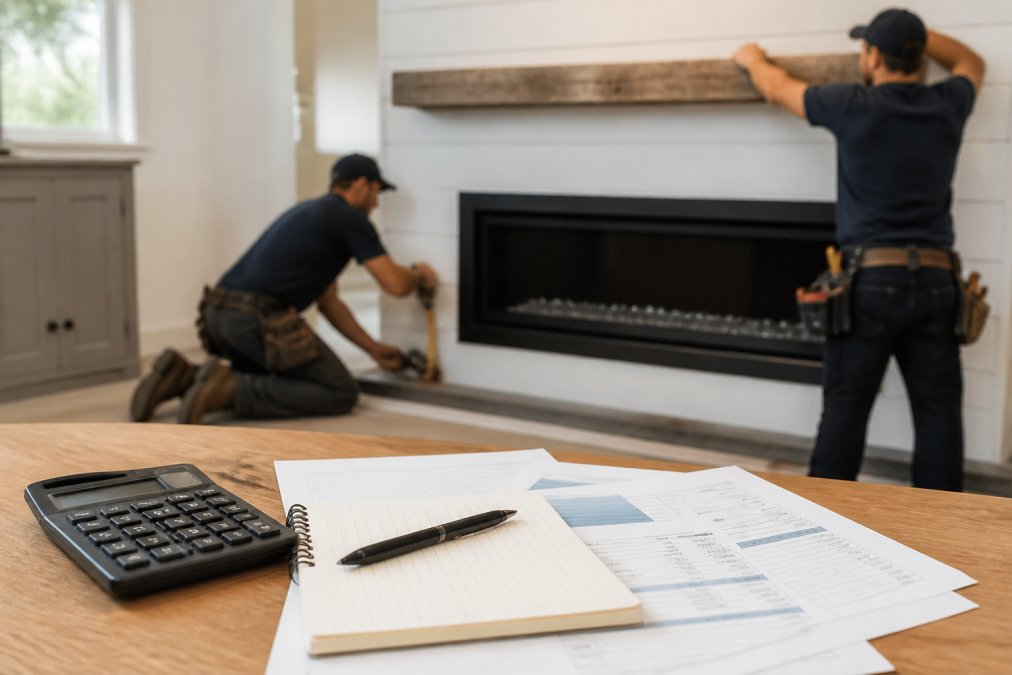
Gas fireplace installation cost runs higher than electric because it combines three trades: gas fitting, venting, and finish carpentry. A direct vent unit needs a termination cap through an exterior wall or roof, a gas line from the meter, and electrical for ignition and blower.
Venting Requirements, Gas Line Installation, and BTU Output
Venting requirements are the hidden line item. Direct vent systems use a coaxial pipe that pulls combustion air from outside and pushes exhaust out, so they do not depressurize the home like older vent-free units. Run length, elbows, and termination location all affect material and labor.
Gas line installation is usually the second-largest cost. An existing stub near the hearth means a short run; a line across the house means paying by the linear foot plus a permit.
Propane conversion adds a step: the correct orifice kit plus a tank or existing supply. BTU output determines whether the fireplace heats the room or just provides ambiance, and a larger BTU unit often needs a larger gas line diameter.
U.S. Department of Energy guidance on hearth products and efficiency
Electric Fireplace Insert Installation Requirements and Costs
Electric fireplace insert installation requirements are the simplest of the three categories, making electric the default for condos and rentals. No venting, no gas line, no combustion, the two real constraints are framing depth and circuit capacity.
Zero-Clearance Framing, Hearth Pad, and Circuit Needs
A zero-clearance firebox is rated to sit directly against framing with no air gap, which makes built-in electric units possible in a standard wall. The 40-inch Dynasty Presto built-in electric firebox insert drops into an existing wood or gas fireplace opening or a new framed cavity, with no chimney work.

Circuit needs matter more than most buyers expect. A 120-volt circuit handles most residential electric inserts, but a dedicated circuit is strongly preferred so the fireplace does not share a breaker with nearby outlets. A hearth pad is not always required, but it protects flooring.
Best for: Condo and apartment dwellers who cannot modify venting or gas infrastructure, and anyone retrofitting an existing firebox.
Fireplace Installation Labor Rates and Timeline
Fireplace installation labor rates vary by trade and region, and the total is usually two or three separate invoices: a general installer, a licensed gas fitter for gas units, and an electrician for ignition, blower, or insert wiring.
| Trade | Typical Scope | Billing Basis |
|---|---|---|
| General installer | Framing, unit set, surround, mantel | Per project or hourly |
| Licensed gas fitter | Gas line run, connection, leak test | Per linear foot plus connection fee |
| Electrician | Dedicated circuit, ignition wiring | Per circuit or hourly |
| Chimney sweep or mason | Flue inspection, liner, masonry repair | Per inspection or per job |
Timeline runs from one day for an electric insert swap to two to three weeks for a new masonry or direct-vent build needing permits and inspection. Permit approval is often the longest delay, not the physical work.
Masonry Chimney, Flue Liner, and Structural Reinforcement Costs
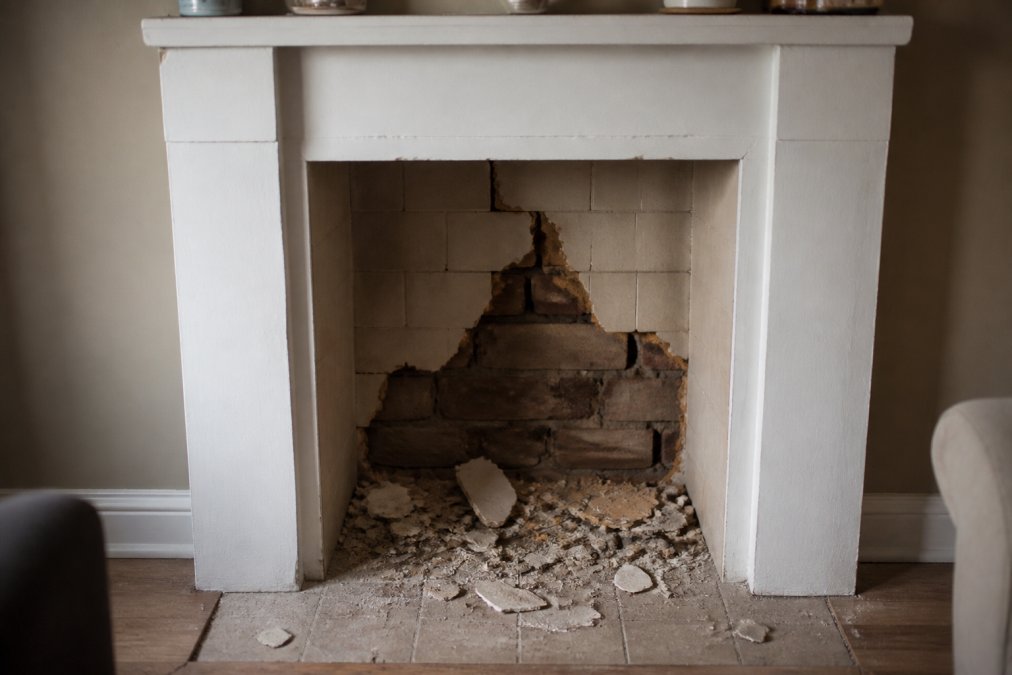
Masonry work is the most expensive line item in any fireplace project and the most often underestimated. A masonry chimney must meet clearance-to-combustibles rules, and older chimneys frequently fail inspection due to cracked flue tiles, missing mortar crowns, or creosote buildup.
A flue liner is often non-negotiable. Stainless steel liners contain heat and corrosive byproducts, and are required in many cases when switching fuel types or installing a gas insert into a wood chimney. Structural reinforcement is needed when the hearth or chimney breast cannot carry the new unit's weight, or when a large linear gas fireplace requires extra framing and blocking.
U.S. Consumer Product Safety Commission guidance on chimney and hearth safety
Building Permits, Local Building Codes, and Carbon Monoxide Safety
Permits are the line item homeowners most often try to skip, and the one that causes the most expensive problems later. The general rule: if the work touches a gas line, modifies venting, alters framing, or changes the combustion air path, a permit is required. Swapping an electric insert into an existing framed cavity usually is not.
What Actually Triggers a Permit
- New gas line or gas line extension: Almost universally permitted. A licensed gas fitter pulls the permit and the inspection covers the connection, leak test, and shutoff location.
- Venting modification or new termination: Permitted in most jurisdictions because termination clearances to windows, doors, and intakes are a life-safety issue.
- Structural changes: Any new framing, header modification, or hearth reinforcement typically requires a building permit separate from the mechanical permit.
- Chimney liner installation: Often permitted, and often inspected, because a liner is the barrier between combustion byproducts and the home's structure.
- Electrical for ignition, blower, or insert: A dedicated circuit addition is usually permitted; plugging a listed insert into an existing receptacle typically is not.
The Inspection Sequence
Inspections generally happen in stages, and missing a stage means tearing out finished work. A common sequence:
- Rough-in inspection, gas line and electrical run are visible, framing is open, venting is partially installed.
- Vent termination inspection, exterior clearances verified before siding or roofing is closed up.
- Final inspection, unit set, surround installed, gas connection leak-tested, CO alarm verified, and manufacturer's installation manual on site.
Most inspectors want the manufacturer's installation manual at the final. It defines clearance-to-combustibles, vent run limits, and termination rules, and overrides generic code language when the unit is listed to a specific standard.
Carbon Monoxide Safety Mechanics
Carbon monoxide is produced whenever fuel burns incompletely. Sealed-combustion direct vent units are the safest gas configuration for a mechanical reason: combustion air is drawn from outside through the outer pipe, exhaust exits through the inner pipe, and the two never mix with room air. A vent-free log set releases combustion byproducts directly into the living space, which is why many jurisdictions restrict them.
A working CO alarm on every level and outside sleeping areas is the baseline. CO sensors have a finite service life, most manufacturers recommend replacement every five to seven years regardless of whether the alarm has sounded.
The Pro-vs-Homeowner Scope Boundary
A practical boundary:
- Homeowner can typically do: remove an old insert, patch and paint the surround, run a dedicated 120-volt circuit if locally allowed and if the homeowner is competent, install a hearth pad, and prep the framed opening.
- Licensed trade required: gas line connection and leak test, any new gas piping, and in most jurisdictions any electrical work inside a wall.
- Permit-and-inspection required: venting modification, chimney liner, structural framing changes, and any gas appliance installation.
When in doubt, call the local building department and ask two questions: does this scope require a permit, and which trades must be licensed? The answer takes five minutes and prevents the resale and insurance problems that come from unpermitted work.
U.S. Consumer Product Safety Commission guidance on chimney and hearth safety U.S. EPA information on indoor air quality and combustion appliances
Total Cost of Ownership: A 10-Year Calculator
Most cost guides stop at the install invoice. That is the wrong number to optimize against, because the cheapest unit to install is frequently the most expensive to own.
The Five Inputs
- Purchase price, unit plus accessories (surround, mantel, remote, hearth pad, liner kit). One-time.
- Installation, labor, venting materials, gas or electrical, permits, inspection fees. One-time.
- Annual maintenance, chimney sweep and inspection for wood and gas-with-chimney; component service for electric; gasket and glass cleaning for all.
- Energy cost, local electric rate per kWh, or gas rate per therm, multiplied by realistic annual hours of use. This is the input most homeowners guess wrong.
- Repair reserve, a percentage of purchase price set aside annually for blower, ignition, valve, or glass replacement.
How to Run the Math
Use your own utility bill, not a national average:
- Electric: (unit wattage ÷ 1,000) × hours of use × your $/kWh = annual energy cost.
- Gas: (unit BTU input ÷ 100,000) × hours of use × your $/therm = annual energy cost.
A 1,500-watt electric insert running four hours a day through a five-month heating season uses roughly 900 kWh. A 30,000 BTU direct-vent gas unit on the same schedule uses roughly 180 therms. Multiply each by your actual rate, the gap often exceeds the install price difference within three to five years.
The Pattern Most Homeowners Miss
- Electric wins on install, loses on run cost. No venting, no gas line, no permit in most cases. But per hour of delivered heat, electricity is usually the most expensive fuel.
- Gas wins on run cost, loses on install. Venting, gas line, permit, and inspection add up front. Per BTU, natural gas is typically the cheapest delivered heat in most markets.
- Wood wins on fuel cost in many regions, loses on labor and maintenance. Annual sweeping, fuel sourcing, storage, and ash handling are real costs that do not appear on any invoice.
- Propane sits between gas and electric. Higher per-unit cost than natural gas, but the same install complexity.
Worked Comparison
Take two units with identical purchase prices. The electric insert installs for a fraction of the gas unit, no venting, no gas line, often no permit. Over ten years, the gas unit's lower run cost typically closes that gap, but only if the fireplace is used heavily. In a condo used a few evenings a week for ambiance, the electric unit may never run enough for the gas unit's run-cost advantage to overcome its install premium.
The break-even point is a function of hours of use, not years of ownership. Run the math with your own hours before assuming the higher-install option pays back.
What the Calculator Does Not Capture
Resale value, aesthetic fit, and the cost of regret. A fireplace that does not match the room's proportions or the home's architecture is a permanent line item, so factor style in before the spreadsheet.
Conclusion
The hard part of fireplace installation cost is not the sticker price, it is the venting, permitting, and trade sequencing hiding behind the wall. Get those three right and the budget stops surprising you.
Zen Home Fireplaces helps homeowners skip that guesswork. Our curated selection includes the 40-inch Dynasty Presto built-in electric firebox insert with zero-clearance installation, the Dimplex Ignite Ultra 50-inch linear electric fireplace with FlexFlame technology, and the Empire Boulevard 72-inch linear direct-vent gas fireplace with a 72-inch ceramic glass viewing area and multi-function remote. Paired with our Zen Hearth Essentials accessories line, each unit is selected for clean lines, warm materials, and craftsmanship that holds up.

Explore the collection at Zen Home Fireplaces and match the right unit to your space before you call a single contractor.
Frequently Asked Questions
What is the average cost to install a fireplace?
Most projects land between $2,000 and $8,000 in total, depending on the unit and site. An electric insert like the Dynasty Presto 40-inch, priced at $1,099.97 on the product page, often installs for a few hundred dollars. Gas direct-vent units such as the Madison Clean Face Deluxe 36-inch at $2,639.00 typically add $1,500 to $3,500 in labor, venting, and a gas line. Masonry chimneys push totals above $10,000 once structural reinforcement and flue liners are included.
Do you need a professional to install a fireplace for safety compliance?
Gas and wood-burning fireplaces require a licensed professional in nearly every jurisdiction. Gas line installation, venting requirements, and carbon monoxide safety fall under local building codes and NFPA 54, and most inspectors will not sign off on homeowner gas work. Electric fireplace insert installation requirements are simpler, but a dedicated circuit and zero-clearance framing still benefit from an electrician. DIY is realistic only for plug-in electric models that need no hardwiring or venting.
What factors influence the total cost of fireplace installation?
Six variables dominate: unit type (gas, electric, or wood), venting complexity, whether a gas line or new circuit is needed, site preparation and finish carpentry, local labor rates, and permit fees. A direct-vent gas unit on an exterior wall is the cheapest gas scenario. A masonry chimney retrofit with a flue liner, structural reinforcement, and a new hearth pad is the most expensive. Historic homes add a seventh factor: matching existing trim and working around original framing.
Are there hidden costs associated with professional fireplace installation?
Yes. Common surprises include a permit the contractor did not quote, a gas line that must be rerouted around a joist, a chimney that fails inspection and needs a new flue liner, and finish carpentry to blend a new surround and mantel into existing walls. Ask for a line-item quote covering permits, venting, gas or electrical work, and finish work. Budget 10 to 15 percent above the quote for change orders, and confirm whether annual maintenance and a chimney sweep visit are included.
Fireplace projects go sideways when the unit and the room are mismatched. Zen Home Fireplaces takes the guesswork out of that decision with a curated range of luxury indoor and outdoor fireplaces, modern electric and gas models, and coordinated accessories designed to work together. Explore the collection and start with the right unit for your space.