Are Electric Fireplace Inserts Worth It for Heating?
Table of Contents
- Quick Comparison: Electric Fireplace Inserts vs Gas Inserts
- How Electric Fireplace Energy Efficiency Actually Works
- What Is the Real Cost to Run an Electric Fireplace?
- Electric Fireplace vs Gas Insert: Which Heats Better?
- Installation Requirements and Versatility for Renters and Condos
- Maintenance, Durability, and Long-Term Repair Costs
- Common Myths About Electric Fireplace Inserts and Heating
- Frequently Asked Questions
Last Updated: September 13, 2026
Quick Comparison: Electric Fireplace Inserts vs Gas Inserts
Electric fireplace inserts are worth it for heating when you want supplemental, zone-specific warmth without venting, gas lines, or a service contract. They convert nearly all the electricity they draw into heat, and they cost far less to install than a gas insert.
Here is how the two options stack up:
| Factor | Electric Insert | Gas Insert |
|---|---|---|
| Upfront cost | Lower, no gas line work | Higher, requires licensed gas work |
| Installation | Plug-in or hardwired, zero clearance | Venting and gas line required |
| Heating reach | Supplemental, one room or zone | Can heat larger areas |
| Efficiency at the unit | Nearly all electricity becomes heat | A share of heat escapes the vent |
| Maintenance | Essentially maintenance-free | Annual service recommended |
| Best for | Condos, renters, zonal heating | Whole-home backup in cold climates |
The rest of this guide breaks down efficiency, real operating cost, and where each option makes sense.
How Electric Fireplace Energy Efficiency Actually Works
Electric fireplace energy efficiency is simple to understand: a modern electric insert turns almost every watt it draws into usable heat. There is no chimney, so no heat escapes up a flue. That is the core advantage over a traditional wood-burning fireplace, which loses most of its heat up the chimney and can actually pull warm room air out of the house.
BTU Output and Square Footage Coverage
Most residential electric inserts are built for supplemental heat, not whole-home heating. Manufacturers publish a BTU output and a recommended square footage coverage for each model. Match those numbers to the room, not the whole house. A unit rated for a few hundred square feet will warm a living room or bedroom comfortably but will struggle in an open-plan space with high ceilings.
If you are replacing an existing wood or gas fireplace, measure the firebox opening first. Inserts are sized to fit standard openings, and the wrong size means poor fit and wasted heat. The U.S. Department of Energy guidance on space heaters is a useful reference for how supplemental heating fits into a home's overall energy picture.
Zonal Heating and Smart Thermostat Control
Zonal heating is the practice of warming only the rooms you actually occupy instead of heating the entire house. This is where an electric insert earns its keep. Instead of running a central furnace to bring every room to temperature, you heat the one room you are in.
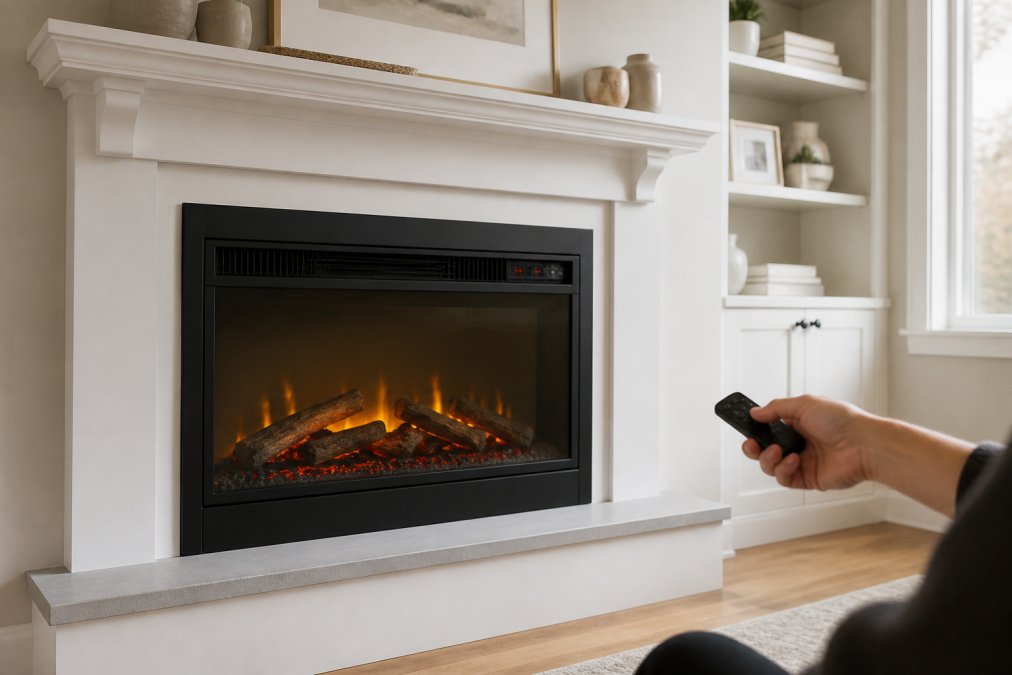
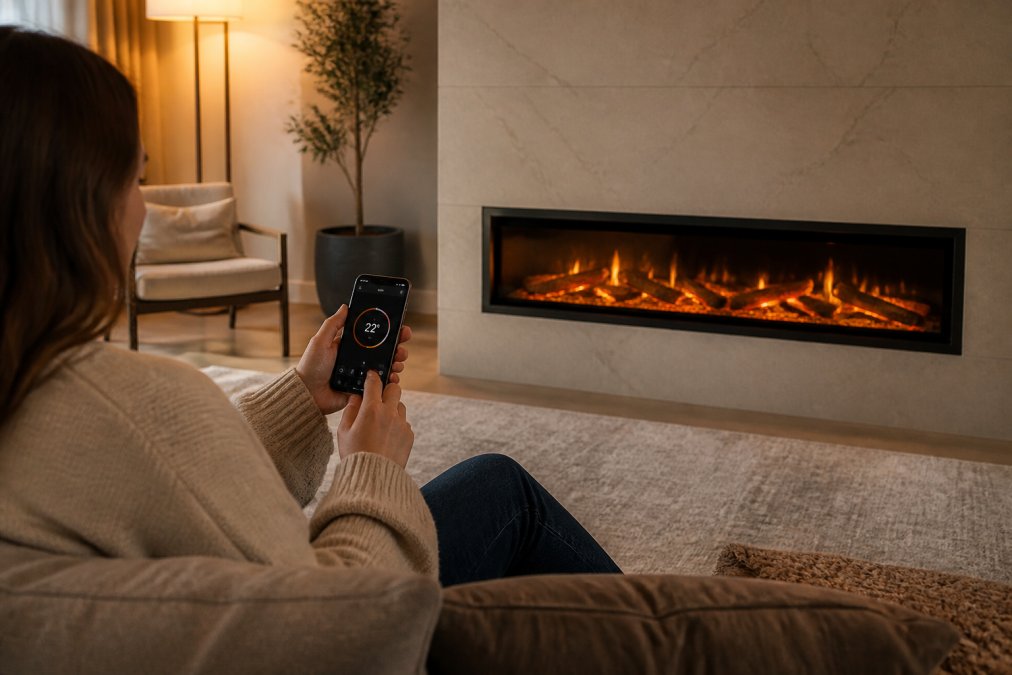
Many modern inserts pair with smart thermostats and remote operation, so you can set a schedule and let the unit cycle on and off to hold a target temperature. Thermostat control matters more than raw BTU output for real-world comfort, because a unit that modulates its output wastes less energy than one that runs flat out.
What Is the Real Cost to Run an Electric Fireplace?
The cost to run an electric fireplace depends on three things: the unit's wattage, how many hours you run it, and your local electricity rate. There is no single national number, because utility rates vary widely by region and by season.
The formula is straightforward:
Operating cost = (watts ÷ 1,000) × hours used × your rate per kilowatt-hour
A kilowatt-hour (kWh) is simply 1,000 watts used for one hour. So a unit drawing 1,500 watts for one hour uses 1.5 kWh. Multiply that by your rate, and you have your cost for that hour.
Calculating Your ROI Based on Local Utility Rates
To work out whether an insert pays for itself, compare its operating cost against what you currently spend to heat the same room. Pull your rate off a recent utility bill, then run the numbers:
- Find your electricity rate in dollars per kWh on your bill.
- Check the insert's wattage (often listed as low/high settings).
- Estimate daily hours of use during the heating season.
- Multiply: (watts ÷ 1,000) × hours × rate = daily cost.
- Compare that daily cost against the cost of heating the same room with your central system.
If you are heating one room for a few hours each evening, the insert often costs less than running a furnace to warm the whole house. If you need to heat several rooms at once, the math shifts toward your central system. The U.S. Energy Information Administration's electricity data publishes average residential rates you can use as a starting benchmark.
Electric Fireplace vs Gas Insert: Which Heats Better?
A gas insert generally produces more heat output and can warm larger spaces, while an electric insert is easier and cheaper to install and needs no venting. That is the honest trade-off, and it is where most buying decisions turn.
Gas inserts burn natural gas or propane and vent combustion byproducts outside, so they require a flue and a gas connection. They deliver strong, immediate heat and suit homeowners in colder climates who want a serious secondary heat source. The trade-off is higher upfront cost, professional installation, and annual servicing.
Electric inserts need no gas line and no vent. They plug into a standard outlet or can be hardwired, and they produce no combustion byproducts. Their heat output is lower, which makes them ideal for supplemental and zonal use rather than primary heating.
Which heats better depends entirely on your goal. For a single room and convenience, electric wins on practicality. For maximum heat in a cold climate, gas has the edge. If you want to compare specific models, the Presto 40-inch built-in electric firebox insert is a good example of a zero-clearance electric option designed for both retrofits and new builds.

Installation Requirements and Versatility for Renters and Condos
Installation is where electric inserts pull decisively ahead. Because they need no venting and no gas line, they qualify as some of the most flexible hearth products available. Options range from plug-in units you can move between rooms to hardwired inserts built into a wall.
For renters and condo dwellers, this flexibility is the whole point. You can install a plug-in insert without structural changes, and in many cases remove it when you move. Hardwired and built-in models offer a cleaner look but require an electrician.
Before you buy, check three things: the firebox or wall opening dimensions, whether the unit is plug-in or hardwired, and any local safety standards or building requirements that apply to your unit type. Zero-clearance inserts are designed to sit safely against combustible materials, which simplifies installation considerably.
Maintenance, Durability, and Long-Term Repair Costs
Most coverage of electric inserts stops at "no chimney, no ash, no service contract" and calls it done. That is true, but it is not the whole durability story. The honest version separates the parts that last from the parts that eventually wear, and tells you what replacement looks like.
What does not wear out quickly. The LED lighting array and the flame-effect mechanism are the longest-lived components in a modern insert. LED emitters are rated for tens of thousands of hours of operation, which in typical evening-use patterns translates to many years of service. The glass front, the metal housing, and the flame reflector are essentially passive parts with no meaningful wear cycle.
What does wear. Three components carry the maintenance burden over the life of the unit:
- The heating element. Resistive elements degrade gradually with use. Output does not fail suddenly; it declines slowly, and most owners notice the room takes longer to reach temperature before they notice anything is wrong.
- The blower fan. This is usually the first part to make noise. Bearings dry out, dust accumulates on the blades, and airflow drops. A fan that sounds different than it did a year ago is telling you something.
- The control board and thermostat. Electronics are sensitive to heat, dust, and power surges. A board failure typically shows up as erratic cycling, unresponsive remote control, or a unit that will not hold a set temperature.
What repair actually looks like. The practical question is whether replacement parts are available and whether the unit is serviceable without pulling it out of the wall. Before you buy, confirm that the manufacturer lists replacement parts and that the unit's design allows access to the blower and element without demolition.
How this compares to gas and wood. A gas insert needs annual professional servicing, periodic thermocouple and igniter replacement, and venting inspection, recurring costs that accumulate every year you own it. A wood-burning fireplace needs annual chimney sweeping and inspection, plus the ongoing cost of fuel and ash disposal. An electric insert's recurring cost is closer to zero, with occasional part replacement spread over years rather than an annual service line item.
The realistic lifespan picture. A well-built electric insert with a serviceable design and available parts can reasonably be expected to deliver many seasons of use, with one or two component replacements along the way. The failure mode to avoid is the sealed, non-serviceable unit that becomes landfill the first time the blower dies. If long-term cost of ownership is your priority, that design choice matters more than any spec on the box.
Common Myths About Electric Fireplace Inserts and Heating
Several myths keep homeowners from considering electric inserts. Here is what actually holds up.
Myth: Electric inserts are just decorative and give off no real heat. Modern units produce genuine supplemental heat with adjustable output and thermostat control. They will not heat a whole house, but they warm a room effectively.
Myth: They will spike your electric bill. The cost depends on wattage, hours, and your rate. Used as zonal heating for one room, the operating cost is often lower than heating the entire home.
Myth: They are unsafe and prone to overheating. Reputable units are built to safety standards and include overheat protection. Reputable units are built to safety standards and include overheat protection.
Myth: Installation always requires major renovation. Many models are plug-in or zero-clearance and install with minimal work, which is exactly why they suit condos and rentals.
Myth: They look fake. Flame technology has advanced considerably. LED lighting and layered flame effects now produce realistic flame effects that read as convincing in a well-designed room.
The real question is not whether an electric insert can heat your whole home, because it is not designed to. The question is whether you want a low-maintenance, easy-to-install heat source that warms the room you are actually in. For most condos, rentals, and single-room upgrades, the answer is yes.
Zen Home Fireplaces curates modern electric and gas models built around clean lines, warm materials, and exceptional craftsmanship, so your hearth looks as good as it heats. Explore our collection to find the insert that fits your space, your firebox, and your design.
Frequently Asked Questions
Do electric fireplace inserts use a lot of electricity?
Most electric fireplace inserts draw between 1,400 and 1,500 watts on their highest heat setting, which works out to roughly 1.4 to 1.5 kilowatt-hours per hour of use. At an average U.S. electricity rate of about 16 cents per kilowatt-hour, that's around 22 to 24 cents per hour. Using one for three hours a day would cost roughly $20 to $22 per month, making it a modest supplemental heating source rather than a whole-home solution.
Is it cheaper to run an electric fireplace or heat with a central system?
It depends on how you use it. Running a whole-home furnace heats every room, including ones you're not using. An electric fireplace insert with zonal heating lets you warm only the room you're in, which can reduce overall energy use if you turn down the central thermostat while the insert is running. The cost to run an electric fireplace is predictable and easy to calculate, but it works best as a supplement, not a full replacement for central heat.
What are the common problems with electric fireplace inserts?
The most frequent issues are limited heating capacity (most units warm 400 to 1,000 square feet), fan noise on higher settings, and flame effects that look less realistic than real fire. Some cheaper units have poor thermostat control or short lifespans. Higher-quality models use ceramic heating and multi-layer flame technology to address these concerns, and they require almost no maintenance compared to wood or gas inserts.
How much square footage can an electric fireplace heat?
Heating capacity varies by BTU output. Most residential electric inserts produce around 5,000 BTUs, which comfortably warms 400 to 500 square feet. Larger models, such as the Dimplex Ignite XL 50-inch, can heat spaces up to 1,000 square feet. For best results, treat the insert as a supplemental heating source for a single room rather than expecting it to replace your furnace.