How to Make a Fireplace Look Expensive: 7 Designer Steps
Table of Contents
- Start With the Surround: Luxury Fireplace Surround Ideas That Read High-End
- Modern Fireplace Mantel Styling: Visual Weight, Texture Contrast, and Trim Work
- Fireplace Insert Upgrade Benefits: Modernizing the Firebox
- Update the Hearth Area and Fireplace Screen
- Lighting Design for Fireplaces: Ambient Decor That Changes the Room
- Fireplace Safety Codes and Clearances Before You Style
- Maintenance and Longevity of DIY Finishes
- Frequently Asked Questions
Last Updated: September 14, 2026
Start With the Surround: Luxury Fireplace Surround Ideas That Read High-End
The fastest way to make a fireplace look expensive is to change the surround, not the firebox. The surround frames the opening and carries more visual weight than any mantel accessory. At Zen Home Fireplaces, we see homeowners spend on decor, then wonder why the room still reads builder-grade.
Refacing the surround with stone veneer, tile, or limewash changes the proportions of the whole wall. It also lets you hide dated brick without demolition. For reference on how finish materials behave around heat, the Tile Council of North America installation guides are worth reading before you buy anything.
Refacing With Stone Veneer, Tile, or Limewash
Stone veneer gives the most dramatic shift: a full-height panel draws the eye upward and makes ceilings feel taller. Tile reads cleaner and more contemporary, especially in large-format slabs with minimal grout lines. Limewash and brick whitewash cost the least and soften red brick into a warm, chalky finish.
High-End Material Sourcing on a Budget
Buy remnants. Stone fabricators sell offcut slabs at a fraction of full-slab pricing, and a surround uses very little material. Architectural salvage yards carry reclaimed mantels and stone with patina you cannot fake. Mix one expensive-looking material with inexpensive ones, and the eye reads the whole surround as custom.
Modern Fireplace Mantel Styling: Visual Weight, Texture Contrast, and Trim Work
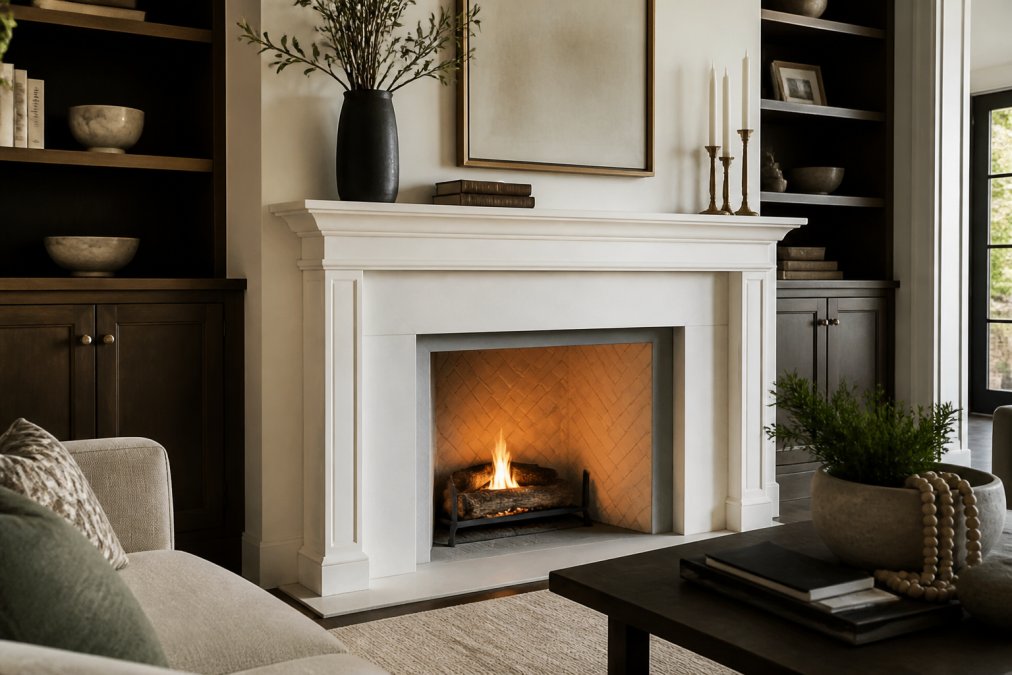
Modern fireplace mantel styling works on three levers: visual weight, texture contrast, and trim work. Get those right and a modest mantel looks curated. Get them wrong and even an expensive surround looks unfinished.
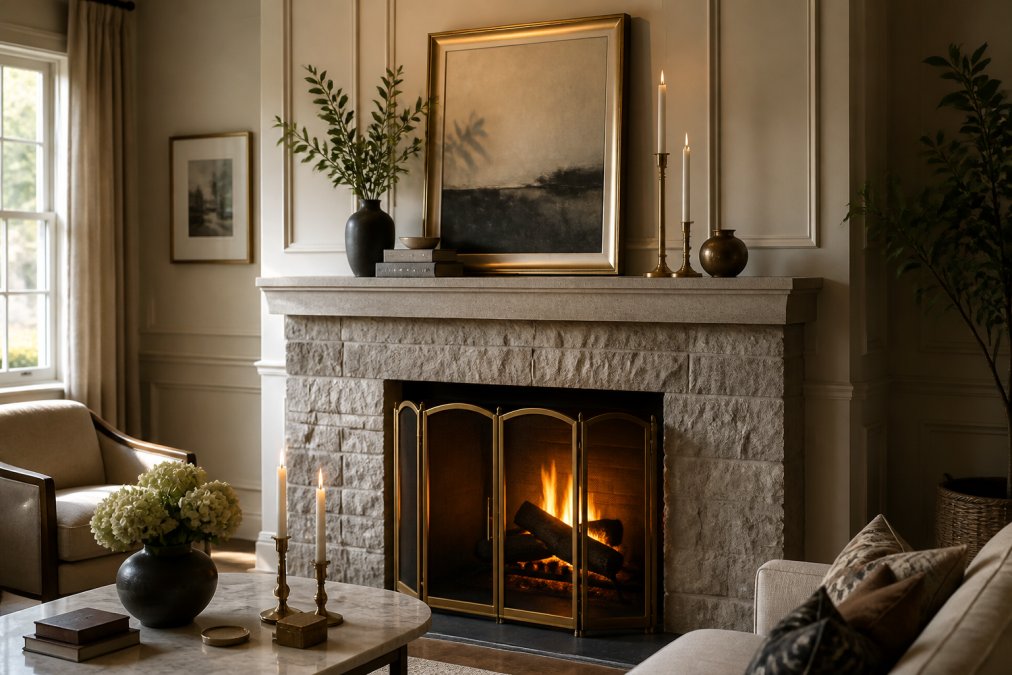
Visual weight means balancing mass across the mantelpiece, a heavy object on one side needs a counterweight on the other. Texture contrast means pairing smooth with rough: polished marble against raw linen, matte ceramic against aged brass. Trim work is the quiet hero: a simple picture-frame molding or deeper mantel shelf reads as custom carpentry.
Layering Accessories Without Clutter
The rule that separates designer mantels from cluttered ones: odd numbers, varied heights, one anchor piece. Start with a large mirror or artwork as the anchor, then layer three objects of different heights beside it. A mantel that is 60 percent empty looks intentional; a fully covered one looks like storage.
- Anchor: oversized mirror, framed art, or a sculptural object
- Mid-layer: candlesticks, a small vase, stacked books
- Texture layer: greenery, dried branches, or a woven element
Where fireplaces are in active use, decorative screens matter as much as styling. The NFPA fireplace and chimney safety guidance covers the basics of keeping embers contained, and a well-chosen screen handles that while adding a design element. The Pilgrim Bedford Single Panel Fireplace Screen - Burnished Brass is a good example: the warm metallic finish picks up candlelight and reads deliberate rather than utilitarian.

Fireplace Insert Upgrade Benefits: Modernizing the Firebox
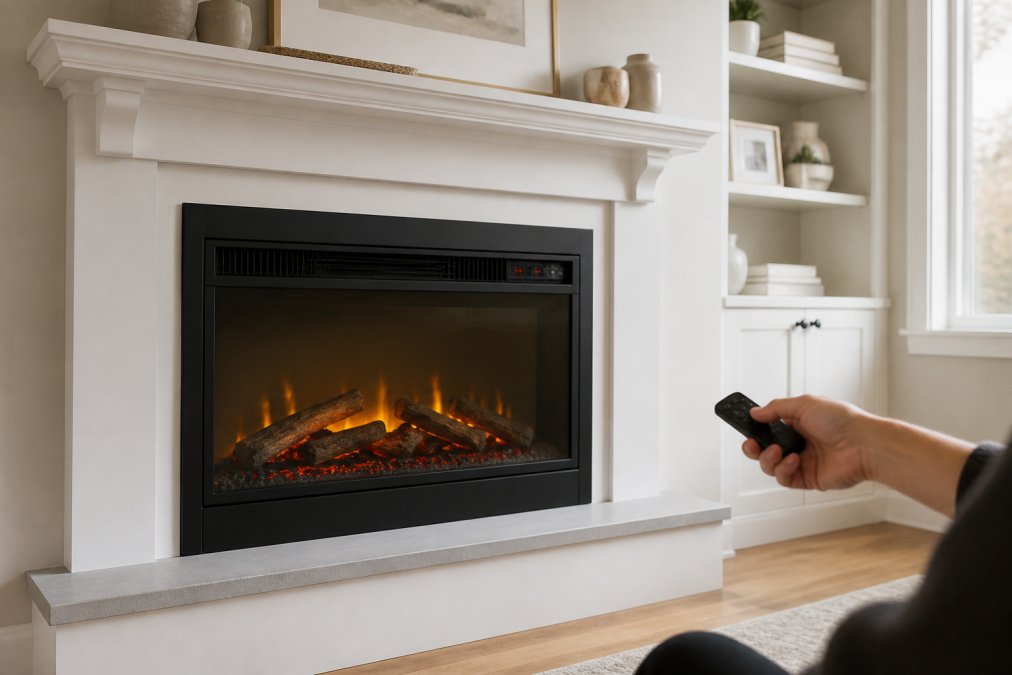
A fireplace insert is a self-contained unit that fits into an existing firebox to improve heating efficiency and reduce emissions. The fireplace insert upgrade benefits go beyond warmth: a modern insert with a clean glass front and defined frame instantly updates the firebox, the part most likely to look dated.
Older open masonry fireboxes are inefficient and often stained; an insert covers that interior with a controlled, finished surface. Gas and electric inserts skip firewood entirely, which suits condo and apartment dwellers.
What Actually Changes When You Add an Insert
Four things shift at once:
- The opening gets a frame. Inserts ship with a surround panel and trim kit that covers the gap between unit and masonry, making the firebox read as intentional rather than a hole in the wall.
- The glass front becomes the focal plane. A clean, gasketed glass door reflects candlelight and room lighting, so an insert often makes the whole wall look more expensive.
- The fire itself changes character. Gas inserts produce a steady, controlled flame. Wood inserts burn hotter and longer per load than an open fire. Electric inserts give flame without venting.
- Heat output becomes adjustable. Most modern inserts use a blower and variable setting, so the fireplace becomes a room you use rather than avoid.
Does a Fireplace Insert Increase Home Value?
It can, but the return depends on the market and the buyer. A working, efficient, good-looking fireplace is a feature buyers notice during showings, and an insert that looks modern and heats the room beats an open firebox that smokes. Treat it as a renovation that improves how the home shows, not a guaranteed dollar-for-dollar return.
Perceived value depends less on the insert's spec sheet than on how finished the firebox looks. A tight surround panel, flush trim kit, and clean glass read as a deliberate upgrade; a visible gap, mismatched trim, or hazy glass door reads as an unfinished project.
Matching the Insert to the Surround You Already Have
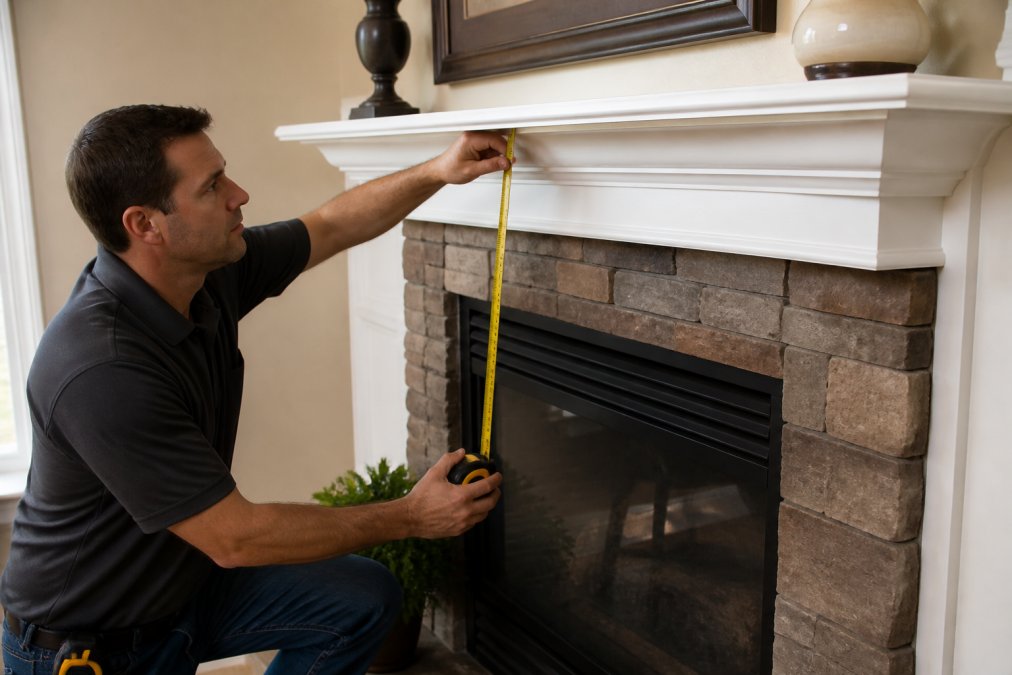
An insert has to sit inside the surround you have refaced or plan to reface. Three dimensions control whether it looks custom or cobbled together:
- Surround panel width. The panel must cover the old masonry opening completely, or you will see a strip of raw brick or stained firebox edge on one or both sides.
- Trim kit depth. The trim sits against the finished surround face. With thick stone or tile, a shallow trim will not sit flush and will leave a shadow line.
- Hearth extension. Inserts often require a larger hearth than the original open firebox did because the unit projects forward. Check the manufacturer's requirement before committing to a hearth design.
The Trade-Off Nobody Mentions
An insert changes how the fireplace is used, not just how it looks. A wood insert needs seasoned fuel and periodic chimney cleaning; a gas insert needs a gas line and usually a vent or liner; an electric insert needs an outlet and gives up the real-flame experience. Choose the insert before the surround, the unit dictates the frame, hearth depth, and clearances.
Update the Hearth Area and Fireplace Screen
The hearth is the floor-level zone in front of the firebox and the most overlooked part of the fireplace. Refinishing or extending it in the same stone or tile as the surround ties the composition together; a mismatched hearth makes even a beautiful surround look like two separate projects.
Hearth Proportion: The Rule That Makes or Breaks the Look
The hearth reads as expensive when its width and depth relate to the surround above it, not when it is simply new. Three proportions do the work:
- Width. A hearth narrower than the surround looks like an afterthought. Extending it to match the outer edge of the surround, or a clean fraction of it, makes the two elements read as one design.
- Depth. A shallow hearth (a few inches) reads modern and minimal. A deep hearth (a foot or more) reads traditional and substantial. Pick one and commit, a mid-depth hearth looks unresolved.
- Height. A raised hearth creates a step and a visual platform. A flush hearth keeps the floor plane continuous. Raised hearths suit traditional rooms; flush hearths suit contemporary ones.
Material matching matters as much as proportion. Using the same stone or tile on hearth and surround is the safest way to make the fireplace look built-in rather than assembled. For contrast, vary finish (honed hearth against polished surround) rather than color family.
Refinishing vs. Extending the Hearth
If the existing hearth is sound, refinishing it, tile over tile or thin stone veneer, is the lower-cost path. If it is cracked, uneven, or too small for your insert or screen, extending it is the better investment. Extension means building out the subfloor and matching the new surface to the old, a job for a tile setter.
The Fireplace Screen: Frame, Scale, and Finish
The fireplace screen is the other easy win. A sagging mesh curtain reads cheap; a single- or three-panel screen with a defined frame reads like furniture. For decorative fireplaces and gas units with their own protection, a mesh-free summer screen gives a clean architectural line without blocking the firebox view.

Three details separate a screen that elevates the fireplace from one that just sits in front of it:
- Frame weight. A thin, spindly frame looks like an accessory. A frame with visible mass, a solid top rail, defined corner joints, looks like furniture.
- Scale relative to the opening. The screen should be slightly wider and taller than the firebox opening so it reads as a frame, not a patch. A screen that is too small leaves the opening looking unfinished.
- Finish consistency. Match the screen finish to the other metals in the room, brass with brass, black iron with black iron. A single mismatched metal makes an otherwise expensive fireplace look assembled from spare parts.
For an updated look, the Pilgrim Contemporary Summer Screen keeps the opening open and adds a crisp black frame. If you want traditional detailing instead, the Iron Fireplace Screen/Mariella brings scrolling and floral accents in matte black that suit older homes.
Lighting Design for Fireplaces: Ambient Decor That Changes the Room
Lighting design is the angle most fireplace guides ignore, and it is the cheapest way to change how a fireplace reads. Fireplaces look expensive when lit in layers, not by a single overhead fixture.
Use three layers: ambient light for the room, accent light grazing the surround texture, and task or candlelight at the mantel. Warm color temperature around 2700K flatters stone, brick, and brass; cool white makes natural materials look gray and flat. Dim everything on one circuit so the fireplace is the brightest thing in the room after dark.
Fireplace Safety Codes and Clearances Before You Style
Style comes second to clearances. Combustible materials must be kept a safe distance from the firebox opening, set by the manufacturer and local building codes, not by what looks good. Before you hang art, stack books, or run a mantel garland, check the clearance rating for your unit.
Two rules matter most. First, keep flammable decor off the mantel directly above an active firebox unless the clearance allows it. Second, never block the air intake or the screen with furniture or heavy decor. For code specifics in your area, the U.S. Consumer Product Safety Commission hearth product guidance and your local building department are the sources to check, since requirements vary by jurisdiction and by unit.
Heat-rated materials belong anywhere near the opening. Standard drywall, untreated wood trim, and most fabrics are not rated for close proximity. If you are refacing, choose non-combustible tile, stone, or metal for the immediate surround.
Maintenance and Longevity of DIY Finishes
DIY finishes fail for predictable reasons, and knowing them separates a finish that lasts a decade from one that looks tired in two years.
- Grout: Seal cement-based grout on tile surrounds. Unsealed grout absorbs soot and stains permanently.
- Caulking: Use heat-rated caulk at joints near the firebox. Standard caulk cracks and pulls away.
- Limewash and paint: Use heat-resistant paint on any surface within the clearance zone. Standard paint yellows and peels.
- Stone veneer: Check the bond line annually. Vibration and heat cycling loosen poorly adhered pieces.
- Metal screens and tools: Wipe burnished brass and satin nickel with a dry cloth. Abrasive cleaners strip the finish.
| Task | Frequency | Why It Matters |
|---|---|---|
| Inspect caulk and grout lines | Every 6 months | Prevents moisture and soot damage |
| Reseal grout | Annually | Blocks staining on tile surround |
| Wipe metal screens and tools | Monthly | Preserves finish and patina |
| Check veneer adhesion | Annually | Catches loose pieces before they fall |
| Sweep and inspect hearth | Monthly | Removes grit that scratches stone |
A fireplace tool set earns its place here, not just on looks. The Pilgrim Nero 5 Piece Marble Tool Set - Satin Nickel pairs solid black marble handles with satin nickel, and keeping tools on the hearth rather than in a closet means you actually maintain the fireplace on schedule.

Making a fireplace look expensive is less about spending and more about sequence: surround first, then mantel, then firebox, then lighting. Most homeowners do it in reverse and wonder why the room never comes together.
Zen Home Fireplaces curates modern indoor and outdoor fireplaces alongside the Zen Hearth Essentials accessories line, so the screen, tool set, and surround styling pieces work together rather than fight each other. Clean lines, warm materials, and exceptional craftsmanship do the heavy lifting.
Explore Collection and start with the surround. The rest of the room will follow.
Frequently Asked Questions
How can I make my fireplace look more attractive on a budget?
Focus on the surround and mantel first. A limewash or heat-resistant paint refresh costs far less than new masonry, and swapping dated hardware or a worn screen instantly changes the look. Add texture contrast with a stone veneer accent, then style the mantel with three to five pieces of varying height. Small changes to lighting, like a warm-toned lamp or dimmable sconces, make the fireplace look expensive without a full renovation.
What materials make a fireplace look more expensive?
Natural stone, marble, honed limestone, and soapstone read as high-end because of their depth and variation. Stone veneer delivers a similar look at a lower cost. Burnished brass, satin nickel, and blackened iron accents add a luxury feel, especially on screens and tool sets. Pair these with a clean, well-proportioned mantel in painted or stained wood. The material mix matters more than the price tag, so choose two or three finishes and repeat them across the hearth.
Can I modernize my fireplace without a full demolition?
Yes. Refacing with tile or stone veneer, replacing the screen, and updating the mantel are all non-demolition upgrades. A fireplace insert upgrade benefits the look and efficiency without rebuilding the firebox. If you want a new surround, thin veneer panels can be applied over existing masonry. For renters or condo dwellers, a freestanding electric or gas model and a decorative screen give a high-end look with no structural changes.
Does a fireplace insert increase home value?
An insert can improve buyer appeal because it updates the focal point and often raises heating efficiency. Real estate agents frequently note that a modernized fireplace helps a living room feel finished. The value bump depends on your market, the unit's efficiency rating, and installation quality. Pairing the insert with a refreshed surround, mantel, and lighting makes the upgrade more visible to buyers. Always confirm local code requirements for venting and clearances before installation.