How to Safely Install Electric Fireplace Inserts
Last Updated: November 6, 2026
Quick Summary
To safely install electric fireplace inserts, match the unit to your opening, confirm the cavity depth clears the body plus cord, and verify a grounded outlet on a circuit with enough headroom. Measure the opening at its narrowest points and follow the manufacturer's clearance table exactly. If the job needs hardwiring, a new circuit, or panel work, stop and call a licensed electrician.
- Built-in, wall-mounted, and freestanding models cover most homes, each with different structural needs.
- Measure the opening at its narrowest point, top, bottom, and both sides, before buying.
- The Dimplex Revillusion 24" runs on a 120V, 1,500W supply, so check your circuit first.
- Never cut or modify the plug or cord, and do not swap a 15-amp breaker for a 20-amp one.
- Positioning and securing a unit 42 inches or wider is a two-person job.
Table of Contents
- Before You Begin: Choosing the Right Electric Fireplace Insert
- How to Install an Electric Fireplace in an Existing Fireplace
- How to Install an Electric Fireplace Insert in a Wood-Burning Fireplace
- Measuring the Opening and Checking Clearance Requirements
- Electric Fireplace Insert Electrical Requirements
- Do You Need an Electrician to Install an Electric Fireplace Insert?
- Positioning, Securing, and Testing the Insert Safely
- Explore the Zen Home Fireplaces Collection
- Frequently Asked Questions
Before You Begin: Choosing the Right Electric Fireplace Insert
Installing electric fireplace inserts safely starts with picking the right electric fireplace inserts for your space. The safest install is the one the unit was designed for.
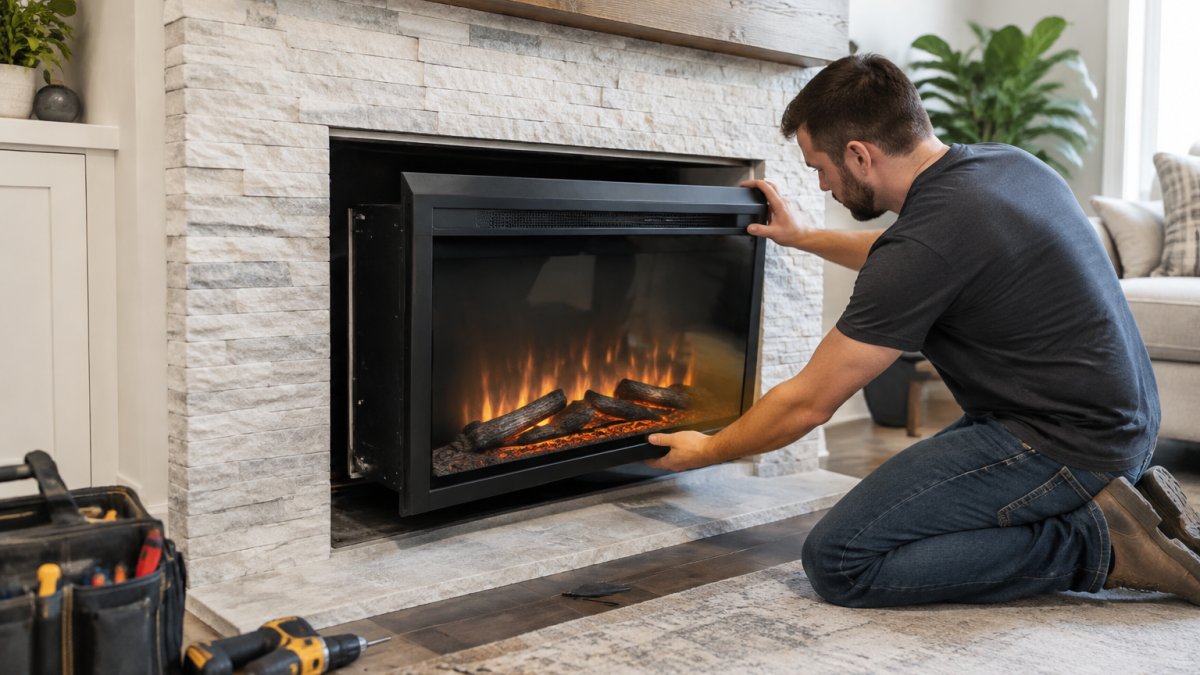
An electric fireplace insert is a self-contained firebox that drops into an existing opening or a framed wall cavity and runs on a standard household electrical supply. No gas line, no chimney, no venting.
Three main types cover most homes:
- Built-in inserts: slide into a masonry opening or a framed cabinet for a flush, finished look
- Wall-mounted units: hang on the wall, ideal for condos and renters
- Freestanding models: roll into place with no structural work at all
Built-In, Wall-Mounted, and Freestanding Options
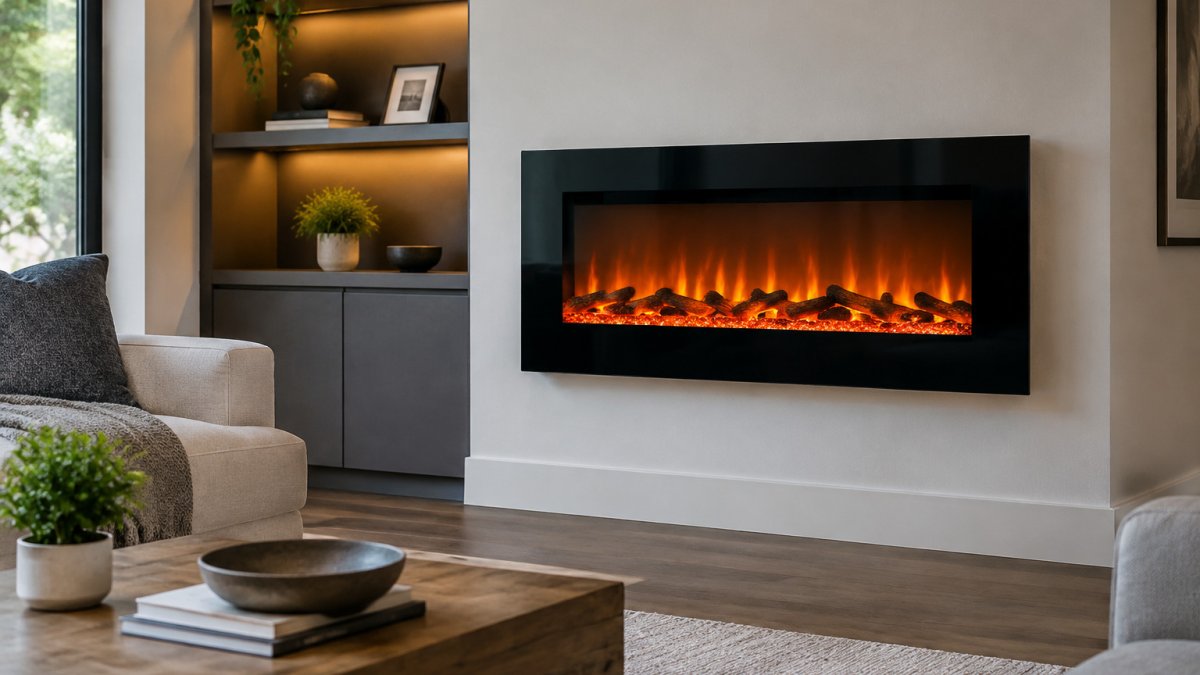
Built-in models give the most convincing fireplace look. They need a framed cavity with the right depth and a power source nearby. Wall-mounted units suit smaller rooms and rentals, since they need only a sturdy wall and an outlet. Freestanding fireplaces need nothing more than floor space and a grounded outlet.
If you are weighing built-in against wall-mounted, browse options like the Dimplex Revillusion 24" Built-In Electric Fireplace or the Napoleon Element 42 Built In Electric Fireplace to see real dimensions before you commit. For tight spaces, the Napoleon Allure Vertical 32" Wall Mount Electric Fireplace shows how a tall, narrow profile can anchor a small room without any framing work.


How to Install an Electric Fireplace in an Existing Fireplace
Installing an electric fireplace in an existing fireplace is mostly a measuring and prep job. The old firebox becomes a housing for the new insert, and the chimney stays unused. You are not connecting anything to the flue.
Here is the sequence we recommend:
- Confirm the opening is larger than the insert's outer dimensions
- Check that the cavity depth clears the unit's body plus its cord
- Look for a grounded outlet within reach of the power cord
- Inspect the surround for loose mortar, rust, or water damage
- Clean out soot and debris before anything goes in
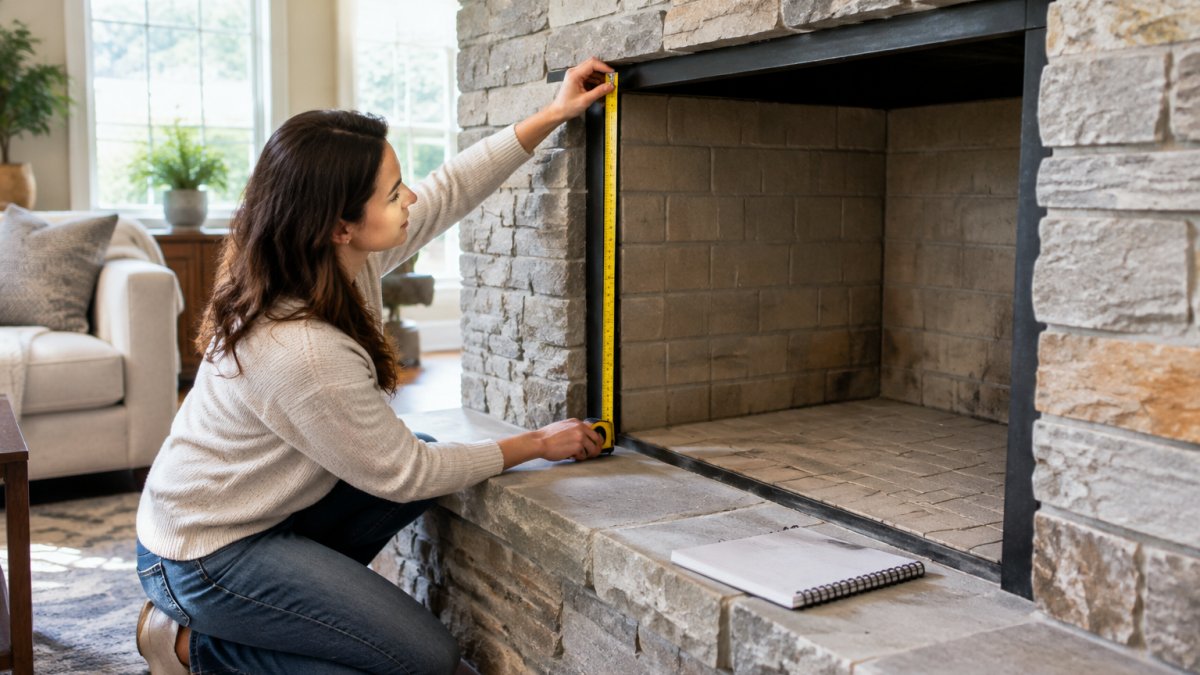
A common mistake is buying first and measuring second. Measure the opening at its narrowest point, top, bottom, and both sides, then compare against the spec sheet.
Inspecting the Masonry Fireplace and Chimney First
Look closely at the firebox before you cover it up. Check for crumbling mortar joints, cracked brick, rusted dampers, and stains that suggest water coming down the flue. Any of these needs attention before an insert goes in, because the unit will hide the problem from view.
Have a chimney sweep inspect the flue if the fireplace has not been used in years.
How to Install an Electric Fireplace Insert in a Wood-Burning Fireplace
To install an electric fireplace insert in a wood-burning fireplace, treat the old firebox as a shell. You are not running a liner or connecting a flue. The insert sits inside the opening, plugs into a grounded outlet, and the original chimney goes unused.
Steps that matter:
- Remove the grate, andirons, and any leftover ash
- Cap or seal the flue at the top if the chimney is no longer in use
- Check that the damper stays open or is removed so heat can escape upward
Watch out: never block the insert's front vents against the firebox walls. Electric fireplaces move heat with a fan, and trapped air leads to overheating and a shortened unit life.
Measuring the Opening and Checking Clearance Requirements
Clearance requirements decide whether an insert fits safely. Every unit ships with a spec sheet listing minimum distances to combustibles, and those numbers are not suggestions.
Measure and record:
- Opening width, height, and depth at the tightest points
- Distance from the opening to any mantel, shelf, or trim
- Distance to a TV mounted above
Compare each number to the manual. If the gap is tight, stop and pick a smaller unit. Our guide on how to measure a fireplace opening walks through the process step by step if you want more detail.
Framing Depth, Mantel Clearance, and TV Clearance
Framing depth must clear the firebox body plus room for the cord and plug. Mantel clearance protects wood and paint above the unit from long-term heat exposure.
Model-specific verification is where most guides get vague. Read the exact clearance table for your unit, not a generic rule of thumb. A 24-inch insert and a 45-inch insert can carry very different requirements.
Electric Fireplace Insert Electrical Requirements
The Dimplex Revillusion 24" runs on a 120V, 1,500W supply, so check your circuit before you plug it in.
Start with the manual's electrical table. It will state the voltage, amperage draw, wattage, plug type, and whether a dedicated circuit is required. Write those numbers down, you will compare them against your household circuit in the next step.
How to Check the Circuit in Plain Language
Check the breaker label and the outlet's circuit map before you commit.
Walk through this sequence:
- Find the breaker that controls the outlet you plan to use, and confirm its amperage printed on the switch.
- List every other load on that circuit, lights, a microwave, a space heater, a window air conditioner.
- Add the fireplace's wattage to the existing load and compare the total to the circuit's continuous rating.
- Confirm the outlet is a grounded NEMA 5-15 or 5-20 receptacle with a visible ground slot and no scorch marks, looseness, or missing ground pin.
- Confirm the cord reaches the outlet without an extension cord, power strip, or daisy chain.
Watch out: a circuit that already serves a microwave or a space heater may not have room for a fireplace, and tripping the breaker is the symptom, not the fix.
What Not to Change Yourself
Do not replace a two-prong outlet with a three-prong outlet, do not swap a 15-amp breaker for a 20-amp breaker to stop tripping, and do not cut or modify the plug or cord.
If the manual calls for a hardwired connection, a new dedicated circuit, or a 20-amp supply and your home does not have one, that is electrician work, see the next section for the decision guide.
Do You Need an Electrician to Install an Electric Fireplace Insert?
You need an electrician when the job touches wiring, the panel, or a new circuit. Plugging a cord into an existing grounded outlet in good condition is a homeowner task. Anything beyond that is not. The useful part is knowing which side of that line your install falls on before you buy.
The Stop-and-Call Decision Guide
Work through these checks in order. If any one lands on the right-hand column, stop and call a licensed electrician.
- Outlet condition: A grounded outlet with a firm grip, no discoloration, and an intact ground slot is homeowner territory. Scorch marks, a loose plug, a missing ground pin, or a two-prong receptacle means stop.
- Circuit capacity: A circuit with headroom for the fireplace's wattage is fine. A circuit already near its continuous rating, or one that trips when the heater runs, means stop.
- Breaker and panel: An open slot for a new circuit and a panel with clear labeling is a planning conversation. A panel with no open capacity, a fuse box, or a breaker that trips repeatedly means stop.
What to Tell the Electrician
Bring the manual's electrical table, the outlet location, the breaker amperage, and a photo of the panel.
Watch out: a fireplace that trips the breaker on first use is telling you the circuit is overloaded or the unit is faulty, unplug it and have both checked rather than resetting the breaker repeatedly.
Work through these checks in order, if any one lands on the right-hand column, stop and call a licensed electrician.
| Check | Homeowner territory | Stop and call an electrician |
|---|---|---|
| Outlet condition | Grounded outlet, firm grip, intact ground slot | Scorch marks, loose plug, missing ground pin, two-prong receptacle |
| Circuit capacity | Headroom for the fireplace's wattage | Near continuous rating, or trips when heater runs |
| Breaker and panel | Open slot for a new circuit, clear labeling | No open capacity, fuse box, breaker trips repeatedly |
| Wiring method | Cord-and-plug connection to existing outlet | Hardwired connection, new cable run, junction box change |
| Permits and inspection | No permit triggered | Install triggers a permit; needs licensed electrician and inspection |
Positioning, Securing, and Testing the Insert Safely
Positioning and securing the unit is a two-person job for anything 42 inches or wider. Lift with your legs, keep the firebox square to the opening, and set it down on a level base before you fasten anything.
Secure the unit with the mounting hardware the manufacturer supplies. Then test in this order:
- Plug in and confirm the flame effect runs
- Run the heater for a short cycle and check for odd smells
- Feel the surround for excess heat after 20 minutes
- Confirm the cord is not pinched or warm
- Test the remote and thermostat
If anything smells like burning plastic or the breaker trips, unplug it and call a professional. Our Dimplex 42" Revillusion Electric Firebox ships with its own installation manual, and we recommend reading it cover to cover before the unit leaves the box.

Explore the Zen Home Fireplaces Collection
A safe install comes down to four things: the right unit, accurate measurements, correct clearances, and a grounded circuit that can carry the load. Get those right and an electric insert delivers years of warmth without the maintenance of wood or gas.
Zen Home Fireplaces curates modern designs from trusted brands, with clean lines and warm materials that suit a range of interiors.
Get started with Zen Home Fireplaces and find the insert that fits your space, your style, and your electrical setup.
Frequently Asked Questions
Can I install an electric fireplace insert myself?
Many plug-in electric fireplace inserts can be a DIY installation if you already have a grounded outlet on a suitable circuit and the opening meets the manufacturer's dimensions. The work involves measuring the opening, checking clearances, building or adjusting framing, and securing the unit. Direct-wire models and any new circuit work should be handled by a licensed electrician. Always read the model's installation instructions before you start.
What outlet does an electric fireplace insert need?
Most standard inserts draw 1,500 watts and run on a 120-volt, 60-hertz supply, which means a grounded NEMA 5-15 outlet on a 15-amp circuit. Because the heater pulls close to the circuit's full capacity, the outlet should be on a dedicated circuit where possible. Avoid extension cords and power strips, which can overheat under a continuous load. Check your model's label for its exact amperage before plugging in.
How much clearance does an electric fireplace insert need?
Clearance requirements vary by model, so the manufacturer's instructions are the only figure that applies to your unit. Typical specs cover distance from the top of the unit to a mantel or TV, space around the framing, and airflow at the front and vents. A common rule is at least 8 inches below a TV, but confirm it in your manual. Blocking airflow can cause overheating, so never pack insulation tight against the firebox.
Can you put an electric fireplace insert in a wood-burning fireplace?
Yes, provided the existing masonry fireplace is sound and the insert fits the opening with the required clearances. Have the chimney and firebox inspected first for cracked brick, loose mortar, or creosote buildup. The damper should be sealed or blocked so conditioned air does not escape up the flue, and the insert must sit level on a solid base. Follow the model's instructions for venting and clearance before you install.