Benefits of Wall Mounted Electric Fireplaces for Modern Homes
Quick Summary
Wall mounted electric fireplaces offer a realistic flame without a chimney, gas line or venting, so they install far more easily than traditional fireplaces. They suit renters and condo owners, can serve as a room's focal point, and often need only a standard outlet. Their heat output is limited, so they work best as supplemental heat.
- Plug-in units need no chimney, gas line, or venting.
- Anchor the bracket into wood studs, typically 16 inches on center.
- Most plug-in models run on a standard 120V outlet with no hardwiring.
- Estimate operating cost with watts divided by 1,000, times hours, times your kWh rate.
- A 1,500W heater running one hour uses 1.5 kWh of electricity.
Table of Contents
- Why Wall Mounted Electric Fireplaces Are Gaining Ground
- Installation Ease and Wall Compatibility
- Wall Mounted Electric Fireplace Pros and Cons
- Electric Fireplace Operating Cost and Energy Use
- Are Wall Mounted Electric Fireplaces Safe to Live With?
- Placing a Wall Mounted Electric Fireplace Under a TV
- Choosing Your Wall Mounted Electric Fireplace From Zen Home
- Frequently Asked Questions
Why Wall Mounted Electric Fireplaces Are Gaining Ground
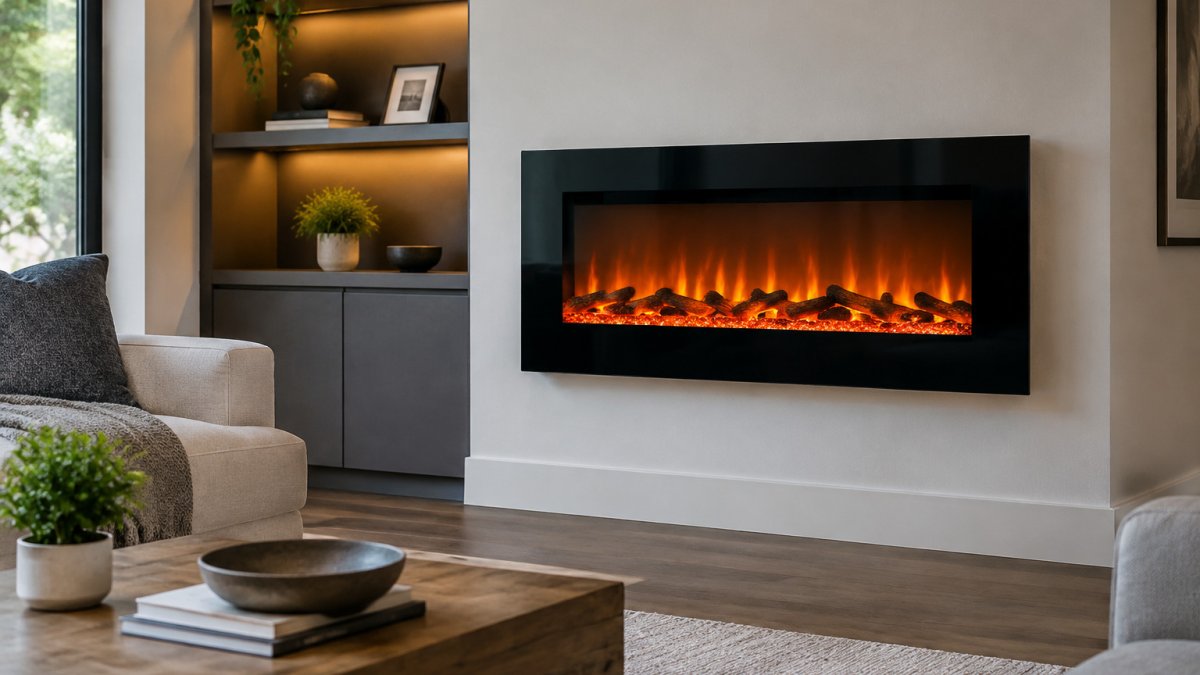
Wall mounted electric fireplaces have moved from a niche upgrade to a mainstream choice for American homeowners. The appeal is simple: a realistic flame, no chimney, and a clean look that works in nearly any room.
Electric fireplace units are plug-in appliances, so they skip the venting, gas lines and masonry work that traditional fireplaces demand. For many households, that difference decides whether a fireplace is possible at all. Renters and condo owners may value a unit that does not require permanent alterations.
A wall mounted unit also changes how a room is arranged. Instead of building the room around a hearth, the fireplace becomes one more design element. Many homeowners find this makes it easier to create a focal point in a living room, bedroom or den without giving up floor space.
Installation Ease and Wall Compatibility
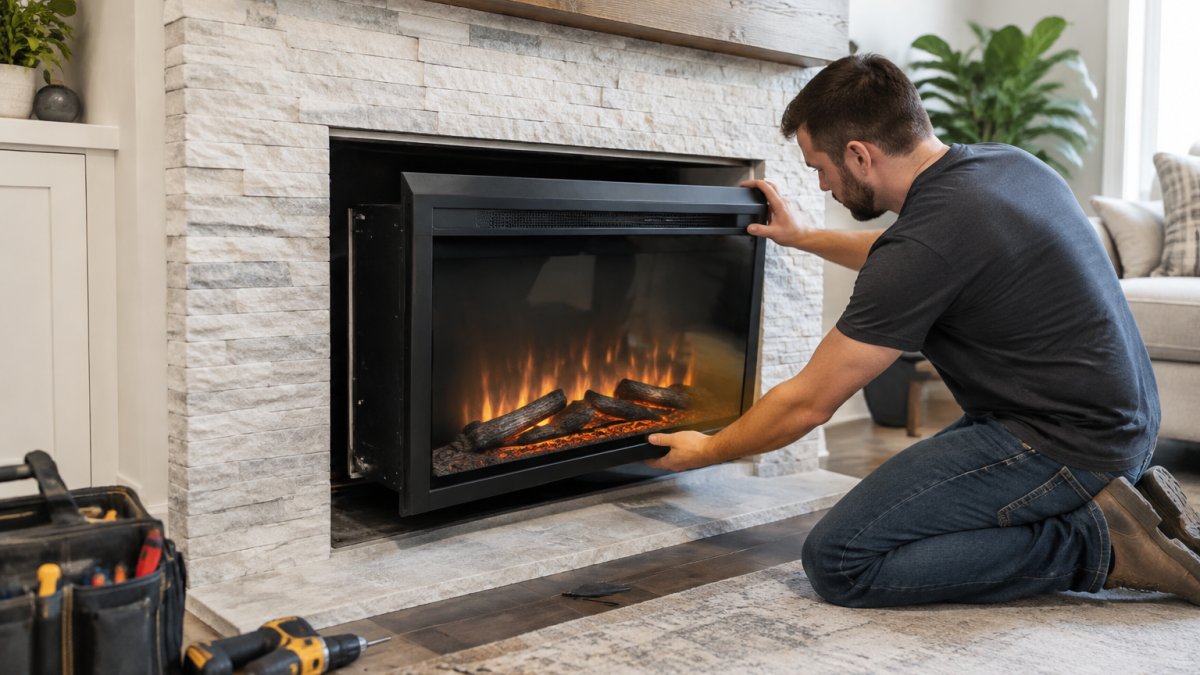
Installation is the headline advantage, but 'easy' depends on four things: the wall, the outlet, the mounting height, and the circuit. Our guide to installing electric fireplace inserts walks through each step safely. Plan all four before the box arrives.
Wall type and studs. A wall mounted unit hangs on the wall, so the wall has to carry it. Drywall alone will not hold a fireplace, the mounting bracket must anchor into wood studs, or into masonry with appropriate anchors. Stud spacing is typically 16 inches on center in U.S. residential framing, but verify with a stud finder; older homes and steel-framed walls vary. A unit like the Dimplex Ignite Aspire 30" Electric Fireplace weighs 92 lbs, which is well beyond what drywall anchors should carry. Lighter slim models are more forgiving but still want stud engagement.
Mounting height. Center the viewing area at a comfortable height and follow the manual's minimum clearance to the floor and ceiling. If a TV goes above the unit, the fireplace height is set by the TV's clearance requirement, not the other way around.
Outlet access. Most plug-in models, including the Napoleon Allure Vertical 32" Wall Mount Electric Fireplace, run on a standard 120V outlet and need no hardwiring. Check cord reach and cord visibility before choosing a wall, and consult the manual regarding extension cord use.
Circuit capacity. Confirm the circuit can handle the heater's load before relying on full heat, and consult a licensed electrician if unsure.
Recessed versus surface mount. Surface mount is the simplest: bracket on the wall, unit hangs, plug in. Recessed installation looks cleaner but requires framing a cavity to the manual's depth and clearance spec, and the cavity has to land between studs or be framed to accept the unit. Partial recess (some models allow it) splits the difference. Recessed installation may require professional help.
Clearances. Every manual lists minimum clearances to combustibles, typically a few inches to the sides and below, and more above if a TV or mantel is involved. These are not suggestions; they are the manufacturer's safety envelope and often the condition of the warranty.
Watch out: a unit that looks plug-and-play can still need a licensed electrician if the outlet is far, the circuit is shared, or you are installing a 240V model. Confirm wall type, stud locations, outlet position, and circuit load before you buy, not after.
The article breaks installation down into four checks, each with its own requirement.
| Check | What to confirm | Why it matters |
|---|---|---|
| Wall type and studs | Anchor into wood studs, typically 16 inches on center | Drywall alone will not hold the unit |
| Mounting height | Follow the manual's floor and ceiling clearance | Sets the viewing area and TV spacing |
| Outlet access | Standard 120V outlet, check cord reach | Most plug-in models need no hardwiring |
| Circuit capacity | Confirm the circuit handles the heater's load | Needed before relying on full heat |
| Mount style | Surface mount is simplest; recessed needs a framed cavity | Recessed installs may need professional help |
| Clearances | Minimum distances to combustibles in the manual | Often a condition of the warranty |
Wall Mounted Electric Fireplace Pros and Cons
Wall mounted electric fireplaces offer clear strengths, but they are not right for every room. Weigh both sides before you choose.
Pros
- Plug-in operation with no chimney, gas line or venting
- Flame effects that can run with or without heat
- Space-saving profiles, especially vertical models
- Wide range of sizes, from 32 inches to over 100 inches
Cons
- Heat output is limited compared with a gas or wood-burning unit
- Large linear models may need framing or professional help
- Realistic flames depend on lighting and room conditions
Heat output is the key limitation. The Napoleon Allure Vertical 32" Wall Mount Electric Fireplace provides supplemental heat for spaces up to approximately 400 sq. ft. It is a useful addition for a small room, but it will not heat a large open-plan space by itself. For most homeowners, an electric fireplace works best as a supplement and a visual centerpiece.
Electric Fireplace Operating Cost and Energy Use
Operating cost is where most buying guides wave their hands. Here is the actual math, so you can run your own numbers before you buy.
The formula. Electricity is billed in kilowatt-hours (kWh). One kWh equals 1,000 watts running for one hour. To estimate cost:
Watts ÷ 1,000 × hours of use × your price per kWh = cost per session
Pull your own electricity rate off your utility bill rather than guessing. Learn how to find the heat output of an electric fireplace to pair it with the wattage in this formula.
Worked example at 1,500 watts. A 1,500W heater running for one hour uses 1.5 kWh. At 20 cents per kWh, that is about $0.30 per hour of heater operation. Run it four hours an evening for 30 days and you are at roughly $36 for the month. At 15 cents per kWh the same usage is about $27; at 30 cents it is about $54. The wattage does not change, your rate does.
Flame-only mode is a different number. Most wall mounted units separate the flame effect from the heater. Check the product label or manual for the flame-only wattage, which is listed separately from the heat setting.
High/low heat settings. The Napoleon Allure Vertical 32" Wall Mount Electric Fireplace runs at up to 1,500W; check the manual for any reduced heat settings and their wattage.
240V models. The Dimplex Ignite Ultra 50" Linear Electric Fireplace - ULT50 supports 1,500W on 120V and 2,500W on 240V. The 240V mode delivers more heat and draws more power per hour, so factor the electrical requirements into the total cost of ownership.
What the numbers mean in practice. Treat the operating cost as you would any space heater: suited to supplemental warmth in the room you are using. Flame-only mode uses far less power than heat mode.
Watch out: confirm the circuit can support the unit's load before relying on full heat, especially if it is shared with other loads.
Are Wall Mounted Electric Fireplaces Safe to Live With?
Safety is a common concern, and it is a fair one. Electric fireplaces have no open flame, so the main risks are surface heat, electrical faults and placement near combustible materials. Follow the manufacturer's clearance and placement instructions, and do not place the unit near curtains, bedding or furniture that could block airflow.
The Dimplex Ignite XL 50" Linear Electric Fireplace - XLF50 includes a cool-touch glass front. Cool-touch features are not the same as untouchable surfaces, though, so keep children and pets at a safe distance, especially around the heater vents.
Watch out: if you have concerns about any electric heater, check the model and serial number against the manufacturer's notices. Always use the outlet and circuit the manual specifies.
Placing a Wall Mounted Electric Fireplace Under a TV
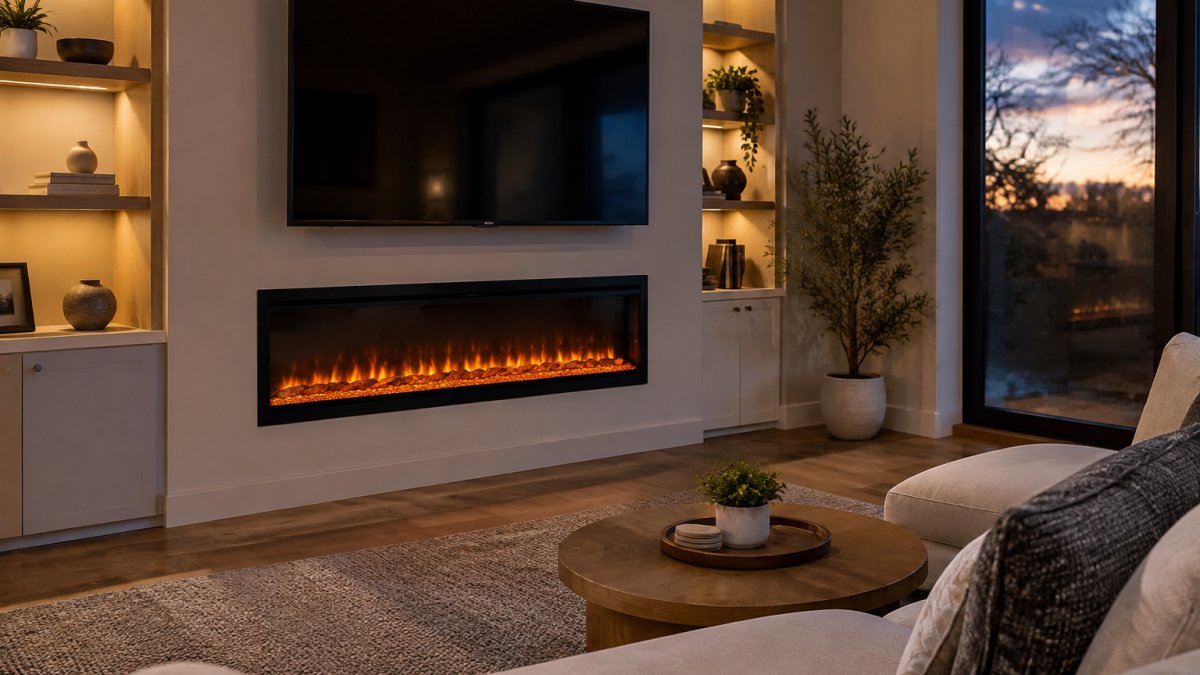
Mounting a television above a wall mounted fireplace is a popular design, but it takes planning. Many homeowners want the screen and the flame to line up without crowding the room. Consider the fireplace width relative to the TV, and position the TV at a comfortable viewing height. Our guide on how to choose fireplace size for your living room explains how to match width to your TV.
Heat is the other factor. Heat rises, so a fireplace placed directly below a TV can warm the screen area. Check the manufacturer's clearance guidance and avoid mounting a television directly above a heat outlet. A slim vertical unit can sit beside a TV rather than under it, which often avoids the issue.
Choosing Your Wall Mounted Electric Fireplace From Zen Home
The right model depends on your room, your heating needs and your budget.
For a narrow wall or a small room, the Napoleon Allure Vertical 32" Wall Mount Electric Fireplace at $429.00 is the most compact choice. For a wider linear look, the Napoleon Entice 50" Linear Electric Fireplace at $1,229.00 offers a broader flame display. Larger rooms may call for the Dimplex Ignite Ultra 100" Linear Electric Fireplace, priced at $6,799.99.


Before you buy, confirm the wall type, outlet location, weight and clearances. Product pages list specifications and installation manuals for each model, and those documents are a useful guide to your exact installation.
Frequently Asked Questions
What is the downside of an electric fireplace?
The main downside is that an electric fireplace produces heat only up to its rated output, typically up to about 5,000 BTU for models like the Napoleon Allure Vertical, which suits spaces up to roughly 400 sq. ft. It cannot match a gas or wood unit for whole-house heating. Flame-only operation is available, but the real flame look and radiant warmth of wood are absent. Buyers should size the unit to the room and set expectations for supplemental rather than primary heat.
Do wall-mounted electric fireplaces put out heat?
Yes. Most units, including the Napoleon Allure Vertical 38-inch model and the Dimplex Ignite Aspire 30-inch, provide supplemental heat using a fan-forced heater. Output varies: 5,000 BTU at 120V for smaller models and up to 8,530 BTU on 240V for the Dimplex Ignite Ultra 50. Heat coverage is rated up to about 400 to 1,000 sq. ft. depending on the model. The flame effect can also run alone for ambiance without heat.
Can you mount an electric fireplace under a TV?
Many homeowners do, but check the TV's mounting height and the fireplace's viewing height first. The Dimplex Ignite Ultra 100 has a 16.875-inch viewing height, which is relevant for placement. Keep clearance to the heater outlet and follow the manufacturer's installation manual for wall mounting and clearances.
Do electric fireplaces increase the electric bill?
They do when the heater runs. The Napoleon Allure Vertical draws 1,500 watts on heat, which is about 1.5 kWh per hour at full output. Running the flame effect without heat uses very little power. Electricity cost depends on your local rate per kWh and how many hours the heat runs, so the flame-only setting is the lowest-cost option for ambiance.