7 Direct Vent Gas Fireplace Troubleshooting Issues to Fix
Last Updated: November 2, 2026
Quick Summary
Direct vent troubleshooting works from the simplest cause to the most complex: power, gas supply, pilot and ignition parts, then venting. Check batteries, the wall switch, the gas shutoff valve, the breaker, and debris at the outside vent cap yourself, and leave the firebox, pilot assembly, gas pressure, and venting work to a qualified technician.
- A pilot that dies within 10 to 30 seconds points to a dirty or failed thermocouple.
- After summer, hold the pilot button down for a full 30 to 60 seconds to clear air from the gas line.
- Write down how many times the control module LED blinks before calling a technician.
- Clear snow, leaves, nests, and insect debris from both vent termination openings.
- Never run the fireplace with a known vent blockage to see if it clears.
Table of Contents
- Start With a Gas Fireplace Troubleshooting Chart
- When a Gas Fireplace Won't Light but the Pilot Is On
- Thermocouple Gas Fireplace Troubleshooting: Pilot That Won't Stay Lit
- Gas Fireplace Won't Light After Summer: Seasonal Restart Checks
- Ignition System, Wall Switch and Remote Control Failures
- Weak Flame, Insufficient Heat and Unbalanced Fire
- Direct-Vent Intake, Exhaust and Vent Termination Checks
- Choosing a Direct-Vent Fireplace That Troubleshoots Easier
- Frequently Asked Questions
Start With a Gas Fireplace Troubleshooting Chart
Most direct vent troubleshooting starts the same way: the fire looks dead, and you are not sure whether to call someone or grab a screwdriver. This guide walks through the most common issues, in the order a service tech would check them.
Direct vent troubleshooting works from the simplest cause to the most complex: power, gas supply, pilot and ignition parts, then venting. Skip that order and you will waste an afternoon on the wrong part.
Here is a chart to help sort symptoms quickly:
| Symptom | Most Likely Cause | Who Should Fix It |
|---|---|---|
| Nothing happens at all | No power, dead batteries, tripped breaker | Homeowner |
| Pilot lights but main burner stays off | Wall switch, remote, or gas valve | Homeowner check, tech repair |
| Pilot will not stay lit | Dirty pilot assembly, thermocouple, thermopile | Technician |
| Weak flame or poor heat | Low gas pressure, blocked vent, dirty burner | Technician |
| Odd smell or soot | Blocked vent or incomplete combustion | Technician, stop use now |
Safe Homeowner Checks vs. Technician-Only Repairs
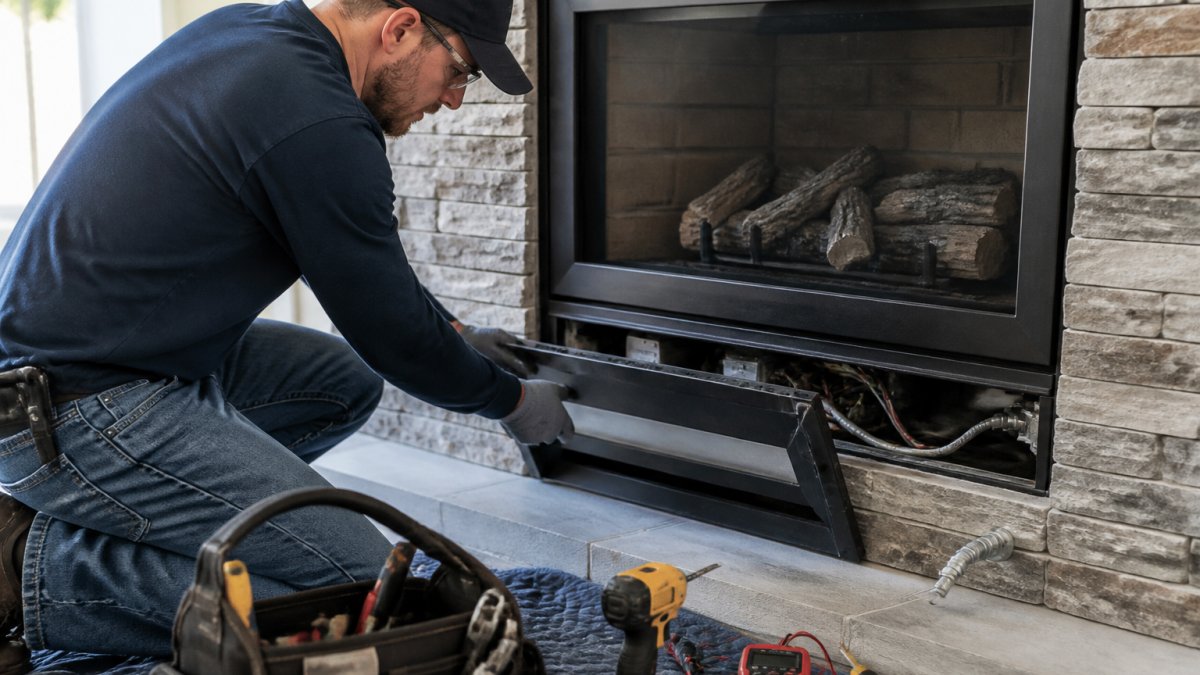
Some checks are yours to make. Others are not, and pushing past that line can void a warranty or put your home at risk.
Safe for you:
- Replace remote batteries and check the wall switch
- Confirm the gas shutoff valve is open
- Reset the breaker and check the fuse
- Clear snow, leaves, or debris from the outside vent cap
- Vacuum dust from the glass and front louvers
Leave these to a qualified technician:
- Opening the firebox or touching the pilot assembly
- Testing gas pressure at the valve
- Replacing a thermocouple or thermopile
- Any work on the venting system or its seals
If you smell gas, shut the valve off, leave the room, and call your gas provider. That is not a troubleshooting step.
When a Gas Fireplace Won't Light but the Pilot Is On
A lit pilot with a cold firebox almost always points to a control problem, not a gas problem. The pilot proves gas is reaching the unit. What fails next is the signal telling the main burner to open.
Check these in order:
- Wall switch: flip it firmly and listen for a click at the valve.
- Remote control: fresh batteries fix most of these.
- Thermostat setting: make sure it is calling for heat.
- Gas valve knob: confirm it sits in the "on" position, not "pilot."
If the pilot flame is healthy and blue but the burner stays silent after all four checks, the gas valve or its wiring needs a technician. Do not tap the valve or force the knob.
Thermocouple Gas Fireplace Troubleshooting: Pilot That Won't Stay Lit
A pilot that lights and then dies within seconds is the classic thermocouple gas fireplace troubleshooting case. The thermocouple tells the gas valve the pilot is burning; when it gets dirty or fails, the valve shuts off as a safety measure.
Signs the thermocouple is the culprit:
- Pilot lights, then goes out after 10 to 30 seconds
- Pilot flame is yellow or lazy instead of crisp blue
- Pilot stays lit only while you hold the button
Start with a careful cleaning of the pilot assembly using a soft brush, never a sharp tool. If the flame still will not hold, the thermocouple or thermopile likely needs replacement, a technician job, and usually a quick one.
Gas Fireplace Won't Light After Summer: Seasonal Restart Checks
A gas fireplace won't light after summer for one boring reason most of the time: air in the gas line. Months idle let air work its way in, and the pilot cannot light until it clears.
Run this restart sequence:
- Open the gas shutoff valve fully
- Hold the pilot button down for a full 30 to 60 seconds
- Try the igniter two or three times, pausing between attempts
- Check the remote batteries, which often die over the off-season
Dust is the other summer culprit: a thin film on the pilot assembly blocks the flame sensor. A soft vacuum and a dry cloth on the glass handle most seasonal no-starts. If the unit still refuses after three tries, stop and call a tech rather than cycling the igniter.
Ignition System, Wall Switch and Remote Control Failures
Standing-pilot (millivolt) systems. A small pilot burns continuously and generates millivolts to hold the gas valve open.
Intermittent-pilot (IPI) systems. The pilot lights only when heat is called for, then shuts off.
Electronic ignition systems. These use a hot-surface or spark igniter and a control board that monitors flame rectification.
Madison Clean Face Deluxe 36" Gas Fireplace →
Work through these checks in order, regardless of ignition type:
- Power supply: confirm the circuit breaker is on and any inline fuse is good.
- Batteries: replace the remote batteries and any control-module backup batteries.
- Wall switch: flip it firmly and listen for a click at the valve. A loose connection at the switch kills the signal on millivolt and IPI systems alike.
- Remote pairing: re-pair the remote if the fireplace ignores it. A remote that lost its pairing behaves exactly like a dead control board.
- Thermostat setting: make sure it is actually calling for heat, not sitting in a hold or off mode.
A blown fuse or tripped breaker is a homeowner fix. Wiring faults, control board failures, and igniter replacement are not.
Weak Flame, Insufficient Heat and Unbalanced Fire
A flame that looks small, lazy, or lopsided is telling you something. Weak flame and insufficient heat usually trace back to gas pressure, a dirty burner, or a venting problem.
Look at the flame pattern:
- Short, mostly blue flame: often low gas pressure, a technician check
- Uneven flame across the burner: clogged burner ports or shifted logs
- Yellow, lifting, or floating flame: possible venting or combustion issue, stop use
Cleaning the glass and checking that the fireplace logs and embers sit where the manual shows them are safe homeowner steps. Anything involving gas pressure or the burner itself belongs to a technician. Unbalanced fire that persists after repositioning the media is a call-it-in situation.
Direct-Vent Intake, Exhaust and Vent Termination Checks
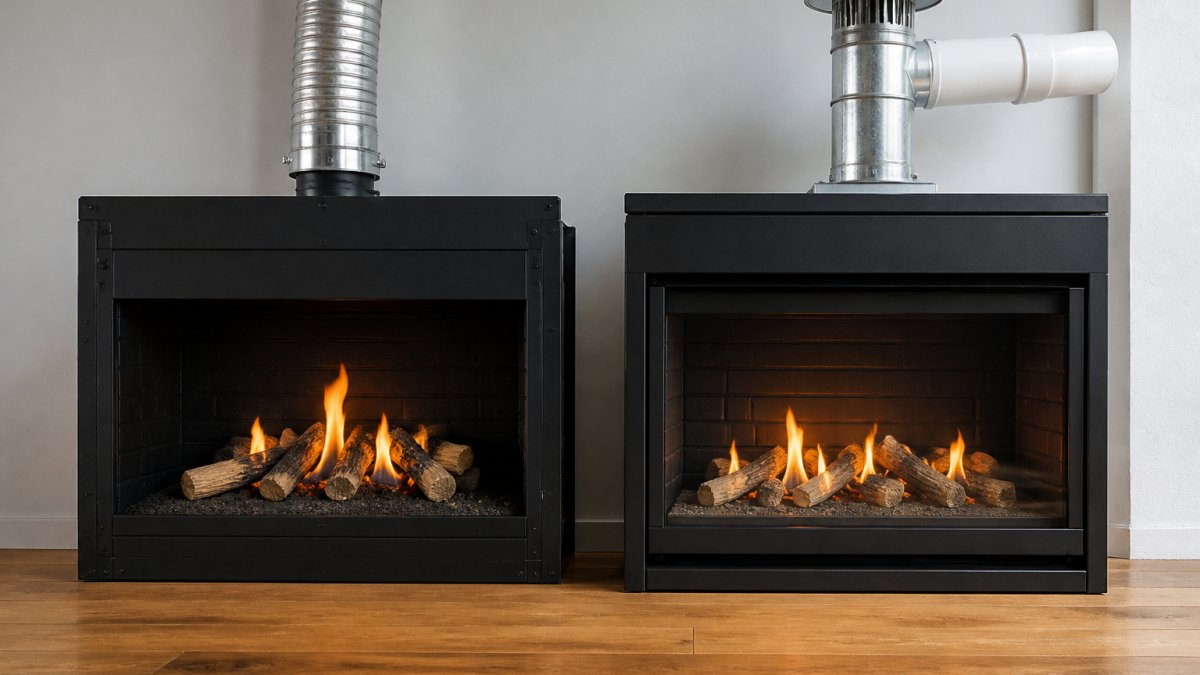
A direct-vent fireplace is a sealed-combustion appliance: it pulls outside air in through one passage and pushes exhaust out through another, and the two never mix with room air. That design is why direct-vent units are safer and more efficient than older atmospheric fireplaces, and why venting problems show up as strange flame behavior rather than obvious smoke.
The intake and exhaust are typically concentric (a pipe within a pipe) or side-by-side, depending on the model.
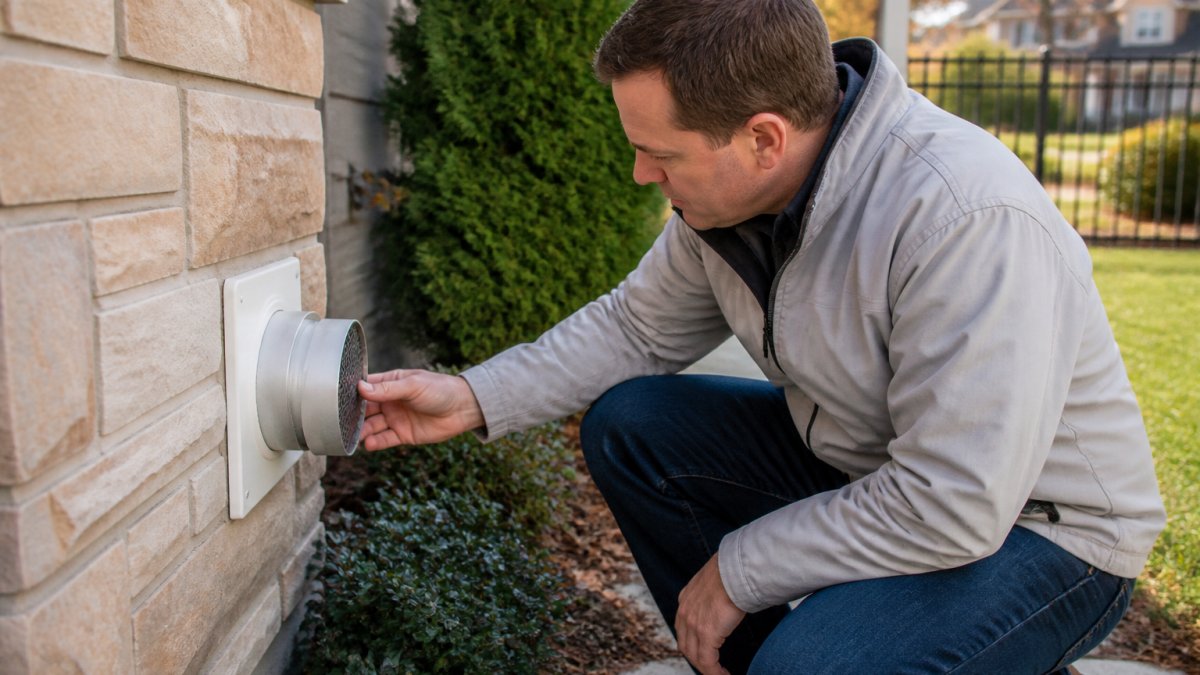
Check the termination from outside, safely and without disassembling anything:
- Clear snow, leaves, nests, lint, and insect debris from both openings. A shop vacuum with a soft brush attachment handles most surface blockage.
- Confirm the termination cap is not bent, crushed, or pushed tight against the wall; a deformed cap can partially block one passage.
- Look for soot streaks or discoloration around the cap. Soot outside signals incomplete combustion or a venting fault, and the unit should not be used until a technician inspects it.
- Note the wind exposure. A termination on a windy corner or under a deck can experience negative pressure that pulls exhaust back toward the intake, causing shutdowns and odd odors.
- Check clearance to nearby surfaces. Direct-vent terminations have minimum clearances to windows, doors, and corners, and a termination that was fine at installation can become non-compliant after a deck, fence, or addition is built nearby.
Watch out: never run the fireplace with a known vent blockage to "see if it clears." A sealed-combustion unit that cannot exhaust properly can trip its safety switch, and repeated operation against a blockage stresses the vent seals.
Glass, gaskets, and seals. The sealed firebox depends on intact glass gaskets and door seals.
When to stop and call a technician. Draft problems, blocked vent symptoms, damaged vent pipe, and any work involving the direct-vent pipe and its seals belong to a qualified technician. If you are weighing whether to keep repairing a direct-vent unit or switch fuels, our guide to direct vent gas vs electric fireplace efficiency lays out the comparison before you spend more on service calls.
Choosing a Direct-Vent Fireplace That Troubleshoots Easier
When replacing a troublesome unit, pick a model with a simple ignition type and a clear owner's manual.
Best for most living rooms: the Empire Tahoe Clean-Face Premium 32" Direct Vent Gas Fireplace brings a traditional look with up to 24,000 BTUs and a choice of Millivolt or IPI electronic ignition.

Best for a modern focal wall: the Empire Boulevard 36" Linear Direct Vent Gas Fireplace pairs electronic ignition with an included multifunction remote and up to 28,000 BTUs. If you are sizing a unit around a mounted TV, our guide on how to choose the right fireplace width for a TV helps you get the fit right the first time.

Best for a dramatic centerpiece: the Empire Boulevard 72" Linear Direct-Vent Gas Fireplace offers an expansive linear viewing area with a thermostat variable remote.
Before you buy, confirm the ignition type, the venting components your installer needs, and the manual's troubleshooting section.
Frequently Asked Questions
What is the most common problem with a direct-vent gas fireplace?
Ignition failure tops the list. In a millivolt model, a dirty pilot assembly or a thermocouple that has drifted out of the flame stops the burner from firing. In an electronic ignition model, a dead battery in the remote or a tripped circuit breaker is the usual culprit. Before calling anyone, check the gas shutoff valve, confirm the wall switch is on, and look at whether the pilot flame is actually reaching the thermocouple tip. Those three checks resolve a large share of no-heat calls.
Why does my gas fireplace pilot light but the burner won't turn on?
The pilot is proving itself, but the signal to open the main gas valve is not arriving. On a standing-pilot unit, the thermocouple or thermopile may be weak or misaligned, so the valve stays closed. On an electronic ignition unit, the burner often depends on the wall switch, remote, or thermostat circuit, and a dead remote battery or loose wire breaks that chain. Test the wall switch first, then the remote batteries, then inspect the thermopile connections. If the pilot flame itself is small and yellow rather than blue, clean the pilot orifice before replacing parts.
How do I know if my direct-vent fireplace is venting properly?
A properly venting direct-vent fireplace burns with a steady blue-based flame and shows no soot on the glass or logs. Warning signs include a lazy orange flame that lifts off the burner, black streaks on the glass, a gassy smell in the room, or the fireplace shutting off on its own after 10 to 15 minutes. Step outside and confirm the termination cap is clear of snow, leaves, nests and shrubs. If symptoms persist with a clear termination, stop using the fireplace and have a qualified technician inspect the vent pipe joints and gaskets.
What should I check if my gas fireplace won't light after summer?
Start with the fuel and power path. Confirm the gas shutoff valve behind or beside the fireplace is fully open, since many homeowners close it in spring. Replace the batteries in the remote and the receiver, then reset the ignition module by cycling power at the breaker. Air in the gas line is common after months of disuse, so allow the pilot several attempts to purge it. Finally, inspect the vent termination outdoors for nests or debris and clean any dust from the pilot assembly before assuming a part has failed.
A fireplace that will not light or heat properly is frustrating, but most issues trace back to a short list of causes you can work through calmly. Zen Home Fireplaces curates direct-vent gas models with dependable ignition systems, clean-face designs, and clear documentation, so troubleshooting stays simple and your hearth stays warm. Explore our collection of direct-vent gas fireplaces and find the model that fits your room, your venting, and your style.