Direct Vent Gas vs Electric Fireplace Efficiency
Last Updated: October 31, 2026
Quick Summary
Fireplace efficiency is the share of fuel energy that becomes usable room heat, and electric units convert nearly all their wattage to heat while sealed direct-vent gas units keep most combustion heat indoors. Gas still wins on output, reaching 24,000 to 28,000 BTU versus roughly 8,530 BTU for a premium electric model.
- Sealed combustion draws outside air and exhausts outdoors, so heated room air does not escape up a chimney.
- A 1,500W electric heater uses 1.5 kWh per hour, so running cost tracks your kWh rate directly.
- Electric fireplaces typically provide supplemental heat for about 1,000 sq. ft., while gas output scales to larger rooms.
- Compare cost per delivered BTU, not cost per hour, because a 28,000 BTU gas unit outheats a 1,500W electric heater.
- Electric units need no venting or gas line; gas units require venting and gas-line work by a qualified professional.
Table of Contents
- Fireplace Efficiency Defined: What the Numbers Actually Mean
- Direct-Vent Gas Fireplace Efficiency: Sealed Combustion Explained
- Electric Fireplace vs. Gas Fireplace Heat Output: BTU and Coverage
- Electric Fireplace Cost to Run: Watts, Utility Rates, and Real Numbers
- Comparing Operating Costs Side by Side
- Fireplace Zone Heating: Supplemental Warmth vs. Whole-Home Systems
- Installation, Venting, and Maintenance Trade-Offs
- Choosing Your Fireplace at Zen Home Fireplaces
- Frequently Asked Questions
Fireplace Efficiency Defined: What the Numbers Actually Mean
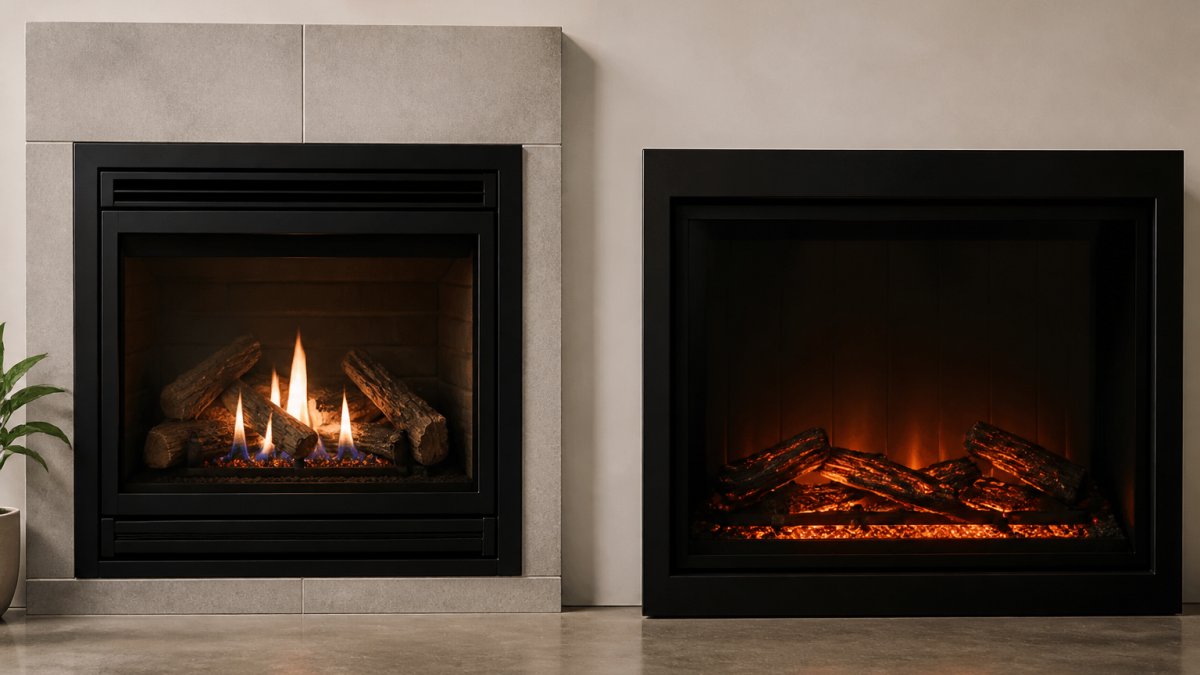
Fireplace efficiency is the percentage of fuel energy that becomes usable room heat rather than lost exhaust or waste. For gas, that means AFUE-style ratings; for electric, it means nearly all consumed wattage converts to heat. Understanding that split is the foundation of any direct vent gas fireplace vs electric fireplace efficiency comparison.
Annual Fuel Use Efficiency (AFUE) and Steady-State Ratings
AFUE measures how much of a fuel's energy a unit converts to heat over a full heating season, expressed as a percentage. Steady-state efficiency captures performance at a fixed operating point, ignoring start-up and cycling losses. Gas fireplaces are rated this way; a sealed direct-vent unit keeps most combustion heat in the room because it draws air from outside and exhausts outdoors.
Why 'Efficiency' Means Different Things for Gas and Electric
An electric fireplace converts resistance heat to warmth with almost no waste at the unit. Those are different accounting systems, and comparing the headline numbers without context misleads buyers. The U.S. Department of Energy guidance on heating equipment explains how AFUE is defined for fuel-burning appliances.
Direct-Vent Gas Fireplace Efficiency: Sealed Combustion Explained
Direct-vent gas fireplace efficiency comes from sealed combustion: the unit pulls outside air for the fire and sends exhaust back outside through a paired pipe. Because the firebox is sealed from room air, heated indoor air doesn't escape up a chimney, and drafts stay controlled.
A sealed firebox also protects indoor air quality, since combustion gases never mix with room air. The U.S. Environmental Protection Agency indoor air quality resources notes that properly vented combustion appliances protect indoor air. For a real example of this build, view the Empire Boulevard 36" Linear Direct Vent Gas Fireplace, which delivers up to 28,000 BTU with direct-vent technology.
Electric Fireplace vs. Gas Fireplace Heat Output: BTU and Coverage
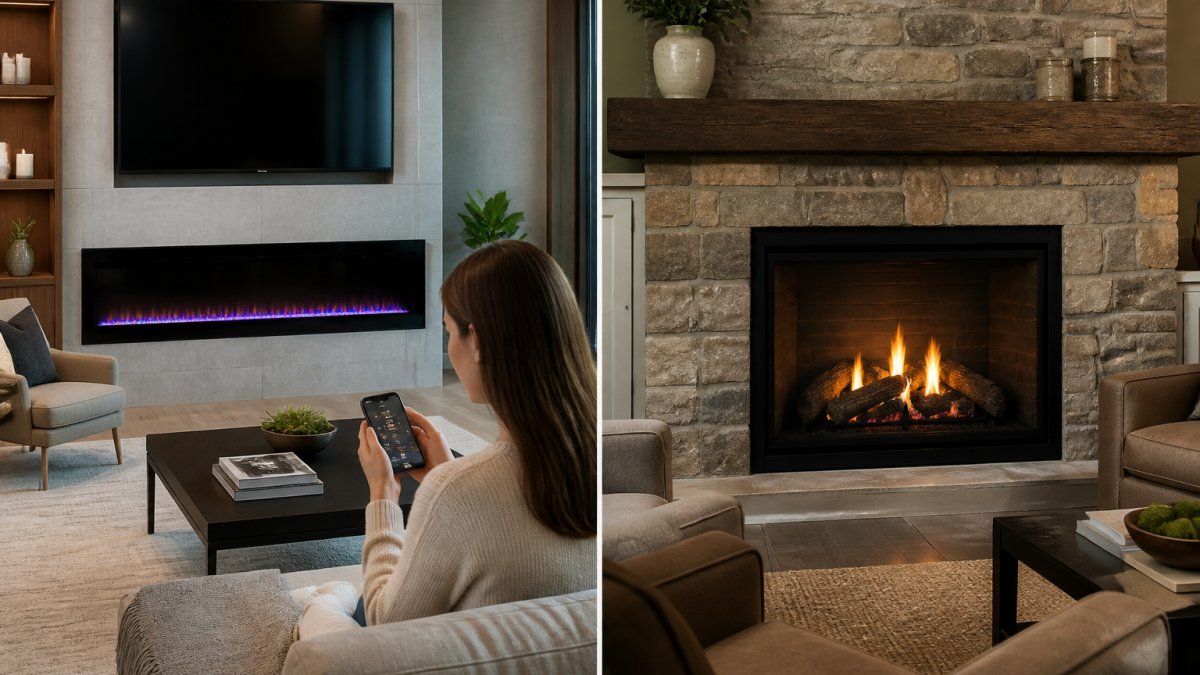
Electric fireplace vs. gas fireplace heat output differs sharply in scale.
Electric Fireplace Cost to Run: Watts, Utility Rates, and Real Numbers
Electric fireplace cost to run depends on wattage and your local utility rate. A 1,500W heater running one hour uses 1.5 kWh; at a typical residential rate, that's a modest per-hour cost.
The U.S. Energy Information Administration electricity data publishes average residential rates by region, which is the number to plug into that formula. A concrete model to anchor the math is the Dimplex Ignite Ultra 50", rated 1,500W at 120V or 2,500W at 240V.

| Factor | Electric Fireplace | Direct-Vent Gas Fireplace |
|---|---|---|
| Fuel | Electricity (kWh) | Natural gas or propane |
| Heat output | Up to ~8,530 BTU | Up to ~28,000 BTU |
| Efficiency basis | Near-total conversion at unit | Sealed combustion, AFUE-style |
| Running cost driver | Utility rate per kWh | Fuel price per therm/gallon |
| Best for | Supplemental, smaller rooms | Zone heating, larger rooms |
Comparing Operating Costs Side by Side
Most comparisons stop at "it depends on your rates." That is true but useless. The honest way to compare a direct-vent gas fireplace and an electric fireplace is to run the same job through both: deliver a defined amount of heat to a defined room for a defined number of hours, then multiply by the rate you actually pay. Below is the transparent method, with the assumptions stated so you can substitute your own numbers.
The two formulas
- Electric: cost per hour = (watts ÷ 1,000) × hours × your price per kWh.
- Gas: cost per hour = (BTU input ÷ 100,000) × hours × your price per therm (natural gas), or, for propane, (BTU input ÷ 91,500) × hours × your price per gallon.
Both formulas price input energy. To compare delivered heat, divide by the appliance's efficiency: electric units convert nearly all wattage to room heat, while a sealed direct-vent gas unit loses a share up the flue. That is why a gas fireplace with a higher BTU number is not automatically cheaper per unit of warmth, the fuel price and the efficiency both move the result.
A worked example (substitute your own rates)
Assume you run the fireplace 3 hours per evening for 30 evenings, 90 hours per month, and you want roughly 5,000 BTU of delivered heat per hour.
- Electric at 1,500W (120V): 1.5 kWh × 90 hours = 135 kWh. At a residential rate of $0.17/kWh, that is about $22.95 for the month. At 2,500W (240V), the same runtime uses 225 kWh, or about $38.25.
- Gas at 28,000 BTU input, sealed direct-vent: 28,000 ÷ 100,000 = 0.28 therm per hour × 90 hours = 25.2 therms. At $1.20 per therm, that is about $30.24 for the month before efficiency adjustment; at a higher delivered-heat fraction the effective cost per usable BTU drops.
Those numbers are illustrative, not universal, the point is that the electric unit's cost is locked to your kWh rate, while the gas unit's cost is locked to your fuel price and how much of the combustion heat reaches the room.
What the comparison hides
Three factors routinely flip the answer:
Dimplex Ignite Ultra 50" Linear Electric Fireplace – ULT50 →
- Runtime and output. A 28,000 BTU gas unit run for one hour delivers far more heat than a 1,500W electric heater run for one hour. Comparing cost-per-hour without matching delivered BTU is the most common error.
- Standby and fan draw. Electric fireplaces use a small amount of electricity for controls, flame effect, and fan even when heat is off; gas units draw power for ignition, controls, and blower on most modern models. Neither is free, and both belong in a full annual estimate.
- Zone heating offset. If the fireplace lets you dial back central heat in the occupied room, the real comparison is fireplace cost versus the central-system cost you avoid, not fireplace versus nothing.
Run the formulas with your own rates and runtime, and the "which is cheaper" question becomes a number instead of a slogan.
Fireplace Zone Heating: Supplemental Warmth vs. Whole-Home Systems
Zone heating means warming the room you are actually in and letting the rest of the house run cooler, rather than paying to condition every square foot. A fireplace is a zone heater by nature, it heats the space in front of it, not the whole home, and the efficiency question only makes sense once you accept that framing. The practical comparison is not "which fireplace heats a house better" but "which one delivers usable warmth to the room I occupy, at what cost, and how far does that warmth travel?"
Delivered heat, not nameplate heat
A fireplace's rated BTU is input, not comfort. What reaches you depends on three things:
- Sealed combustion (gas). A direct-vent unit draws outside air for the fire and exhausts outdoors through a paired pipe, so it does not pull heated room air up a chimney the way an open masonry fireplace does. That is the core reason a sealed direct-vent unit delivers a larger share of its heat to the room.
- Air movement. Gas models with a variable-speed blower push warmed air into the room instead of letting it stratify at the ceiling; the Madison Clean Face Deluxe 36" Gas Fireplace includes one for exactly this role. Electric units rely on a fan to move their lower output across the floor.
- Room layout and insulation. A fireplace in a large, open, poorly insulated room will feel weaker than the same unit in a smaller, tighter space. Coverage claims assume a typical room, not a cathedral-ceiling great room with single-pane glass.
Practical coverage: what each type can actually warm
- Electric: supplemental warmth, typically sized for a single room, the Dimplex Ignite Ultra 50" Linear Electric Fireplace is rated up to 8,530 BTU at 240V and is described as supplemental heating for roughly 1,000 sq. ft.
- Direct-vent gas: higher output, a linear gas fireplace can push 24,000 to 28,000 BTU, which scales to larger rooms and open living areas. The Empire Boulevard 36" Linear Direct Vent Gas Fireplace delivers up to 28,000 BTU with direct-vent technology, enough to anchor a great room as a zone heater.
The gap matters most in cold weather: an electric unit at the top of its range is working hard to hold a room, while a gas unit at mid-output has headroom. In mild climates where the fireplace is mostly ambiance, the electric unit's lower output is not a limitation at all.

Zone heating versus the central system
The efficiency case for either fireplace depends on what it replaces. If running the fireplace lets you set the central thermostat back several degrees in the evening, the fireplace is offsetting central-system cost, and the comparison becomes fireplace operating cost versus the central heat you avoid, not fireplace versus nothing. If the central system runs unchanged, the fireplace is pure added cost, however efficient it is.
Operation during outages and standby draw
Check each model's spec sheet for its ignition type and whether it operates without household power before counting on it as a backup heat source. Either way, budget for the small standby draw from controls, flame effect, and fan, and confirm the model's ignition and backup requirements before you buy.
Installation, Venting, and Maintenance Trade-Offs
Installation requirements differ between these two types. Electric units need no venting or gas line. Gas units require venting and gas-line work, so consult the specific model's installation manual and a qualified professional.
Choosing Your Fireplace at Zen Home Fireplaces
The right pick depends on the job you need done. Direct-vent gas models list higher heat output, while electric models suit ambiance and installations without venting. Browse the flagship Empire Boulevard 72" Linear Direct-Vent Gas Fireplace to see the product details.

Frequently Asked Questions
Is an electric fireplace more efficient than a direct-vent gas fireplace?
The answer depends on what you compare, including heat output and running costs. Compare each model's listed BTU output and your local fuel and electricity rates.
Which is cheaper to run: a direct-vent gas fireplace or an electric fireplace?
It depends on local utility rates. Check both your electricity and gas rates before deciding.
Does a direct-vent gas fireplace heat a room during a power outage?
Operation during a power outage depends on the model's ignition type. If outage resilience matters, check the specific model's spec sheet before buying.
Which fireplace is better for zone heating?
Zone heating works best when the fireplace can warm the room you actually use without heating the whole house. Match each model's listed BTU output to your room size and how often you will run it.
Are electric fireplaces cheaper to install than direct-vent gas fireplaces?
Electric fireplaces need no chimney, gas line, or venting. Direct-vent gas fireplaces require a gas line and venting, and professional installation is recommended. Budget for the full installed cost, not just the unit price, when comparing.
The hardest part isn't understanding fireplace efficiency, it's matching a model to your room, fuel, and install constraints. Zen Home Fireplaces curates modern gas and electric fireplaces with the specs and design detail to fit each space, from sealed direct-vent gas to vent-free electric. Get started with Zen Home Fireplaces and choose a fireplace built to warm your home beautifully.