How to Choose the Right Fireplace Width for a TV
Last Updated: November 1, 2026
Quick Summary
Choose a fireplace width by measuring your TV's actual body width, not its screen size, then matching the fireplace to that number. A 65-inch TV measures about 57 inches wide, so a linear fireplace between 50 and 60 inches tends to sit well beneath it. Keep at least 12 inches between the top of the fireplace opening and the bottom of the TV.
- A 65-inch class TV typically measures about 57 inches wide with the stand removed.
- A TV about 57 inches across pairs well with a fireplace in the 38 to 43 inch range.
- Keep at least 12 inches between the top of the fireplace opening and the bottom of the TV.
- The center of the TV should sit roughly 42 to 48 inches from the floor when seated.
- If a spec sheet and a manual disagree, trust the manual for clearance figures.
Table of Contents
- Step 1: Measure the TV, Not the Screen Size
- Step 2: Apply the Fireplace and TV Size Ratio
- Step 3: Match Fireplace Dimensions for a 65-Inch TV
- Step 4: Set the TV Above Fireplace Clearance
- Step 5: Use an Electric Fireplace Size Guide for Your Wall
- Step 6: Check Heat Clearances and Manufacturer Specs
- Step 7: Confirm Proportions and Viewing Height on the Wall
- Plan Your Media Wall with Zen Home Fireplaces
- Frequently Asked Questions
Step 1: Measure the TV, Not the Screen Size
The first rule of fireplace width is simple: measure the TV's actual body, not its screen. A 65-inch TV does not measure 65 inches across. Screen size is a diagonal measurement, and the frame adds several more inches on each side. That difference decides whether your fireplace and TV look balanced or slightly off.
Here is a practical measurement method, in order:
- Find the published width. Check the TV spec sheet for the width with the stand removed. This is the number you will use for layout, because a wall-mounted TV has no stand.
- Verify with a tape measure. Run the tape across the back of the set, edge to edge, at the widest point of the bezel. Write the number down in inches.
- Add the mount allowance. A wall mount and its brackets can add roughly 1 to 2 inches of depth but usually do not change the visible width. If your mount has side arms or a soundbar bracket that extends past the bezel, measure that span instead.
- Account for a soundbar or shelf. If a soundbar sits below the TV, its width may exceed the TV body. Use the wider of the two as your top line.
A worked example makes this concrete. A 65-inch class TV typically measures about 57 inches wide with the stand removed. A 75-inch class TV typically measures about 66 inches wide. A 55-inch class TV typically measures about 48 to 49 inches wide. Those are the numbers you plug into the ratio in the next step, not 65, 75, or 55.
Most people skip this step. Then they buy a fireplace that looks right in a showroom photo and wrong on their own wall. Get the real number first, and write it down before you shop.
Step 2: Apply the Fireplace and TV Size Ratio
The fireplace and TV size ratio is the fastest way to choose a fireplace width. A common rule of thumb is to keep the fireplace within a comfortable proportion of the TV's width for a clean, balanced look. A fireplace that runs wider than the TV can also work, but only when the wall has room to carry it.
Think of the two pieces as one composition. The TV is the top line. The fireplace is the base. Neither should look like it wandered in from a different room.
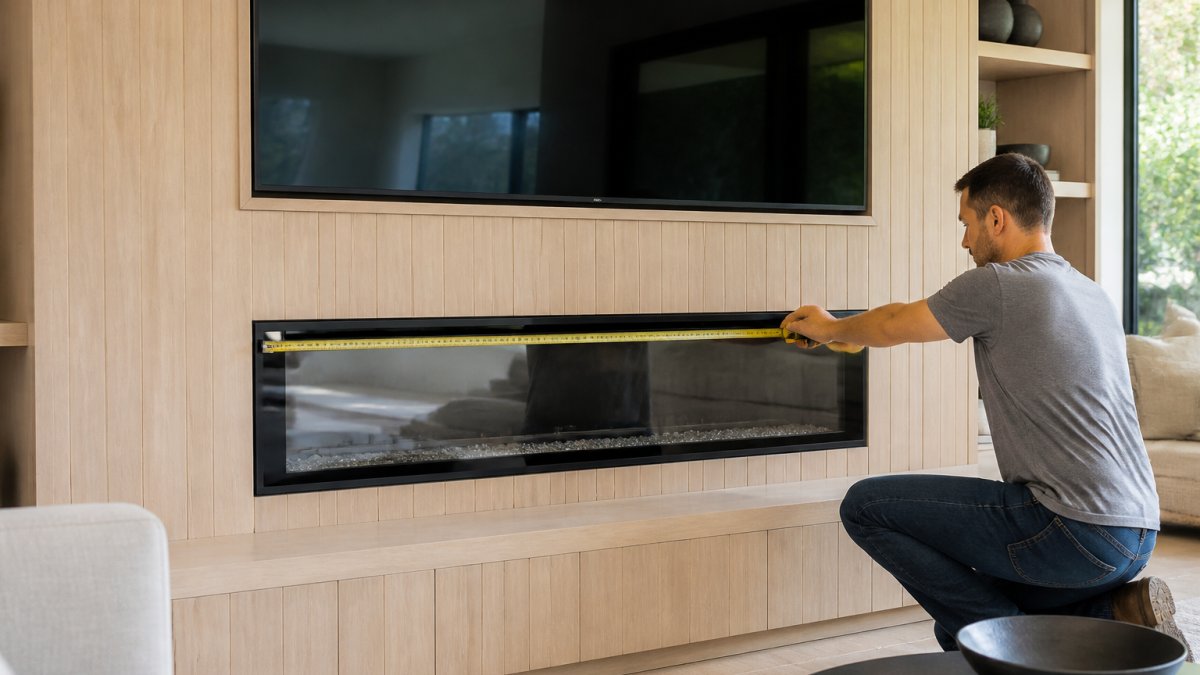
A quick example. A TV that measures about 57 inches across pairs well with a fireplace in the 38 to 43 inch range. A wider fireplace, closer to 57 inches, gives a bolder, more architectural result.
Neither choice is wrong. They just read differently on the wall.
Step 3: Match Fireplace Dimensions for a 65-Inch TV
Fireplace dimensions for a 65-inch TV usually land in a clear range. A 65-inch set is roughly 57 inches wide, so a linear fireplace between 50 and 60 inches tends to sit well beneath it.
Here is a starting point:
| TV body width | Fireplace width | Visual result |
|---|---|---|
| Under 50 in | 30-40 in | Compact, understated |
| 50-58 in | 40-50 in | Balanced and safe |
| 58-65 in | 50-60 in | Bold, modern focal point |
| Over 65 in | 60-72 in | Full media wall statement |
If you want a reference point, the Dimplex Ignite Ultra 100" linear electric fireplace is a wide unit suited to large TVs. For a tighter fit, the Empire Boulevard 72" linear direct-vent gas fireplace offers a 72-inch width to check against your own ratio.


Step 4: Set the TV Above Fireplace Clearance
TV above fireplace clearance is the measurement most people get wrong. The safe rule is to keep at least 12 inches between the top of the fireplace opening and the bottom of the TV. That gap protects the screen from heat and keeps the wall from looking cramped.
Here is what that 12 inches actually does:
- It gives heat room to rise and spread
- It keeps the TV's lower edge from crowding the fire
- It leaves space for a slim mantel if you want one
If your TV sits lower than that, the layout will feel tight. It may also push heat toward the screen, which shortens the life of the electronics.
Step 5: Use an Electric Fireplace Size Guide for Your Wall
An electric fireplace size guide starts with the wall, not the unit. Measure the full width of the wall you plan to use. Then subtract the space you need on each side.
As a general rule of thumb, leave some margin of wall on either side of the fireplace surround so the unit does not look wedged in.
Dimplex Ignite Ultra 50" Linear Electric Fireplace – ULT50 →
Two real sizes to compare against your wall:
- The Dimplex Ignite XL 50" linear electric fireplace measures 50-1/4 inches wide, a good fit for mid-size media walls
- The Amantii Symmetry Xtra Tall Bespoke 60 shows how extra height changes the look on a tall wall
Write your wall width down. Then match it to a fireplace that leaves breathing room on both sides.

Step 6: Check Heat Clearances and Manufacturer Specs
Heat clearance is not a design preference. It is a safety requirement, and every manufacturer publishes its own numbers. Those numbers vary by fuel type and installation style, so the clearance advice that works for one unit can be wrong for the next. Treat visual sizing and safety clearance as two separate checks: the ratio in Step 2 tells you what looks balanced, and this step tells you what is safe to install.
Here is how the requirements differ by fireplace type:
- Linear electric fireplaces. These produce little or no external heat at the glass, so the clearance above the opening is often modest. Many models still publish a minimum distance to a TV or mantel, and some recommend a heat deflector when a TV sits directly above. Check the manual for the exact figure.
- Direct-vent gas fireplaces. These concentrate heat at the glass and above the opening. Clearance to a mantel or shelf is usually specified in the manual, and a mantel often acts as a heat deflector that lets you mount a TV closer than the bare-wall clearance would allow. Do not assume a mantel solves the problem; confirm the mantel depth and height the manual requires.
- Wood-burning fireplaces. These have the most variable clearances and the strongest reason to follow the manual exactly. Heat output and radiant surface temperatures are higher, and clearance to combustibles is typically the largest of the three types.
Installation style matters too. A recessed fireplace flush with the wall, a wall-mounted surface unit, and a freestanding unit each change where heat goes and how much wall clearance you need. A recessed unit may push heat forward into the room, while a surface-mounted unit can radiate toward the wall above it.
Before you buy, confirm four things in the current installation manual for your exact model:
- The minimum clearance above the fireplace opening
- The required distance to any mantel or shelf, and the mantel depth that distance assumes
- Whether the unit needs a heat deflector when a TV sits above it
- The clearance to the TV itself, which some manufacturers publish separately from the mantel clearance
A practical approach is to set the TV height from the viewing-height guidance in Step 7 first, then check that the resulting gap meets the manual's clearance. If it does not, raise the TV or add the mantel and deflector the manual specifies rather than shrinking the gap.
Step 7: Confirm Proportions and Viewing Height on the Wall
Viewing height decides whether the whole layout feels comfortable. The center of the TV should sit near seated eye level, roughly 42 to 48 inches from the floor when you are seated on a sofa.
Then check the full picture:
- Fireplace centered on the wall
- TV centered above it
- Side margins equal on both sides
- Bottom of TV at least 12 inches above the fireplace
Small rooms need extra care. If your space is tight, our guide to the best electric fireplace for small apartments helps you judge proportions and viewing height without oversizing the wall.
Plan Your Media Wall with Zen Home Fireplaces
Getting the fireplace width right comes down to four numbers: your TV's real body width, your wall width, your side margins, and your clearance above the opening. Measure all four before you buy anything.
At Zen Home Fireplaces, we offer a curated selection of modern linear electric and gas models with clean lines and warm materials, plus the Zen Hearth Essentials accessories line to finish the look.
Get started with Zen Home Fireplaces and build a media wall that looks balanced, stays safe, and fits your room.
Frequently Asked Questions
How wide should a fireplace be compared with a TV?
As a working rule, a linear fireplace looks balanced when its width falls between roughly 60% and 100% of the TV's width. Measure the TV's actual casing, not the screen size, since a 65-inch TV is usually about 57 inches wide. A fireplace narrower than about 60% of the TV tends to look undersized beneath it, while one much wider can dominate the wall.
How much space should be between a fireplace and a TV?
Plan for at least 12 inches between the top of the fireplace opening or mantel and the bottom of the TV, and check the fireplace manual for its stated clearance. Gas and electric models differ, and heat deflectors can help. The TV above fireplace clearance protects both the screen and the wall finish, so treat the manufacturer's number as the minimum, not a target.
What size fireplace should go under a 65-inch TV?
A 65-inch TV measures about 57 inches across, so a linear fireplace in the 40 to 57 inch range keeps the proportions comfortable. The Dimplex Ignite XL 50-inch, at 50-1/4 inches wide, sits neatly under that TV size. If you want the fire to read as the focal point, stay closer to the TV's width rather than well beyond it.
Can a TV be wider than the fireplace below it?
Yes. A TV wider than the fireplace is common and often looks intentional, as long as the fireplace is not so narrow that it reads as an afterthought. Keep the fireplace at roughly 60% of the TV width or more, center both on the same axis, and confirm the TV above fireplace clearance so heat does not reach the screen.