Are Electric Fireplaces Better Than Space Heaters for Apartments?
Quick Summary
For most apartments a space heater is better for real warmth, while an electric fireplace suits ambiance with supplemental heat. Both convert electricity to heat almost entirely, so running cost depends on wattage, hours and your rate, and an electric fireplace heats only a limited area.
- An electric fireplace's flame-only setting produces no heat, so switch on the heater function.
- A 1,500-watt unit can heat a room of roughly 400 to 1,000 square feet, depending on the model.
- Check whether the unit's circuit is shared with a microwave, hair dryer or air conditioner before plugging in.
- Plug the unit directly into a wall outlet, avoiding extension cords and power strips.
- Check your lease before any wall-mount or built-in installation, since many restrict permanent work.
Table of Contents
- Electric Fireplace vs. Space Heater: What Each One Actually Does
- Can an Electric Fireplace Heat a Room?
- Electric Fireplace vs. Space Heater Cost: Running Costs Compared
- Electric Fireplace Safety in Apartments: Circuits, Clearance, and Outlets
- Heating Coverage: Matching Output to Your Room Size
- Lease Rules, Noise, and Storage: Practical Apartment Considerations
- Choosing the Right Electric Fireplace for Your Apartment
- Frequently Asked Questions
Electric fireplaces and space heaters both put warmth into a room without a flue, a gas line or a chimney, which is why they're the two options most apartment dwellers weigh first. They look different, though, and they behave differently once they're plugged in. This guide explains what each one actually does, how heat output and running costs compare, what electrical safety means in a rental, and which option suits a typical apartment. It also covers practical details such as lease rules, noise and storage.
Last Updated: November 4, 2026
Electric Fireplace vs. Space Heater: What Each One Actually Does
An electric fireplace is a decorative heater built around a flame effect, with an electric heating element tucked behind or beneath it. A space heater is a purpose-built heating appliance, usually a compact box or tower, designed mainly for warmth. Both convert electricity to heat almost entirely, so the difference comes down to design priorities rather than efficiency.
The fireplace puts the look first. Its flame effect can run with the heater off, so it works as ambiance in spring and fall, not only in winter. The space heater puts output first and often adds thermostats and tip-over shutoffs as core features.
Watch out: A flame-only setting produces no heat at all. Buyers who expect a heater to warm the room in January should check that the heater function is switched on.
Can an Electric Fireplace Heat a Room?
Yes, but only within a limited area. The Dimplex Revillusion 24" Built-In Electric Fireplace is rated for supplemental heat in spaces up to approximately 1,000 sq. ft. at 120V and 1,500W, producing approximately 5,118 BTU. The Napoleon Allure Vertical 32" Wall Mount Electric Fireplace is rated for up to approximately 400 sq. ft. at the same 1,500 watts.
The gap between those two ratings shows that the stated coverage is a rough guide, not a promise for every room. Ceiling height, insulation, window area and how open the floor plan is all change how far the warmth reaches. A single unit placed at one end of a long living room will warm the nearby seating first. Treat the rated square footage as the upper limit for a well-insulated room, and expect less in a drafty one.
Electric Fireplace vs. Space Heater Cost: Running Costs Compared
Running cost comes from the same formula for any electric heat source: watts divided by 1,000 gives kilowatts, multiplied by hours used, multiplied by your electricity rate. At 1,500 watts, one hour of heat uses 1.5 kWh. If your utility charges $0.17 per kWh, that hour costs about $0.26. Check your own rate on your bill, because it varies by region and by season.
Here is how that math scales across a month. A space heater running four hours a day at 1,500 watts uses 6 kWh per day, or about 180 kWh per month. At $0.17 per kWh, that is roughly $30.60 per month. Run it eight hours a day and the same unit uses about 360 kWh, or roughly $61.20 per month. A fireplace used mainly for ambiance with the heater on for two hours a day uses about 90 kWh per month, or roughly $15.30 at the same rate. The appliance type does not change the per-hour cost at equal wattage; your runtime and your rate do.
Thermostat cycling changes the real number. A unit that reaches the set temperature and shuts off its element may draw full power for only part of each hour. Thermostat cycling means a unit may draw full power for only part of each hour, so actual billing can differ from the simple calculation. Treat any estimate as a range, not a guarantee.
To build your own estimate, find the price per kWh on your utility bill or your utility's rate page, multiply by 1.5 for a 1,500-watt unit, then multiply by the hours you expect to run it. Compare that monthly figure with the upfront price. The Empire Nexfire 34" Linear Electric Fireplace is listed at $1,182.00, and the Dimplex Vital Spark 26" Built-In Electric Fire Box is listed at $999.00. A basic portable space heater costs far less upfront, so the fireplace is an investment in appearance as much as warmth, and the running-cost difference between the two is smaller than the purchase-price difference.
Watch out: A fireplace on flame-only mode still draws power for lights and the motor, so do not assume it costs nothing when the heater is off. Check the product specifications for the flame-only wattage if you plan to run it for ambiance through the evening.
Electric Fireplace Safety in Apartments: Circuits, Clearance, and Outlets
A 1,500-watt unit on a 120-volt circuit draws roughly 12.5 amps. Whether a standard circuit can handle that depends on what else shares it, so check the circuit before plugging in a unit.
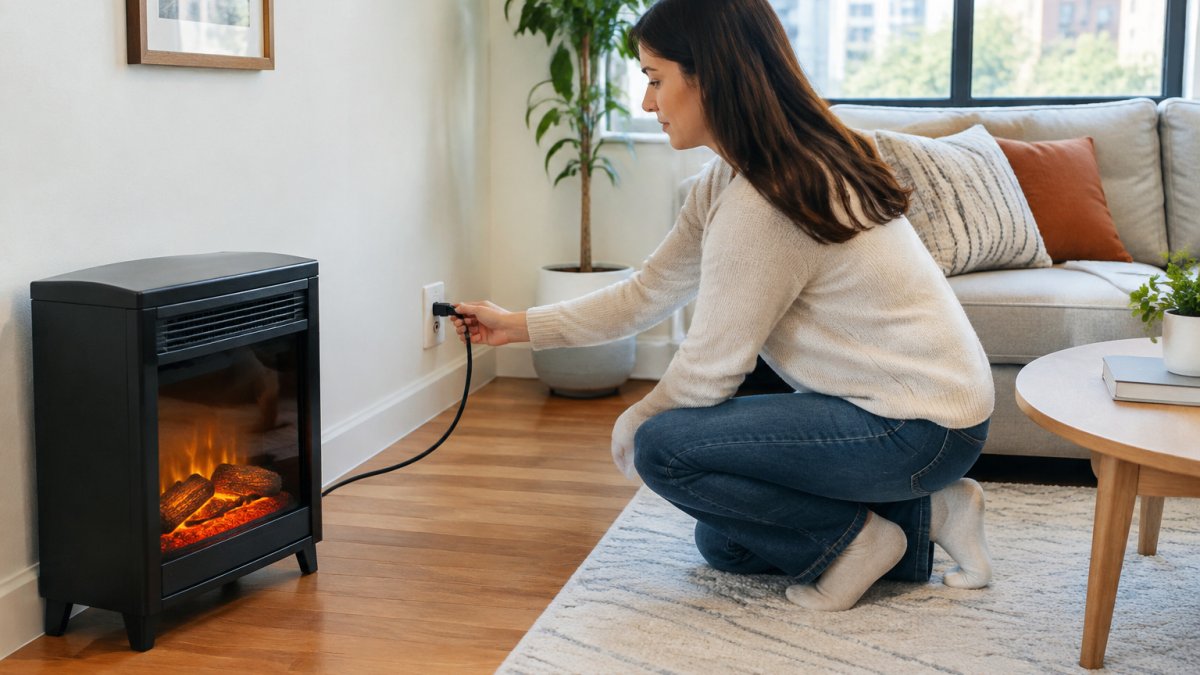
Identifying what shares a circuit is the step most renters skip. In an apartment, a single 15-amp circuit often feeds an entire wall of outlets, a bedroom plus a hallway, or a living room plus a dining nook. Plug the unit in, turn it on, and see whether the breaker trips when you also run a microwave, a coffee maker, a hair dryer, a vacuum, or a window air conditioner.
Plug the unit directly into a wall outlet, not into an extension cord or power strip, to reduce the risk of overheating (There’s a Chill in the Air - Stay Warm Safely - Be Cautious When Using Generators...). If the cord will not reach, move the unit rather than adding an extension. Never run a cord under a rug, across a doorway, or where a chair or foot traffic can pinch it.
Dimplex Ignite Ultra 50" Linear Electric Fireplace – ULT50 →
Clearance rules come from the owner's manual and vary by model. A common pattern is to keep at least three feet of clear space in front of a space heater and to keep curtains, bedding, and furniture away from the discharge (Keep Warm and Safe This Winter: Tips for Using Generators, Furnaces and Space Heaters).
Confirm which safety features a specific model has in its listing before you buy, and read the manual for the clearance and installation rules that apply to that unit. Learn how built-in electric fireplace safety features work to know what to look for.
Watch out: Fireplaces and space heaters on a shared circuit are a common cause of tripped breakers in apartments, and a breaker that trips repeatedly is a signal to stop and reassess the load rather than to reset it and keep going. If a breaker trips more than once with the same setup, move the unit to another circuit or consult building maintenance before using it again.
The table below summarises the key electrical and clearance facts for running a fireplace or heater safely in an apartment.
| Item | Value | Note |
|---|---|---|
| Unit power draw | 1,500 watts | Roughly 12.5 amps on a 120-volt circuit |
| Clearance (space heater) | Three feet | Typical rule; check the owner's manual |
| Outlet use | Wall outlet only | Avoid extension cords and power strips |
| Repeated breaker trips | Move the unit | Reassess load instead of resetting repeatedly |
Heating Coverage: Matching Output to Your Room Size
Match the unit to your room, not to the marketing. A 400-square-foot bedroom and a 900-square-foot open-plan living area need very different output. The Napoleon Allure Vertical 32" is rated for supplemental heat in spaces up to approximately 400 sq. ft., so it suits a compact bedroom or reading nook. The Dimplex Ignite Ultra 50" Linear Electric Fireplace, rated for approximately 1,000 sq. ft. at 120V with up to 5,118 BTU, suits larger open living spaces, and its 240V option produces up to 8,530 BTU for larger rooms if your home has the outlet for it.
Measure your room in square feet first. Multiply length by width. If the result is near or above the unit's rated area, consider a higher-output model or a second unit. Keep in mind that a fireplace's heat output is modest by central-heating standards, so it works best as supplemental warmth for the room you spend the most time in.
Lease Rules, Noise, and Storage: Practical Apartment Considerations
Renting changes the decision. See how electric and gas fireplaces compare for condos before you commit to either. Many leases restrict permanent installations, so a built-in firebox that needs framing or hardwiring may need landlord approval. Plug-in units generally avoid those installation issues. Check your lease before you buy, and ask in writing if you're unsure whether a wall mount is allowed.
Noise matters more in apartments than in houses. Look for the noise description in each product's specifications, and test a unit in a showroom if you can. Storage is also a practical concern: a 39-pound unit with a 19.5-inch height needs a closet or a corner you can spare year-round. A space heater is smaller and easier to tuck away in a closet during the warm months.
Choosing the Right Electric Fireplace for Your Apartment
For a renter who wants ambiance and occasional heat, a plug-in wall unit or a compact linear model is the most practical choice. Compare the best electric fireplaces for small apartments to see which options suit tight spaces. The Napoleon Allure Vertical 32" Wall Mount Electric Fireplace, listed at $429.00, plugs into a standard 120V outlet and suits a bedroom or small living room. The Empire Nexfire 34" Linear Electric Fireplace, listed at $1,182.00, fits a wall-recessed look in apartments that have the wall space and a longer design budget.

If you're in a condo with a fireplace opening or plan a more permanent setup, the Dimplex Vital Spark 26" Built-In Electric Fire Box, listed at $999.00, offers a molded-log look and hardwire or plug-in options. The Dimplex Revillusion 24" Built-In Electric Fireplace, listed at $1,539.99, adds realistic Realogs and four finish choices for a more traditional appearance.
Our practical recommendation: choose a plug-in unit sized to your room, confirm it can run on a dedicated or lightly loaded circuit, and check your lease before any wall or built-in installation. That combination can deliver warmth and atmosphere while reducing common apartment installation concerns. Shop the Zen Home Fireplaces electric fireplace collection to compare sizes and finishes.

Frequently Asked Questions
Is an electric fireplace better than a space heater?
It depends on what you need. An electric fireplace adds a visual flame effect and provides supplemental heat, which suits apartments where ambiance matters as much as warmth. Models such as the Dimplex Revillusion 24" (about 5,118 BTU, 1,500 watts) provide supplemental heat for spaces up to approximately 1,000 sq. ft., while the Napoleon Allure Vertical 32" covers up to approximately 400 sq. ft. Match the unit's rated coverage to your room before choosing.
Can you use an electric fireplace in an apartment?
Yes, most electric fireplaces suit apartments because they need no chimney, gas line, or venting. Many plug into a standard 120V outlet, as the Napoleon Allure Vertical 32" does. Check your lease before installing anything that is hardwired or recessed into a wall, since landlord approval may be required. Compact options like the Empire Nexfire 34" are designed for bedrooms, apartments, and condos where wall space is limited.
How much does it cost to run an electric fireplace in an apartment?
Operating cost depends on wattage, hours of use, and your local electricity rate. A 1,500-watt unit running at full power draws 1.5 kilowatt-hours per hour. The per-hour cost depends on your local electricity rate. Flame-only mode uses far less power because the heater is off. Run the math with your own utility rate before comparing models.
What should renters check before using an electric fireplace?
Check your lease for rules on appliances and wall modifications. Confirm the outlet can handle the unit's 120V, 1,500-watt draw without overloading the circuit, and avoid extension cords. Keep clear space around the unit as specified in the owner's manual. Hardwired installations and recessed units such as the Dimplex Vital Spark 26" typically require more involved installation and landlord approval.