Why Fireplace Mantel Clearance Matters for Safety
Table of Contents
- What Fireplace Mantel Clearance Is and Why It Prevents Fires
- How Heat Moves from the Firebox to Your Mantel
- National Fire Code Requirements for Mantel Clearance
- Combustible Material Clearance Fireplace Rules by Fuel Type
- How to Measure Fireplace Mantel Height and Depth Correctly
- Safe Distance for TV Above Fireplace and Heat-Deflection Options
- Retrofitting Older Fireplaces and Insurance Implications
- Frequently Asked Questions
Last Updated: September 15, 2026
What Fireplace Mantel Clearance Is and Why It Prevents Fires
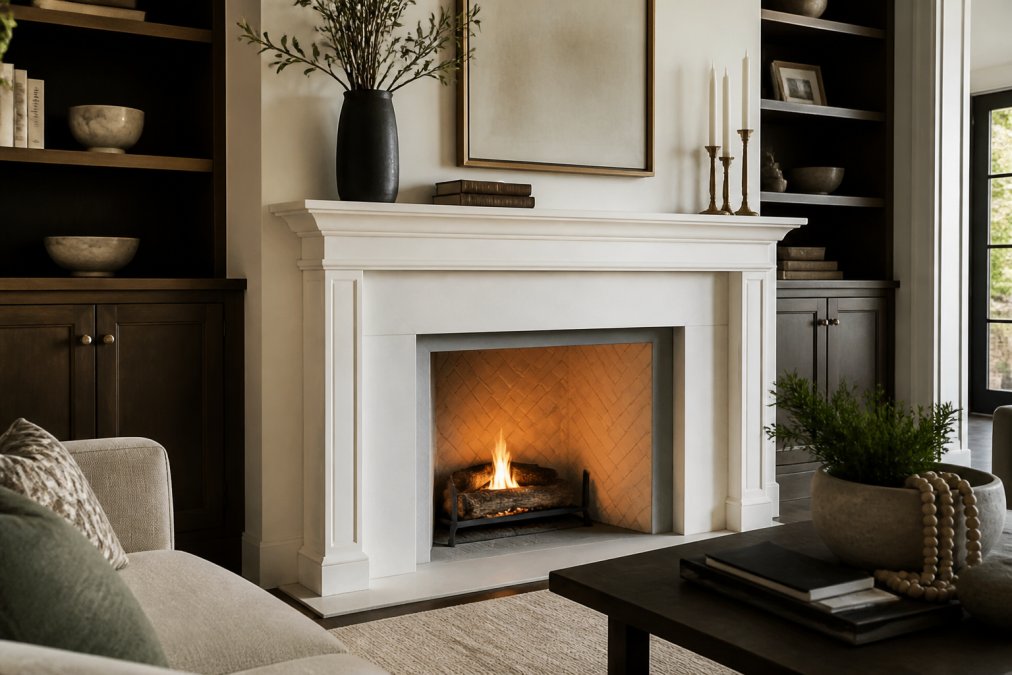
Fireplace mantel clearance is the minimum safe distance between a heat-producing fireplace and any combustible material above or around it, measured from the firebox opening to the nearest wood, fabric, or drywall surface. Fireplace mantel clearance is the minimum safe distance between a heat-producing fireplace and any combustible material above or around it, measured from the firebox opening to the nearest wood, fabric, or drywall surface. That measurement is a critical number in any hearth installation, because it decides whether a beautiful focal point stays beautiful or quietly chars over a winter.
Heat does not need a flame to start a fire. A wood mantel exposed to sustained thermal radiation will pyrolyze: its ignition temperature drops the longer it sits in that heat, until a surface that once resisted 400 degrees Fahrenheit can ignite at 200 (pubmed.ncbi.nlm.nih.gov). That process is invisible. By the time you smell smoke, the damage is already structural.
The 5 clearance rules we cover below come straight from national code language, and they apply whether you are hanging a mantel over a wood-burning unit or placing a decorative shelf above a gas insert.
How Heat Moves from the Firebox to Your Mantel
Heat leaves a firebox three ways: radiation, convection, and conduction. Radiation is the one that burns mantels.
A firebox opening acts like a spotlight. The larger the opening, the more thermal radiation escapes at a wide angle, and the higher the BTU output, the further that radiation travels before it dissipates. A mantel mounted too close sits directly in that cone. Convection adds a second problem: hot air rises along the face of the fireplace, so the underside of a mantel often runs hotter than the wall beside it.
This is why clearance is measured vertically and horizontally. A deep mantel projection traps rising heat against the wall, which is why deeper shelves need more vertical clearance, not less. Builders sometimes treat the two dimensions as independent. They are not.
National Fire Code Requirements for Mantel Clearance
The governing standard for solid-fuel fireplaces in the United States is NFPA 211, the Standard for Chimneys, Fireplaces, Vents, and Solid Fuel-Burning Appliances, published by the National Fire Protection Association. It sets clearance-to-combustibles requirements that local building codes then adopt and enforce.
The practical takeaway: NFPA 211 gives you the floor, not the ceiling. Your specific appliance's installation manual overrides it whenever the manufacturer calls for more distance, and manufacturers almost always do. A code inspector checks the manual first.
Two numbers matter most. Clearance to combustibles is the minimum gap between the appliance and any combustible material. Hearth extension is the non-combustible floor area in front of the firebox that catches embers. Both appear in your manual as a table, not a single figure, because they change with opening size.
Combustible Material Clearance Fireplace Rules by Fuel Type
Combustible material clearance fireplace requirements differ sharply by fuel, and mixing them up is how homeowners fail inspections. The table below summarizes the mechanism that drives each fuel type's clearance, but the numbers that actually govern your install live in your appliance's listing and installation manual, not in a generic chart.
| Fuel Type | Heat Mechanism | Typical Clearance Concern | Where the Real Number Lives |
|---|---|---|---|
| Wood-burning | High radiant flux from an open firebox, plus ember spill | Clearance to combustibles plus hearth extension depth | NFPA 211 and the appliance listing label |
| Gas (vented) | Sustained low-level radiant and convective heat, venting | Mantel height per manual, vent termination distance | Manufacturer's installation manual |
| Gas (vent-free) | Combustion products released into the room | Strict room-volume and clearance rules, often the tightest of any fuel | Manufacturer's manual plus local code |
| Electric | Surface heat only, no combustion | Manufacturer's top and side clearance, often minimal | Product spec sheet |
Wood-burning units produce the most radiant heat and the strictest clearances. NFPA 211, the Standard for Chimneys, Fireplaces, Vents, and Solid Fuel-Burning Appliances, sets clearance-to-combustibles requirements that local building codes adopt and enforce. The practical takeaway: NFPA 211 gives you the floor, not the ceiling. Your specific appliance's installation manual overrides it whenever the manufacturer calls for more distance, and manufacturers almost always do. A code inspector checks the manual first.
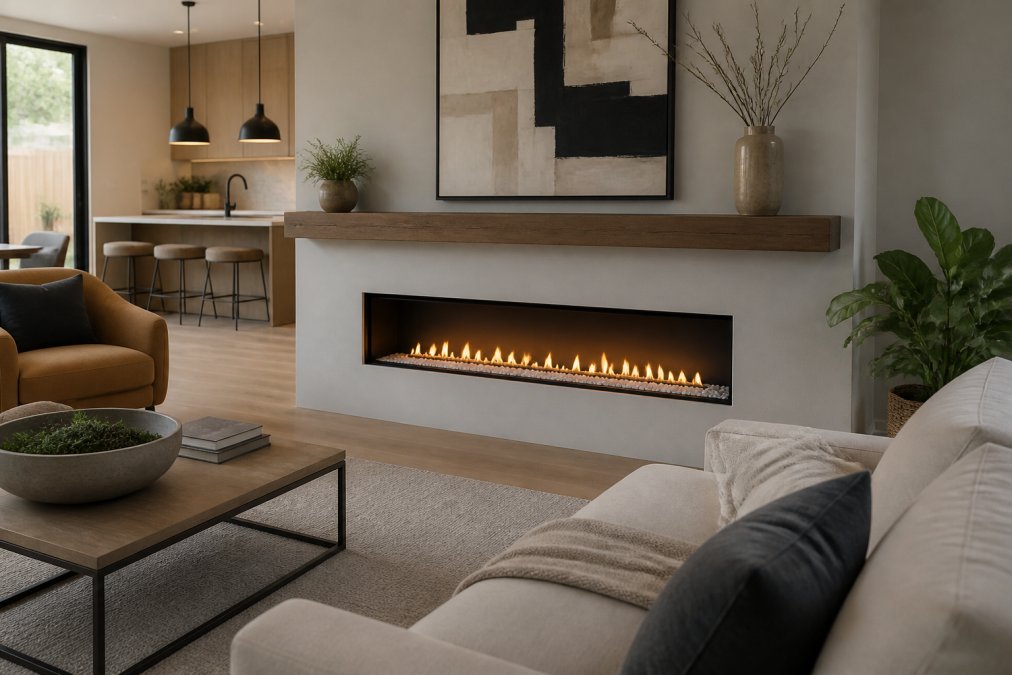
Gas fireplaces run cooler at the face but hold a steady temperature for hours, which is exactly the condition that causes slow pyrolysis in a wooden mantel. That is why a gas unit can be more dangerous for a close mantel than a wood unit that only runs for a few hours at a time. Vent-free gas units add a second constraint: because they release combustion products into the room, they carry some of the most restrictive clearance and room-volume rules of any fuel type (nfpa.org).
Electric fireplaces generate no combustion byproducts, so clearances are usually measured in inches rather than feet, but they still exist and still appear in the manual. A common pattern is that electric units allow a mantel closer than any combustion fuel, which is why they are popular in apartments and additions where a full masonry chimney is not feasible.
The mistake often made is assuming gas is automatically safer for a close mantel. It is not. It is differently dangerous. The clearance number that matters is the one printed on your unit's listing label and repeated in its manual, and it changes with firebox opening size, BTU input, and mantel projection.
How to Measure Fireplace Mantel Height and Depth Correctly
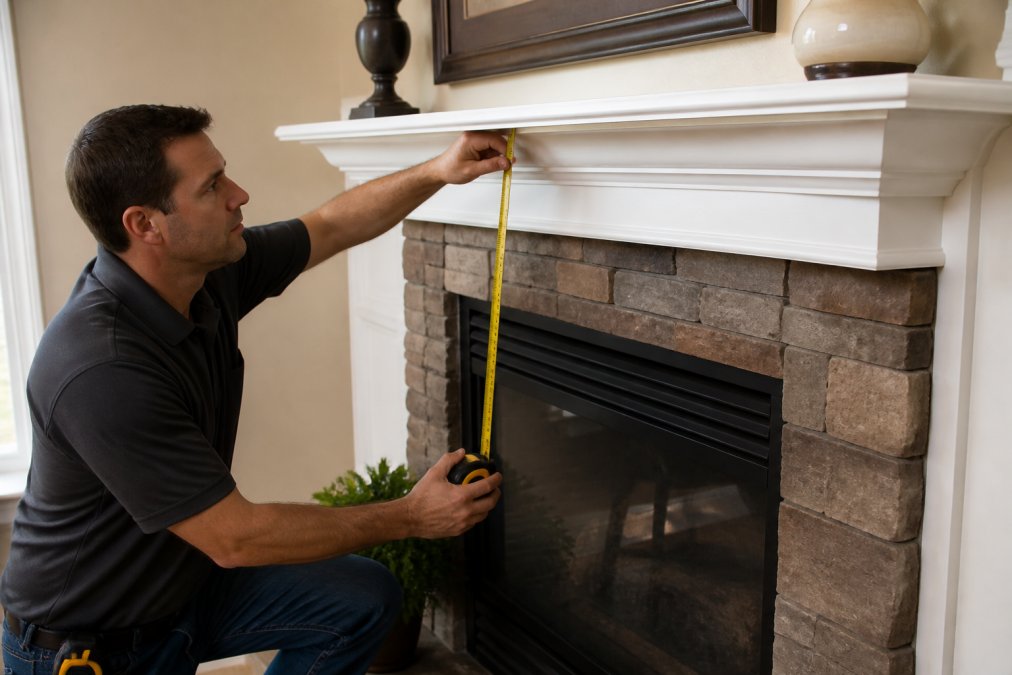
Learning how to measure fireplace mantel height takes a tape measure, a level, and your appliance manual, in that order. Do not start with the tape.
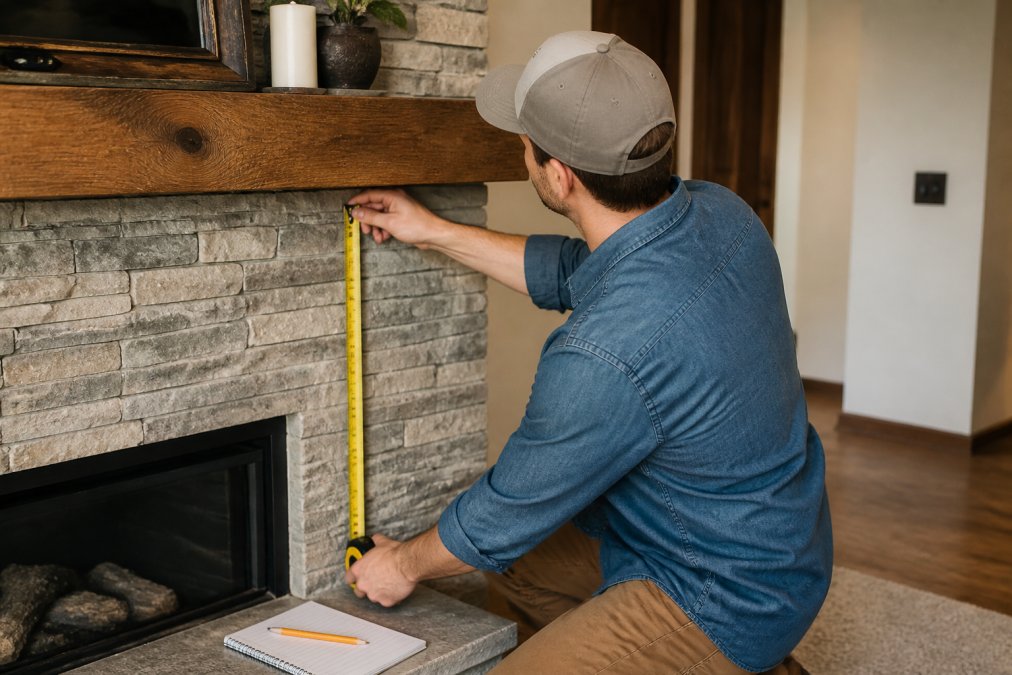
- Find the clearance table in your installation manual and note the required height for your firebox opening size.
- Measure from the top of the firebox opening straight up to the lowest point of the mantel, not its center.
- Measure the mantel's horizontal projection, the distance it extends out from the wall.
- Cross-check both numbers against the manual's depth-to-height pairing.
- Verify with a level that the mantel is true; a tilted shelf changes the effective clearance on one side.
The safe distance for a TV above a fireplace follows the same logic but adds a second constraint: electronics have their own maximum operating temperature, usually listed in the TV's spec sheet. A mantel that satisfies code can still cook a television.
Safe Distance for TV Above Fireplace and Heat-Deflection Options
The safe distance for a TV above a fireplace is whatever distance keeps the screen's intake air below its rated maximum, and that is frequently more than the mantel clearance alone provides. Heat-deflection technology closes the gap.
A mantel itself is the oldest heat deflector: it interrupts the rising plume and pushes hot air out into the room. Modern options go further.
Retrofitting Older Fireplaces and Insurance Implications
Frequently Asked Questions
What are the building code requirements for fireplace mantel clearances?
The International Residential Code and NFPA 211 set minimum clearances between a firebox opening and any combustible mantel. A common rule is 12 inches of vertical clearance for every 1 inch of mantel projection beyond the firebox face, though your specific appliance manual overrides generic code. Always check the installation manual for your exact model, since gas, wood, and electric units carry different requirements. Local inspectors enforce these standards at permit time.
Can a mantel be too close to a fireplace insert?
Yes. Inserts concentrate heat differently than open masonry fireplaces, and a mantel placed too close can char, crack, or ignite over time. Most insert manufacturers publish a minimum clearance to combustibles, often 12 to 18 inches above the insert face depending on BTU output and whether a non-combustible surround is used. If your mantel sits closer than the manual allows, add a heat-deflection shield or relocate the mantel.
What materials are considered combustible in fireplace installations?
Wood, drywall paper facing, plywood, MDF, fabric, and most plastics count as combustible materials in fireplace installations. Brick, stone, tile, concrete, and fire-rated materials are non-combustible. A wood mantel is combustible even when finished with paint or stain. If you want a wood-look mantel closer than code allows, choose a non-combustible surround or a heat-deflection shield rated for the clearance you need.
How do I keep a TV above my fireplace from overheating?
Mount the TV at or above the manufacturer's recommended safe distance, typically 12 inches above the mantel for a standard wood-burning or gas fireplace. Add a heat-deflection shield or mantel shelf to push rising thermal radiation forward rather than up. Monitor surface temperature with an infrared thermometer during the first few burns. Electric fireplaces with low BTU output and no real flame often allow closer TV placement than wood-burning units.
Clearance rules are unforgiving because fire is. Getting the measurement right the first time protects your home, your insurance claim, and the mantel you spent months choosing. Explore the Zen Home Fireplaces collection to pair a properly installed hearth with screens and accessories built to match, and let our curated modern designs turn a compliance requirement into the warmest corner of your home.