7 Alternatives to Traditional Wood Burning Fireplaces
Last Updated: November 1, 2026
Quick Summary
The main alternatives to wood burning fireplaces are linear electric, direct-vent gas, electric inserts, wall-mount electric, vent-free gas and bioethanol units. Electric models need only a standard outlet and no venting, while direct-vent gas delivers the highest heat output at up to 30,000 BTU. Choose based on whether you have a chimney, gas service, and need ambiance or real heat.
- Direct-vent gas units reach up to 30,000 BTU, while electric models top out around 10,000 BTU on 240V.
- Electric fireplaces are the lowest-risk option, with no smoke, carbon monoxide or fuel storage.
- Install a carbon monoxide alarm on every level of the home and test it regularly.
- Compare alternatives on total cost over their expected life, not sticker price.
- Electric fireplaces typically last 10 to 20 years, while direct-vent gas units last 15 to 25 years.
Table of Contents
- Why Homeowners Are Replacing Traditional Wood Burning Fireplaces
- 7 Alternatives to Traditional Wood Burning Fireplaces Compared
- Gas Fireplace vs Electric Fireplace: Which Suits Your Room
- Fireplace Alternatives Without a Chimney
- Fireplace Heating Efficiency: BTU, Square Footage and Real Warmth
- Total Cost of Ownership: Purchase, Installation and Running Costs
- Safety, Indoor Air Quality and Local Emissions Rules
- Choosing Your Fireplace at Zen Home Fireplaces
- Frequently Asked Questions
Why Homeowners Are Replacing Traditional Wood Burning Fireplaces
The case against the open hearth has been building for years, and it now rests on three practical problems rather than one philosophical one. Wood burning fireplaces lose most of their heat up the chimney, they demand constant fuel and cleaning, and they produce smoke that affects both the room and the neighborhood. Many municipalities have tightened rules on wood smoke for exactly that reason, and the EPA's guidance on wood smoke and air quality explains why fine particles from residential burning draw regulatory attention.
At Zen Home Fireplaces, we hear the same story: customers love the idea of a fire, not the work of one. The real question is which alternative fits your room, budget and tolerance for installation.
7 Alternatives to Traditional Wood Burning Fireplaces Compared
Electric options win on installation ease and running simplicity; gas offers higher heat output. The right pick depends on whether you have a chimney, a gas line, or neither.
| Option | Venting Needed | Heat Output | Best For |
|---|---|---|---|
| Linear electric | None | Up to 8,530 BTU | Modern focal walls |
| Direct-vent gas | Yes, exterior wall | Up to 30,000 BTU | Whole-room warmth |
| Electric inserts | None | Supplemental | Retrofitting an old firebox |
| Wall-mount electric | None | Up to 5,000 BTU | Condos and small rooms |
1. Linear Electric Fireplaces
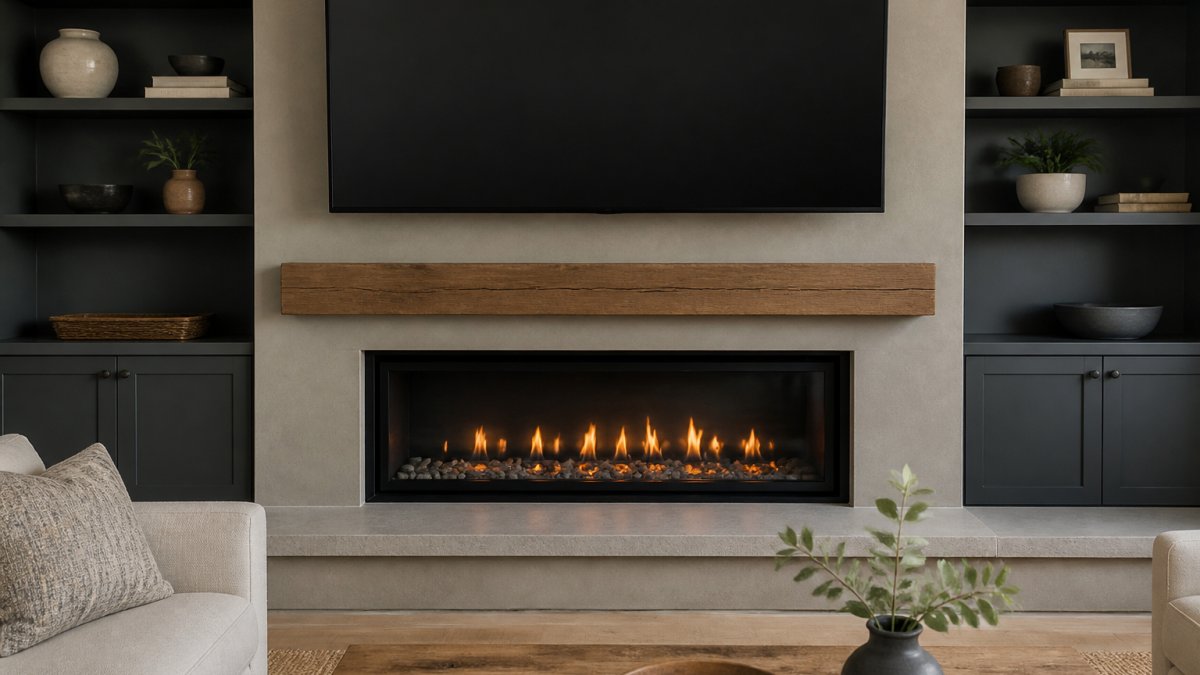
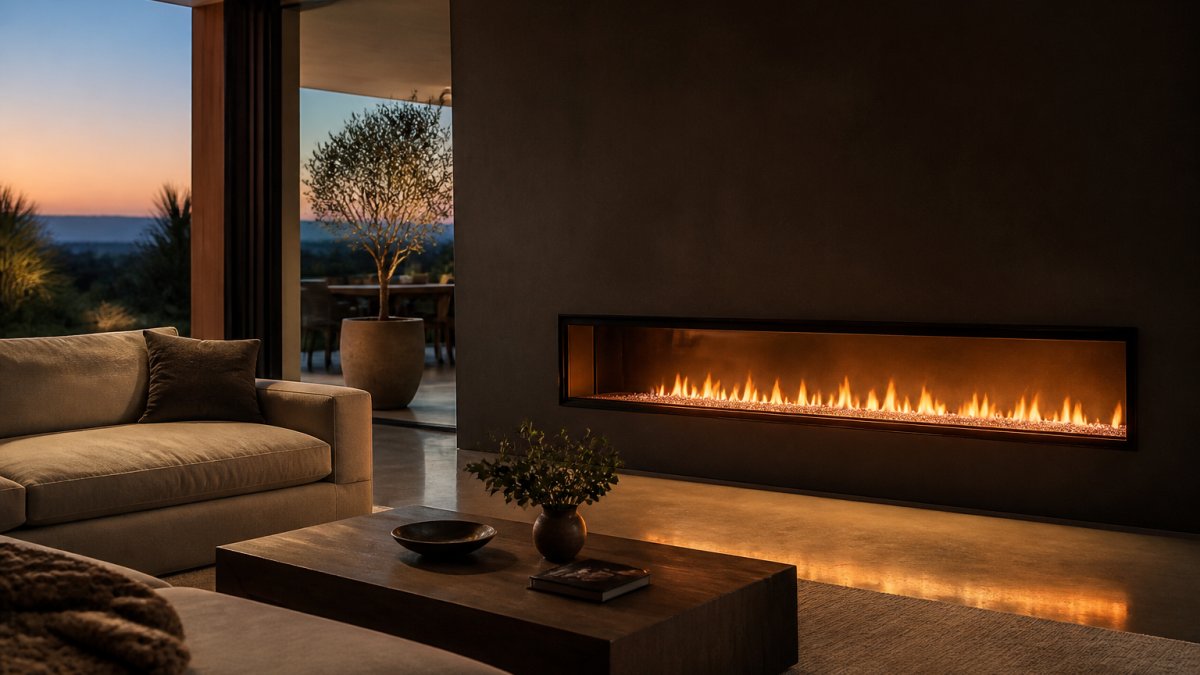
The Dimplex Ignite Ultra 50" Linear Electric Fireplace delivers a wide, contemporary flame line without a chimney, gas line or vent.
It delivers up to 5,118 BTU at 120V or 8,530 BTU at 240V, with supplemental heating for spaces up to roughly 1,000 sq. ft. The flame runs with the heater off.
Best for: modern renovation walls where the fire is the design centerpiece. Skip if: you want the fire to be the primary heat source for a large open plan.
View the Dimplex Ignite Ultra 50" Linear Electric Fireplace

2. Direct-Vent Gas Fireplaces
For genuine heat and a real flame, direct-vent gas is still the benchmark.
The Empire Tahoe Clean-Face Premium 32" Direct Vent Gas Fireplace produces up to 24,000 BTU on natural gas, with a clean-face design that keeps the glass nearly flush.
Best for: homeowners who want real heat and a permanent built-in. Skip if: you have no exterior wall for venting or no gas service.
See the Empire Tahoe Clean-Face Premium 32" Direct Vent Gas Fireplace

3. Electric Fireplace Inserts
An insert is the least disruptive path if you already have a masonry firebox. The old opening stays, the chimney gets capped or blocked, and the insert slides in.
The Dimplex 45" Deluxe Built-In Electric Firebox delivers flame ambiance with no venting and no fuel. Measure the existing opening precisely; a firebox even slightly too large means unbudgeted framing work.
Best for: keeping an existing hearth and surround intact. Skip if: your firebox opening is unusually shallow or irregular.
View the Dimplex 45" Deluxe Built In Electric Firebox
4. Wall-Mount and Built-In Electric Models
Small spaces get the best options here. The Napoleon Allure Vertical 32" Wall Mount Electric Fireplace uses a tall, slender profile that fits where a horizontal unit cannot, plugs into a standard 120V outlet, and provides up to 5,000 BTU for rooms around 400 sq. ft.
For a traditional built-in look, the Empire Nexfire 34" Linear Electric Fireplace can be recessed or surface mounted and runs on 120V. Both suit condos and rentals where structural changes are off the table.
Best for: apartments, bedrooms and offices. Skip if: you need to heat a large, open living area.
Compare the Napoleon Allure Vertical Wall Mount Electric Fireplace
Gas Fireplace vs Electric Fireplace: Which Suits Your Room
The deciding factor is almost always infrastructure.
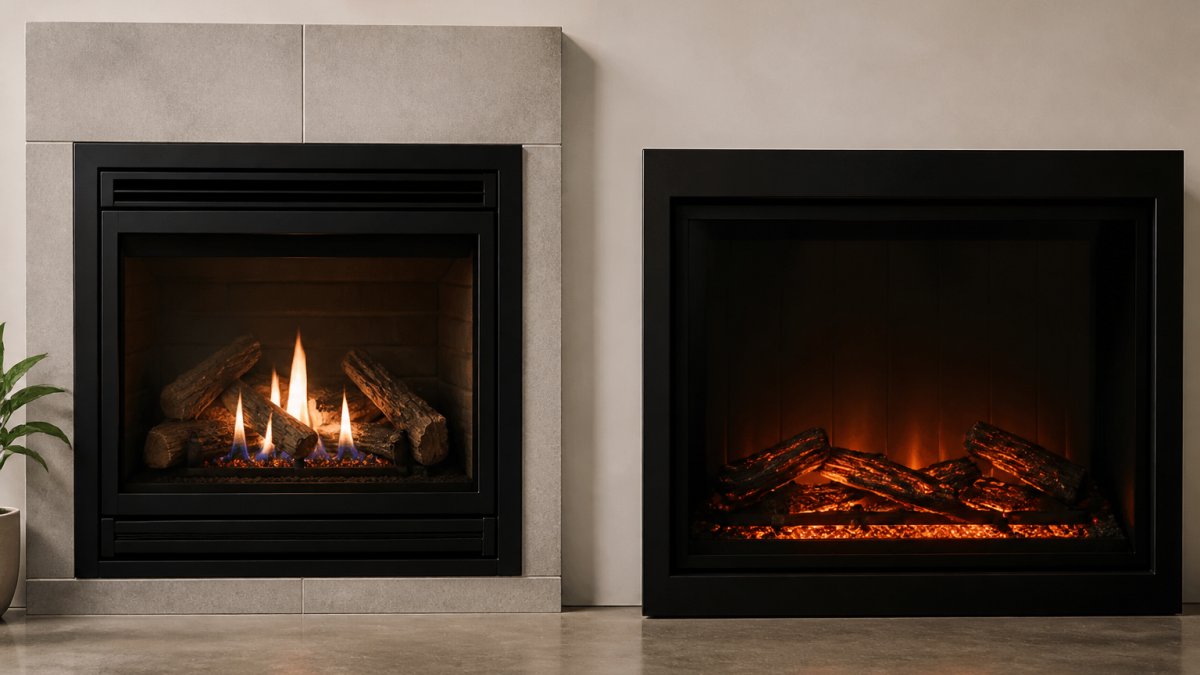
Heat output separates them further. Direct-vent gas units here reach up to 30,000 BTU, while electric models top out around 10,000 BTU on 240V.
Cost and complexity follow the same line. Gas costs more upfront and requires a qualified installer. Electric installs faster and, in most cases, you can do it yourself.
Our rule: if you have gas service and an exterior wall, gas is worth the investment.
Dimplex Ignite Ultra 50" Linear Electric Fireplace – ULT50 →
Fireplace Alternatives Without a Chimney
No chimney is no longer a barrier to a fire. Electric fireplaces, vent-free gas units and bioethanol burners all work without a flue, and each carries different trade-offs.
Electric is the simplest: no combustion, no venting, no fuel. Vent-free gas produces real flame and meaningful heat but releases moisture and combustion byproducts into the room, so CPSC guidance on vent-free gas appliances is worth reading before you commit.
For renters and condo owners, electric is the only option that leaves no permanent mark on the building. Our guide to renter-friendly electric fireplaces covers the models that work in small spaces.
Fireplace Heating Efficiency: BTU, Square Footage and Real Warmth
BTU is the standard measure of heat output, and it determines whether a fireplace warms a room or just decorates it. A unit rated for supplemental heat covers the square footage the manufacturer states, and not much more.
Direct-vent gas units are sealed and draw air from outside.
Match the rating to the room, not to the whole house. A 5,000 BTU wall-mount unit in a 400 sq. ft. bedroom feels warm. The same unit in a 900 sq. ft. great room will not.
Total Cost of Ownership: Purchase, Installation and Running Costs
Upfront price rarely decides whether a fireplace was a good buy. Compare across five buckets: unit price, installation, fuel, maintenance, and service life.
Here is how the major alternatives stack up on each.
| Cost Category | Electric (linear, insert, wall-mount) | Direct-Vent Gas | Vent-Free Gas | Bioethanol | High-Efficiency Wood Insert |
|---|---|---|---|---|---|
| Typical unit price | $400-$3,500 | $2,000-$6,000+ | $800-$2,500 | $300-$2,000 | $1,500-$4,500 |
| Installation | Outlet; framing if new wall | Venting, gas line, licensed installer | Gas line or propane; clearance review | None to minimal | Chimney liner, block-off plate, installer |
| Fuel | Electricity (per kWh) | Natural gas or propane (per therm/gallon) | Natural gas or propane | Bioethanol fuel (per liter) | Cordwood (per cord) |
| Maintenance | Dust and inspect; near zero | Annual service recommended | Annual service recommended | Clean burner; fuel storage | Annual chimney sweep; gasket and glass |
| Expected service life | 10-20 years | 15-25 years | 10-20 years | 5-15 years | 20-30 years |
Installation is where budgets break. A direct-vent gas unit on an exterior wall with gas service stubbed nearby is straightforward.
Maintenance is a recurring line item. Direct-vent and vent-free gas units should be serviced annually by a qualified technician; skipping service is a common cause of sooting and pilot problems.
Lifespan changes the math. A 20-year electric unit at a lower upfront price can beat a 15-year gas unit on total cost even if gas is cheaper to run, depending on how often you use it. Ask two questions before you buy: how many hours a year will this actually run, and what will it cost to service or replace when it reaches end of life?
Safety, Indoor Air Quality and Local Emissions Rules
Safety is where the alternatives separate most sharply, and local rules can override your preference entirely.
Electric fireplaces are the lowest-risk option: no smoke, no carbon monoxide, no fuel storage.
Vent-free gas is a different category. The CPSC guidance on vent-free gas appliances is worth reading before you commit, and the manufacturer's manual governs how the unit may be used.
Bioethanol produces a real flame with no vent, but releases water vapor and, depending on fuel quality, other combustion byproducts into the room.
High-efficiency wood inserts are a combustion appliance and carry the full set of wood-heating considerations: chimney condition, liner integrity, clearances, and creosote buildup.
Choosing Your Fireplace at Zen Home Fireplaces
The right alternative comes down to three questions: do you have a chimney, do you have gas service, and is the fire for ambiance or for heat? Answer those honestly and the shortlist writes itself.
At Zen Home Fireplaces, we curate modern electric and gas models from trusted brands, with clean lines and warm materials that suit a designed interior.
Replacing a wood-burning fireplace is a design decision and a technical one at the same time. Get the infrastructure question right first, and the aesthetics become easy.
Zen Home Fireplaces can help you choose with confidence, from linear electric models with no venting to direct-vent gas fireplaces with real heat output, all backed by our focus on craftsmanship and clean design.
Frequently Asked Questions
Are gas or electric fireplaces better alternatives to wood-burning fireplaces?
It depends on whether you want heat or atmosphere first. Direct-vent gas models deliver the highest output in this lineup, such as the Napoleon Ascent Multi-View 43" Peninsula at up to 30,000 BTUs, and they vent exhaust outdoors. Electric models need no venting and run on a standard circuit, with the Dimplex Ignite Ultra 50" reaching up to 8,530 BTUs at 240V for spaces around 1,000 sq. ft. Choose gas for a permanent built-in centerpiece with strong heat, and electric for flexible installation, lower maintenance and year-round flame-only ambiance.
Can you install a fireplace without a chimney?
Yes. Electric fireplaces require no chimney, gas line or venting at all, which makes them the simplest fireplace alternatives without a chimney. Direct-vent gas units still vent, but not through a masonry chimney, so they can go into rooms that never had a flue. Always confirm framing, clearance and electrical or gas requirements against the manufacturer's installation manual before you commit to a wall.
Do electric fireplaces provide enough heat for a room?
They provide supplemental heat, not whole-home heating. Output varies widely: the Napoleon Allure Vertical 32" delivers up to 5,000 BTUs for roughly 400 sq. ft., while the Napoleon Elevation X 42" reaches up to 10,000 BTUs and 3,000 watts on a 240V connection. Match the BTU rating to your room size and treat the fireplace as a zone heater that takes the chill off a living room, bedroom or den rather than replacing your furnace.
Which fireplace alternative is easiest to maintain?
Electric models win on maintenance. There is no fuel to store, no ash to remove, no chimney sweeping and no annual gas service, and the flame effect can run without heat in summer. Gas fireplaces need periodic professional checks and clear venting, while wood stoves demand cordwood, ash handling and chimney cleaning. If low upkeep matters most, an electric fireplace insert or linear electric model keeps the routine to a wipe-down of the glass and ember bed.
What is the most energy-efficient alternative to a wood-burning fireplace?
A direct-vent gas fireplace draws outside air for combustion and sends exhaust outdoors instead of up an open flue. Electric fireplaces convert nearly all their input to heat at the point of use, which suits short, targeted sessions in one room. Fireplace heating efficiency depends less on the fuel type than on how well the BTU output matches the square footage you are actually trying to warm.