10 Custom Fire Table Designs for Small Balconies
Quick Summary
A compact linear or square fire table suits small balconies better than a full-size fire pit, because it keeps the flame at seating height and uses less floor space. Before buying, check your lease and building rules, measure clearance from railings, doors and walls, and choose a fuel type your building allows.
- Confirm lease, building rules and local fire code before measuring or buying anything.
- Leave at least 24 inches of clear walkway between the table and the door or exit.
- Most open-flame guides call for 24 to 36 inches of clearance from the burner to combustibles.
- Add fire media and fuel tank weight to the table's shipping weight before checking balcony load.
- Choose propane or electric by ruling out fuels the building forbids, then comparing heat and cost.
Table of Contents
- Why Small Balconies Are Better Suited to Fire Tables Than You Think
- Check Your Building Rules and Lease Before You Design Anything
- Measure Your Balcony and Plan Clearance, Footprint and Layout
- Choosing Between a Small Propane Fire Pit and an Electric Fire Pit for Apartment Balcony Use
- Step-by-Step: Designing a Custom Fire Table for Small Balconies DIY
- Best Fire Pit for Apartment Balcony Setups: Shopping for Ready-Made Tables
- Start Planning Your Balcony Fire Table With Zen Home Fireplaces
- Frequently Asked Questions
10 Custom Fire Table Designs for Small Balconies
Last Updated: November 13, 2026
Why Small Balconies Are Better Suited to Fire Tables Than You Think
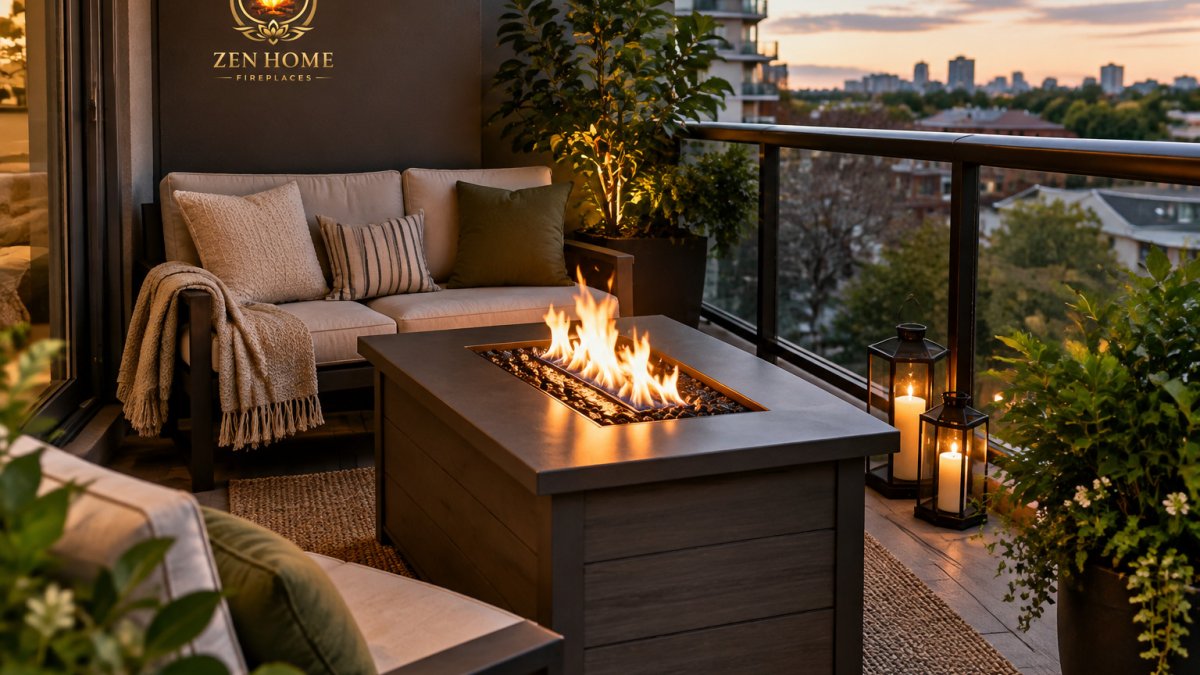
Small balconies are often better suited to a fire table than a full-size fire pit. A compact linear or square table keeps the flame at seating height, uses a smaller footprint, and doubles as a surface for drinks and plates.
Balcony fire tables do have limits: safe clearance from railings, furniture and the building wall, plus a fuel source that complies with your building's rules. The sections below walk through each check.
Check Your Building Rules and Lease Before You Design Anything
Before you measure or sketch anything, confirm what your lease and building allow. Many apartment and condo associations restrict open flames on balconies, and some restrict propane tanks entirely.
Start with three sources: your lease, the building's rules or association bylaws, and your local fire code. Ask the property manager for any written policy on propane, gas or open flame, and get the rule in writing before buying a table.
Some landlords approve a fire table with conditions, a specific fuel type, a maximum size, or a required cover when not in use. Written approval protects your deposit and avoids a forced removal later.
Measure Your Balcony and Plan Clearance, Footprint and Layout
Measure the usable floor area, not the total balcony. Subtract railings, outward-swinging doors, planters and seating you plan to keep, then add clearance around the table.
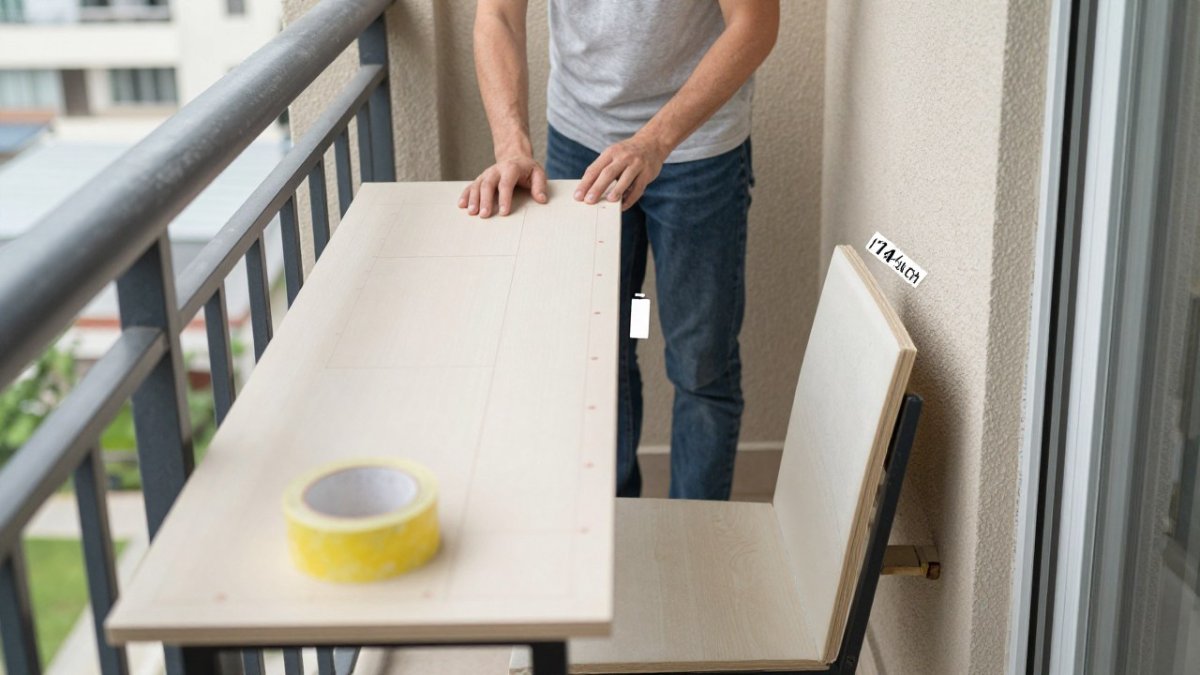
Plan the layout on paper or with painter's tape. Mark the table footprint, then place two or three chairs around it to check traffic flow.
Check the surface load as well. A ready-made table may be heavy once filled with fire media and a fuel tank. Confirm that your balcony structure and any upper-floor loads can carry the weight before placing it.
A Measurement Worksheet You Can Run in Ten Minutes
Work through these steps in order and write each number down.
- Measure the full balcony slab. Record length and depth in inches at the widest point, not at the railing where planters narrow the floor.
- Subtract fixed obstructions. Measure the depth of any intruding railing, the swing arc of outward-opening doors (typically 30 to 36 inches), HVAC units, and built-in planters.
- Reserve a walkway. Leave at least 24 inches of clear path between the table edge and the door or only exit route. On a balcony under 60 square feet, that walkway often decides the table size before clearance does.
- Apply side and overhead clearance. Most guides call for 24 to 36 inches of open space from the burner to combustible walls, railings and overhead structures; confirm the exact figure in your manual. Measure upward too, a ceiling, soffit or the floor above counts.
- Subtract chair pull-out. A chair needs roughly 18 inches behind it. If table plus chairs plus pull-out exceeds the usable depth, switch to a narrower table or a bench against the wall.
- Record the remaining footprint. Usable length by usable depth minus walkway and pull-out is your maximum table footprint.
Three Layout Templates for Common Balcony Shapes
Use these as starting points, then adjust to your measured footprint.
- Narrow balcony (under 5 feet deep): A linear table 36 to 48 inches long and 16 to 20 inches deep, parallel to the railing, with two chairs on the wall side. Keep the burner centered so heat reaches both seats; this preserves the walkway and keeps the flame away from the door.
- Square balcony (roughly 8 by 8 feet): A square table 30 to 36 inches per side, set diagonally in the corner farthest from the door, with two or three chairs. The diagonal buys clearance from both walls without shrinking the table.
- Seating-focused balcony: A low table 24 to 30 inches long with a two-seat bench along the wall and one movable chair. This works when the balcony is deep but narrow, because the bench removes chair pull-out from the depth calculation.
Load Capacity: Do the Math Before You Fill the Table
A fire table's shipping weight is not its working weight. Add the fire media and the fuel.
Check the balcony's rated live load, many residential balconies are designed for 40 to 60 pounds per square foot distributed, but confirm your building's figure rather than assuming.
Choosing Between a Small Propane Fire Pit and an Electric Fire Pit for Apartment Balcony Use
Propane and electric options suit different balconies, and the choice affects what your building will allow.
Propane generally offers a stronger flame and more heat, while electric units avoid tank storage and fuel smell. For a guide to the best electric fireplace options for compact spaces, see best electric fireplaces for small apartments.
For the propane option, keep the tank outside the table cavity and away from direct sun and heat, following the manufacturer's guidance. For either type, check the unit's dimensions against your clearance plan before buying.
Decide in the Right Order: Rules First, Fuel Second
Most buyers pick a fuel and then discover the building forbids it. Reverse the order.
- Read the lease and building rules for fuel language. Look for "open flame," "propane," "LPG," "cylinder," and "combustible storage." A ban on open flame rules out propane; a ban on cylinder storage rules out propane even if flame is allowed.
- Ask the fire department or check the local fire code for rules on outdoor fuel-fired appliances near occupied buildings and on balcony cylinder storage. Get the answer in writing if you can.
- Confirm ventilation and overhead clearance for any flame-based unit; a covered or enclosed balcony changes the ventilation picture.
- Only then compare heat output, cost and convenience within the fuels that survived steps 1 through 3.
Side-by-Side Trade-Offs
| Factor | Propane fire table | Electric fire table |
|---|---|---|
| Real flame | Yes | No, flame effect only |
| Heat output | Higher; often 40,000 to 60,000 BTU on compact models | Lower; typically a few thousand BTU equivalent |
| Fuel storage | Requires a cylinder, often 20 lb | None |
| Ventilation | Needs outdoor airflow; never use in an enclosed space | Minimal ventilation concern |
| Smoke and smell | Low smoke, some fuel odor at startup and shutdown | None |
| Installation | Tank connection, leak check, clearance from combustibles | Standard outdoor outlet; check GFCI protection |
| Operating cost | Depends on local propane price and burn rate | Depends on electricity rate and wattage |
| Weather exposure | Burner and tank need cover and freeze protection | Unit needs a weather-rated enclosure and cover |
| Building approval | Often restricted; written approval strongly advised | More often allowed, but confirm lease and outlet rules |
Estimating Operating Cost Without Guessing
You do not need an exact figure to compare, you need the method.
For electric, multiply the unit's wattage by hours used, divide by 1,000 to get kilowatt-hours, and multiply by your electricity rate. A 1,500-watt unit running one hour uses 1.5 kWh.
Watch out: a propane table's real cost includes the tank exchange or refill and the cover; an electric table's includes a weather-rated outdoor outlet if your balcony lacks one. Factor both in before declaring a winner.
Storage, Weather, and Seasonal Shutdown
Propane cylinders should be stored upright, outdoors, away from heat and ignition, and never in a closet, storage bin or indoors, follow the cylinder label and local rules. Disconnect the tank when not in use and cap the fitting.
Electric units need a covered outdoor outlet protected by a ground-fault circuit interrupter (GFCI), and the cord should not cross a walkway. Both fuel types benefit from a fitted cover and a raised base that keeps water away from the burner or heating element.
NFPA outdoor fire and patio safety guidance
Step-by-Step: Designing a Custom Fire Table for Small Balconies DIY
A custom build lets you fit the table to an odd-shaped balcony, but it adds safety work. Use the steps below as a planning framework, and confirm all gas, fuel and clearance specifications with a qualified installer or your local fire department.
- Set your maximum footprint. Use the clearance measurements from your balcony plan.
- Choose the fuel and burner. Select a burner rated for your table size and approved for outdoor use.
- Pick a material. Aluminum and powder-coated steel resist weather better than untreated wood.
- Plan ventilation and drainage. Leave room for airflow around the burner and a path for rainwater.
- Sketch the table height. Many seating-height tables sit between 16 and 20 inches tall, but check your chair heights first. For more ideas, read the luxury outdoor fire table design tips article.
- Build a test frame. Check it is level and sturdy before adding the burner and media.
- Install and test. Have gas connections checked by a licensed professional before use.
| Step | What to check | Common mistake |
|---|---|---|
| Footprint | Clearance from railings and walls | Ignoring chair space |
| Fuel | Building and fire code approval | Assuming a DIY tank is allowed |
| Material | Weather and heat resistance | Using untreated wood |
| Ventilation | Airflow around the burner | Enclosing the burner too tightly |
Best Fire Pit for Apartment Balcony Setups: Shopping for Ready-Made Tables
If a custom build feels like too much work, a ready-made table is often the faster route. Zen Home Fireplaces carries several compact options. You can view the rectangular fire table details directly.
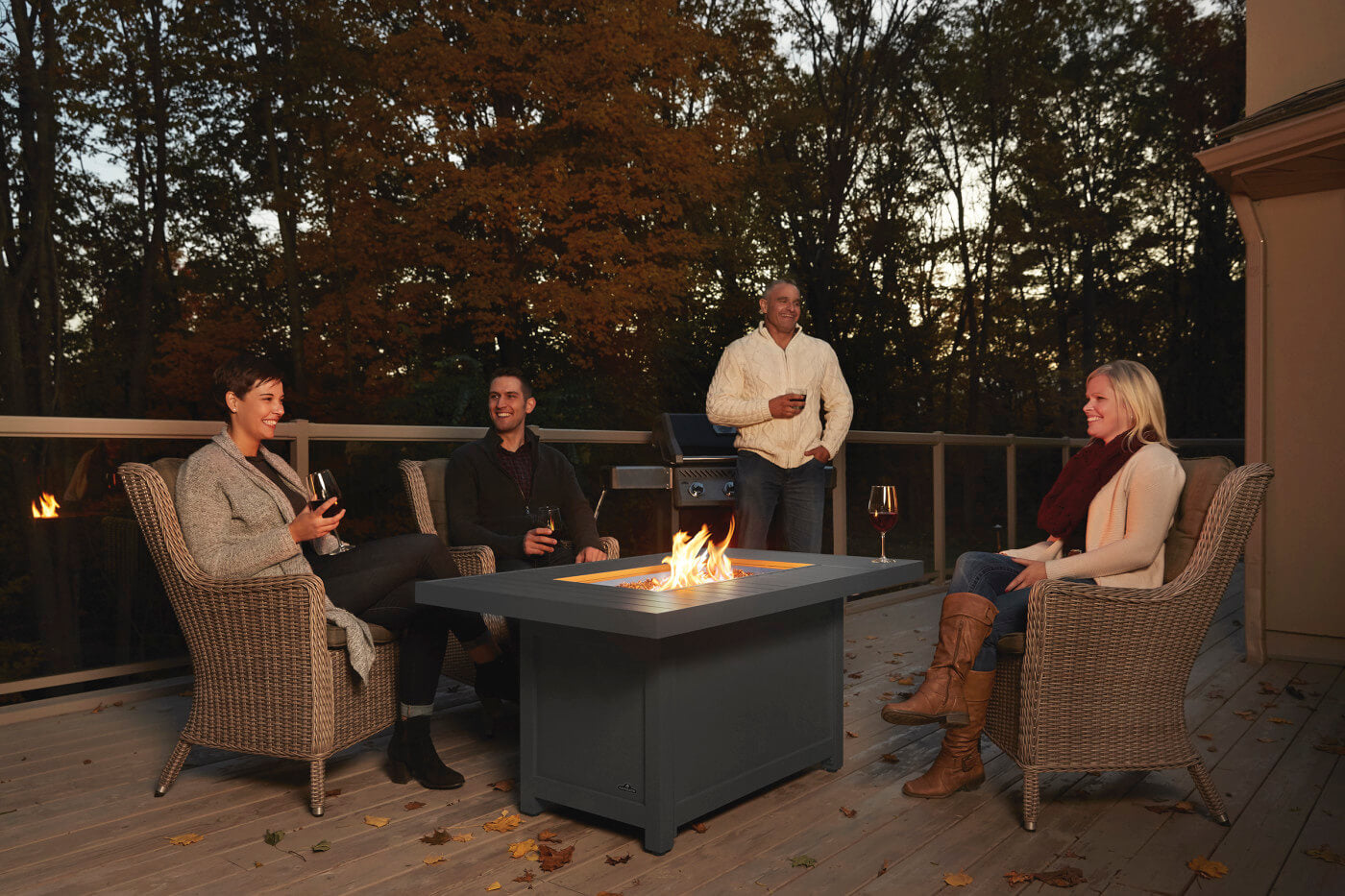
For a more striking focal point, the Napoleon St. Tropez Square Patioflame Table ($1,889.00) provides up to 60,000 BTUs and a concealed propane tank in a square design.
Compare footprints before you choose. A 36-inch table is easier to fit on a narrow balcony than a 72-inch linear model. If your space is tight, measure again before ordering.
Start Planning Your Balcony Fire Table With Zen Home Fireplaces
A small balcony can hold a well-planned fire table. Start with your building rules, measure the usable space, and choose a fuel type that your lease allows. Then decide whether a custom build or a ready-made table fits your time and budget.
When you are ready to compare options, explore the Zen Home Fireplaces fire table collection. Our range includes fire tables with listed pricing and optional accessories such as windscreens and covers.
Frequently Asked Questions
Can you use a fire table on an apartment balcony?
Sometimes, but it depends on your lease, your building's rules and local fire codes. Many buildings prohibit open flames on balconies, and some allow only electric or sealed units. Read your lease and ask your landlord or property manager in writing before buying. Once you have approval, confirm clearance from railings, walls and furniture, and check that the table sits on a level, stable surface that can carry its weight.
Are propane or electric fire tables better for a small balcony?
Propane fire tables give real flame and heat, but they require a tank that must be stored safely and used outdoors only. Electric options are simpler to place and avoid fuel storage, though they produce less heat. For a small balcony, propane suits people who want a traditional fire feature and have approval, while electric suits renters or anyone with tight restrictions. Compare heat output and fuel storage before deciding.
How much space should you leave around a balcony fire table?
Plan clearance from every nearby surface before you choose a footprint. Keep the table away from railings, walls, overhangs and furniture, and leave walking room so people can move past it safely. Check the manufacturer's manual for minimum clearance distances, since these vary by model. Measure your balcony first, then sketch the table and seating together to confirm everything fits with room to spare.
What are some good small fire tables for a balcony?
Zen Home Fireplaces offers square and rectangular fire tables. The Napoleon Hampton Rectangular Fire Table, priced at $1,499.00, offers a 40,000 BTU burner and a clean linear profile. The Napoleon Nexus 36" Patioflame Table, priced at $1,769.00, has a compact half-sphere design producing up to 53,000 BTUs. Check the dimensions against your measured layout before ordering.