How Do You Install a Built-In Outdoor Fire Pit?
Quick Summary
To install a built-in outdoor fire pit, first confirm local permit and setback rules, then choose a level, open location clear of overhangs, fences and trees. Prepare a drained, compacted, level base, install the drop-in burner pan or firebox, connect the gas line through a licensed installer, and finish the surround with clearances the manufacturer specifies.
- Call your local building department about permits, setbacks and whether a licensed installer must do gas work.
- Follow the manufacturer's clearance to combustibles, which is the minimum you must meet.
- Excavate, add compacted gravel for drainage, and pour or lay a level non-combustible base.
- Check level in all directions before building the surround upward.
- Pressure test the gas line and check for leaks with soapy water, never an open flame.
Table of Contents
- Planning Your Built-In Fire Pit Location and Permits
- Fire Pit Safety Clearance Requirements You Must Meet
- Best Materials for Built-In Fire Pits and Their Durability
- Preparing the Base, Drainage and Foundation
- How to Install a Drop-In Fire Pit Kit Step by Step
- Running the Gas Line and Troubleshooting Ignition Problems
- Booking Your Installation and Choosing Your Fire Pit
- Frequently Asked Questions
Planning Your Built-In Fire Pit Location and Permits
Last Updated: November 5, 2026
A built-in outdoor fire pit is a fixed fire feature set into the ground, a patio or a wall, and it is one of the most rewarding backyard upgrades a homeowner can make.
Most homeowners start by picking a spot they like. That's a fine instinct, but the best location also has to pass a few practical checks. You need open air above the fire, a safe distance from the house and fences, and a path for the gas line if you plan to run one.
Here's the short version:
- Choose a level area with good airflow
- Keep it away from overhangs, trees and fences
- Confirm your local permit rules before you buy anything
Zoning, Permitting and Local Code Checks
Local rules decide what you can build, so check them first. Many cities and counties require a permit for permanent gas fire features, and some also review setbacks from property lines.
Start with a call to your local building department.
Keep these items in mind:
- Permit requirements for gas and structural work
- Setback distances from property lines and structures
- Homeowners association rules, if you have one
Local amendments to fuel gas codes can be stricter than the model code, so always confirm with your building department.
Fire Pit Safety Clearance Requirements You Must Meet
Clearance is the space between the fire and anything that can burn or be damaged by heat.
Read the manual for your specific fire pit before you finalize placement. The manufacturer's clearances to combustibles are the minimum you must follow.
A few common rules of thumb:
- Keep the fire away from wood fences and siding
- Leave clear space above the fire for smoke and heat
- Never place the fire under a covered structure without proper venting
Fire pit safety clearance requirements vary, so treat the manual as the final word. If you can't find the clearance numbers, call the manufacturer before you build.
Best Materials for Built-In Fire Pits and Their Durability
Most guides list materials without telling you how they actually fail. The material you choose determines how the fire pit handles heat cycling, moisture, freeze-thaw, and UV, and the differences are large enough to change your choice based on climate and how often you burn.
Fire brick vs. concrete vs. stone vs. steel
- Fire brick (refractory brick): Rated for sustained high heat, typically in the 2,000°F+ range, and the standard liner for fireboxes. It resists spalling better than standard brick, but it is porous and must be paired with a drain or weep holes so water can escape. Best for wood-burning or high-output gas burners.
- Concrete block: Affordable and strong in compression, but standard block is not heat-rated and will crack and spall when exposed directly to flame. Use it as the structural core and protect the firebox with fire brick or a rated liner. In freeze-thaw climates, use air-entrained block and a proper footing.
- Cast concrete or glass-fiber-reinforced concrete (GFRC): Common for modern surrounds. It handles weather well but is not a firebox material; keep it outside the heat zone and follow the manufacturer's clearance to the burner.
Matching material to climate and use
In freeze-thaw climates, the failure mode is water: it gets into porous masonry, freezes, expands, and spalls the surface. Dense stone, air-entrained block, and a drained base outperform soft brick and porous limestone. In hot, dry climates, UV and thermal cycling matter more, and light-colored stone stays cooler and fades less.
Usage frequency also drives the choice. A fire pit used a few times a month can use a standard brick veneer over a block core.
What actually fails first
A common pattern is that the burner and igniter fail before the masonry does. Cheap burner pans rust through, orifices clog, and thermocouples drift.
Watch out: Do not set a burner directly on standard concrete block or pour concrete against the firebox without a heat-rated liner and the manufacturer's clearance.
The table below sums up how the main surround and firebox materials compare on heat tolerance, weather performance and the failure mode to watch for.
| Material | Best for | Key limitation |
|---|---|---|
| Fire brick (refractory) | Wood-burning or high-output gas burners | Porous; needs drain or weep holes |
| Concrete block | Structural core | Not heat-rated; cracks if exposed to flame |
| Cast concrete / GFRC | Modern surrounds | Keep outside the heat zone |
| Natural stone (granite) | Heat and weather stability | Denser stones resist freeze-thaw best |
| Sandstone / limestone | Lower-cost stone finishes | Porous; needs sealing and stable base |
| Stainless steel (304) | Burner pans and rings | Heat tints with use, cosmetic only |
| Stainless steel (316) | Coastal or salt-air sites | Higher cost than 304 |
Preparing the Base, Drainage and Foundation
A fire pit is only as stable as the ground under it. Poor preparation leads to settling, cracked walls and an uneven burner.
Carol Rose 60" Linear Outdoor Gas Fire Pit →
Plan on these steps:
- Mark the footprint and contact your local utility locating service before you dig.
- Excavate to the depth your design requires, usually several inches deeper than the base.
- Add a compacted gravel sub-base for drainage.
- Pour or lay a level, non-combustible base such as concrete or pavers.
- Check level in all directions before building upward.
Drainage matters just as much. Standing water can freeze and push the structure apart, so slope the surface slightly away from the fire pit and keep drainage gravel clear.
How to Install a Drop-In Fire Pit Kit Step by Step
A drop-in kit is a pre-built burner pan that sits inside a masonry surround. It's a practical choice for homeowners who want a built-in look without building the whole firebox from scratch.
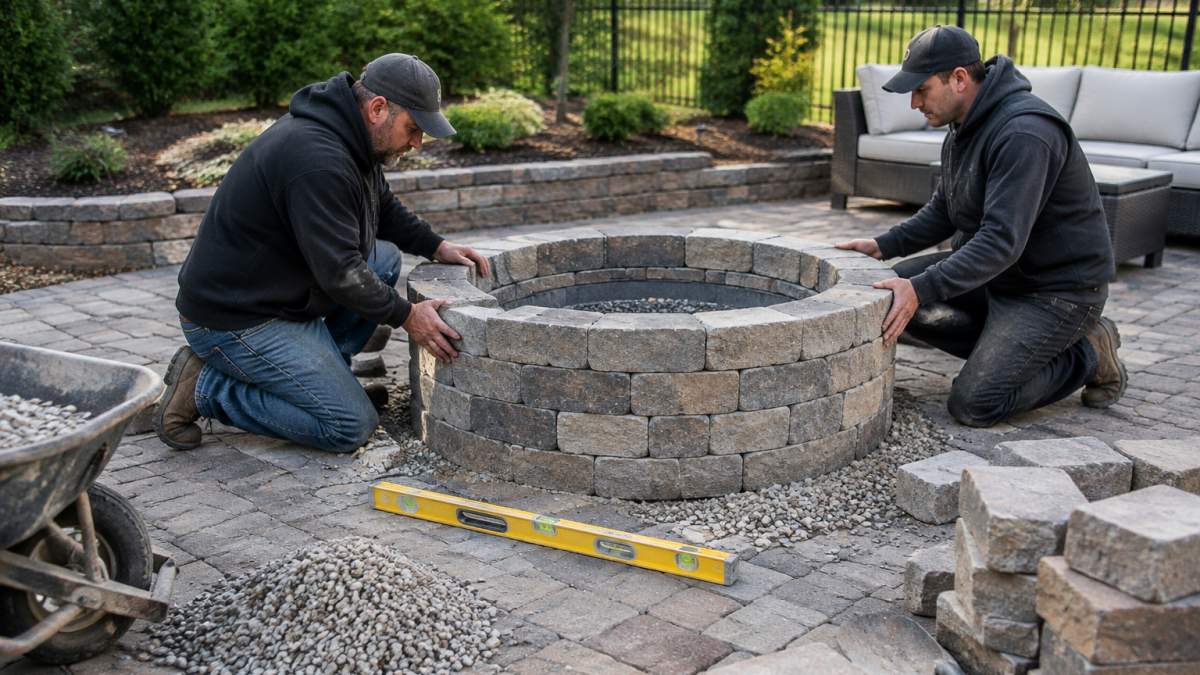
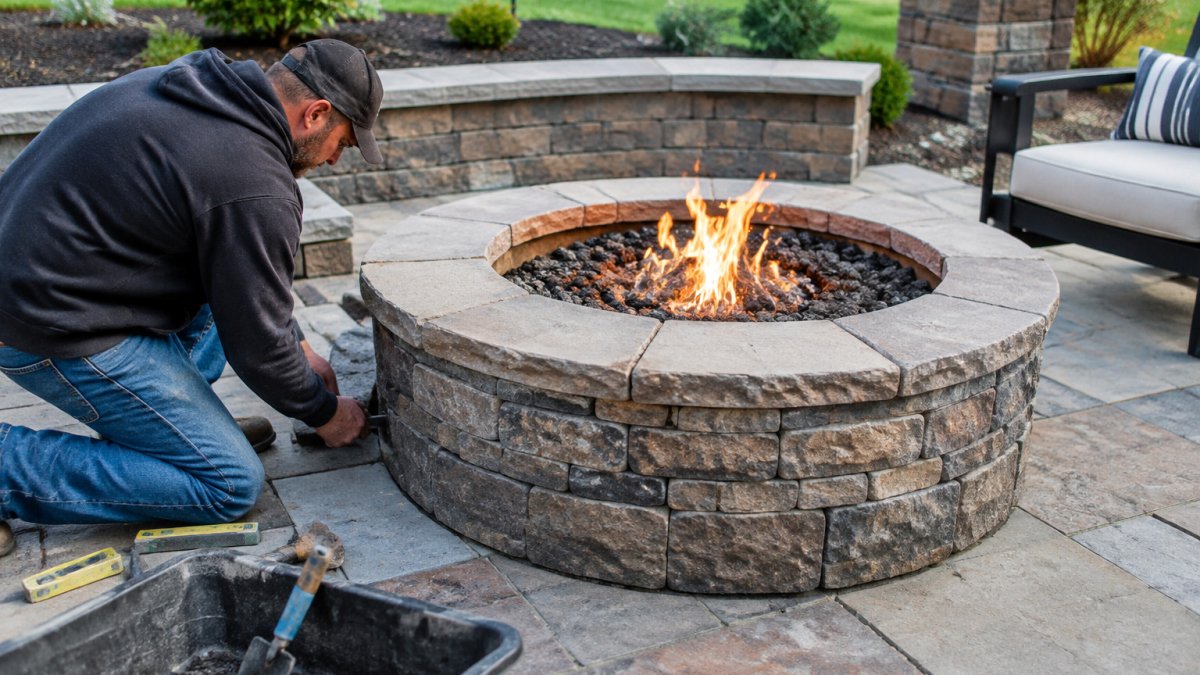
Here's a general sequence. Always follow your kit's manual, since details vary by manufacturer.
- Frame the opening. Build the surround to the exact dimensions of the pan.
- Set the pan. Place it level on the base, checking with a level tool.
- Connect the fuel. Attach the gas line or confirm the electrical hookup.
- Test the burner. Check for leaks and proper ignition before covering anything.
- Finish the surround. Add stone or masonry, leaving clearance around the pan.
Many homeowners underestimate how long the leveling step takes. Plan extra time there, since a slightly tilted pan causes uneven flames.
Running the Gas Line and Troubleshooting Ignition Problems
Gas work is the highest-risk part of this project. In many jurisdictions, a licensed gas fitter must run and connect the line, and local fuel gas codes set the baseline for sizing, materials, and testing. Even if you hire out the work, understanding the sequence helps you ask the right questions and spot a shortcut.
Sizing the line to the burner's BTU load
Gas lines are sized by the total BTU demand of every appliance on the branch, not just the fire pit. A 160,000 BTU burner fed by a half-inch line run 40 feet from the meter will starve for gas and produce a lazy, yellow flame. Your installer will consult the code's sizing tables, which pair pipe diameter, run length, and BTU load.
The installation sequence
- Route and trench. Bury approved gas pipe below the local frost line or at the code-required depth, with a tracer wire and warning tape.
- Install a shut-off valve. Place a manual shut-off within reach of the fire pit and a second at the house if the code requires it.
- Use approved connectors. Flexible stainless connectors are common at the final connection to the burner pan; never use indoor-rated appliance connectors outdoors.
- Pressure test. Cap the line and pressurize it with air or inert gas to the pressure the code specifies, at the pressure the code specifies, and watch the gauge for drop.
- Purge and light. Bleed air from the line, then light the burner and confirm a steady blue flame with no lifting or yellow tipping.
Watch out: Never test for gas leaks with an open flame. Use a soapy water solution on every fitting, or a calibrated combustible-gas detector, and re-test after any adjustment.
Venting and enclosure rules
A built-in fire pit that sits inside a masonry surround is an enclosure, and gas codes treat enclosures differently from open burners. Most manufacturers require cross-ventilation at the bottom and top of the enclosure so leaking gas can escape and the burner can draw combustion air. Follow the manual's vent area specification, usually expressed in square inches per side, and never seal a firebox tight.
Troubleshooting ignition problems
If the burner won't light or keeps going out, work through the basics in order:
- No gas at the burner. Confirm both shut-off valves are open and the line has been purged. A newly installed line full of air can take several minutes to light.
- Weak or yellow flame. This usually points to undersized pipe, a partially closed valve, or low supply pressure. Have the installer check pressure at the burner inlet against the manufacturer's spec.
- Pilot won't stay lit. A dirty pilot orifice, a misaligned thermocouple, or a thermocouple that has drifted out of the flame are the common culprits. Clean the orifice with a pin, not a drill bit, and reposition the thermocouple so the flame engulfs its tip.
If these checks don't resolve the issue, stop and call a qualified technician. For broader fuel-gas safety rules, our NFPA guidance on fuel gas installations is a useful reference.
Booking Your Installation and Choosing Your Fire Pit
Once you've settled the permit, clearance, materials and base, you're ready to choose your fire pit and book the work. Our guide to what sets the installation timeline breaks down the factors that drive how long the job takes.
When you're ready to shop, you can compare the Carol Rose 60" Linear Outdoor Gas Fire Pit at $3,259.00. It's built from stainless steel and includes multicolor LED lighting, with natural gas or propane options.

Getting a written installation quote before you commit is a sensible step. Ask whether the price includes permits, gas work and site prep, since those costs can change the total.
Frequently Asked Questions
What do you put in the bottom of an outdoor fire pit?
Most built-in fire pits start with a compacted gravel sub-base topped with a layer of drainage gravel or lava rock, which lets water drain away and keeps the base stable. For gas models, the burner pan sits on a level, non-combustible base. Check the manufacturer's installation manual for the exact layering it requires. Avoid placing loose wood, mulch or flammable debris beneath the burner.
Can you put a fire pit directly on pavers?
You can set a fire pit on pavers only when the pavers are rated for high heat and the pavement is structurally sound and level. Pavers can crack or spall from repeated heating, and the base beneath them must still drain properly. Use a non-combustible barrier, keep the fire pan within the manufacturer's clearances from the surface, and confirm the installation meets your local code before lighting. A licensed installer can advise on whether your existing patio is suitable.
How do I set up an outdoor fire pit safely?
Start by choosing a level, open location away from structures, overhangs and combustible landscaping, then confirm the clearances your product requires. Build a compacted, well-drained base, install the non-combustible enclosure and burner, and have a qualified gas-appliance professional connect and test the gas line. Keep a shut-off valve accessible and never leave an active fire unattended. Following the installation manual closely reduces the risk of ignition or heat-damage problems.
How deep should an inground fire pit be?
Depth depends on the fire pan and burner you select, since the pan's height and the required gas line clearance determine how far the unit sits below grade. Many built-in designs use an excavation that accommodates a compacted sub-base, drainage gravel and the pan itself, with the top of the pan set at a comfortable working height. Measure your chosen kit before digging and confirm the depth with your installer and the product's installation requirements.
Ready to plan your project? Start with the Carol Rose 60" Linear Outdoor Gas Fire Pit and a permit check, and let Zen Home Fireplaces help you choose a built-in fire feature that suits your space.