How Much Electricity Does an Electric Fireplace Use
Last Updated: November 9, 2026
Quick Summary
An electric fireplace uses between 750 and 1,500 watts on a standard 120-volt outlet, and up to 2,500 watts on 240 volts. That is roughly 0.75 to 1.5 kWh per hour on standard settings. Flame-only mode draws far less.
- Low heat draws about half the power of high heat on most models.
- Divide the wattage by 1,000 to get kWh per hour.
- Flame-only mode uses only a small fraction of heat-mode wattage.
- A built-in thermostat cycles the heater and lowers average power draw.
- Sealing drafts near the fireplace cuts running costs more than changing settings.
Table of Contents
- How Many Watts Does an Electric Fireplace Use?
- How Much Electricity Does an Electric Fireplace Use per Hour?
- How Much Electricity Does an Electric Fireplace Use per Month?
- How to Calculate Your Electric Fireplace's Electricity Use
- Factors That Change How Much Power Your Fireplace Draws
- Does an Electric Fireplace Use More Electricity Than Central Heat?
- Choosing a Model That Keeps Your Electric Bill Predictable
- Frequently Asked Questions
How Many Watts Does an Electric Fireplace Use?
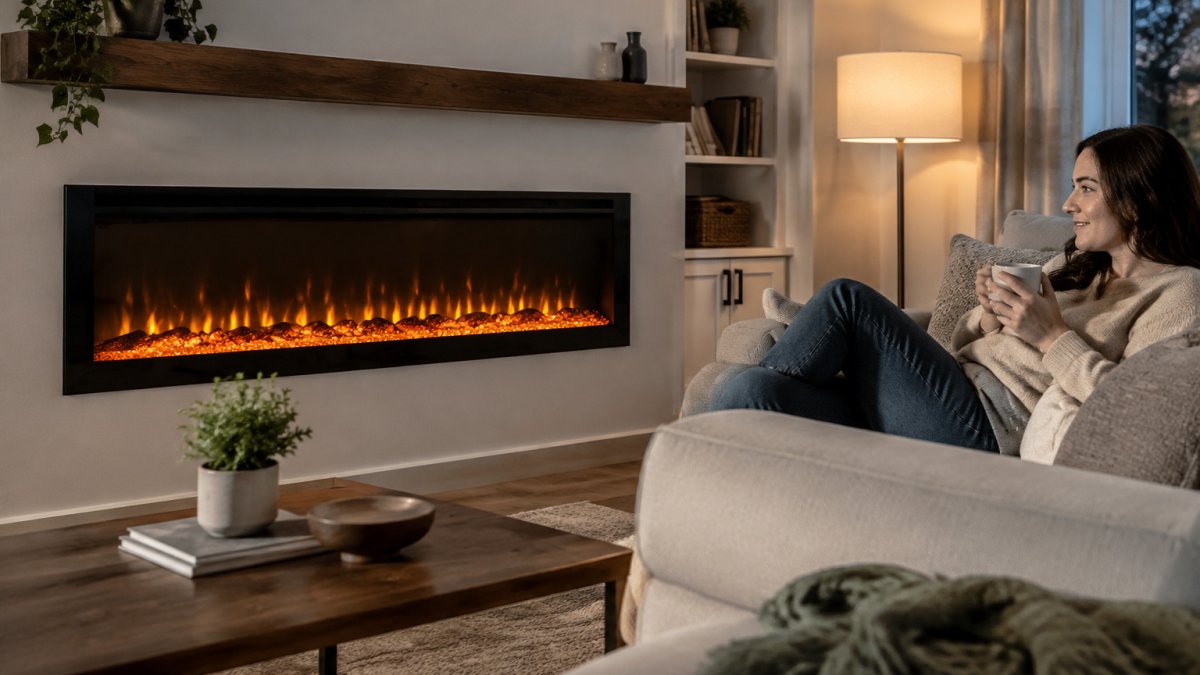
An electric fireplace uses between 750 and 1,500 watts on a standard 120-volt outlet, and up to 2,500 watts on 240 volts.
The wattage tells you how much power the unit pulls at full output. It does not tell you what you will pay, because that depends on how long you run it.
For example, the Dimplex Ignite Ultra 50" Linear Electric Fireplace - ULT50 is rated at 1,500 watts on 120 volts and 2,500 watts on 240 volts. The same unit can run on flame effect alone, which uses far less power.

High vs. Low Heat Settings
Most electric fireplaces offer two heat settings. A low setting typically draws about half the power of a high setting, while a high setting runs at the full rated wattage. Many owners use low heat for supplemental warmth and high heat only on cold nights.
A common mistake is assuming the high setting is always needed. For a room of about 400 square feet, low heat is often enough on a mild evening. Save high heat for larger spaces or colder days.
Flame-Only Mode Energy Consumption
Flame-only mode turns off the heating element and runs just the lights and flame effect. In this mode, a fireplace usually draws only a small fraction of its heat-mode wattage. That makes it the cheapest way to enjoy the look of a fire, including in warmer months when you do not need heat.
Watch out: the flame effect alone is not a heater. If you want warmth, you must switch the heat on, which raises the draw significantly.
How Much Electricity Does an Electric Fireplace Use per Hour?
Electricity use is measured in kilowatt-hours (kWh). To find the hourly use, divide the wattage by 1,000. A 1,500-watt fireplace on high heat uses 1.5 kWh per hour. On low heat, the same unit uses roughly 0.75 kWh per hour.
Multiply that by your local electricity rate to get the cost per hour. You can find your rate on your utility bill. The U.S. Energy Information Administration publishes average residential electricity prices by state, which gives you a useful starting point (U.S. Energy Information Administration average residential electricity price data).
- 750 watts on low: about 0.75 kWh per hour
- 1,500 watts on high: about 1.5 kWh per hour
- 2,500 watts on 240V high: about 2.5 kWh per hour
Here is how the hourly electricity use compares across common wattage and voltage settings.
| Setting | Power draw | Hourly use |
|---|---|---|
| 750 watts, low | 750 watts | about 0.75 kWh per hour |
| 1,500 watts, high | 1,500 watts | about 1.5 kWh per hour |
| 2,500 watts, 240V high | 2,500 watts | about 2.5 kWh per hour |
Power draw
How Much Electricity Does an Electric Fireplace Use per Month?
To estimate monthly use, multiply the kWh per hour by the number of hours you run the fireplace each day, then by 30. A fireplace that runs 4 hours a day on high heat, at 1.5 kWh per hour, uses about 180 kWh per month.
Most households run a fireplace for only part of the day. A few hours of evening use is typical, and that keeps the monthly total far below the maximum.
How to Calculate Your Electric Fireplace's Electricity Use
Follow these steps to estimate your own costs:
- Find the wattage on the label or in the manual.
- Divide the wattage by 1,000 to get kWh per hour.
- Multiply by the hours you run it each day.
- Multiply by your electricity rate in dollars per kWh.
- Multiply by 30 for a monthly estimate.
For example, a 1,500-watt unit run 3 hours daily at $0.17 per kWh costs about $22.95 per month. Your rate may differ, so check your bill for the exact figure.
Factors That Change How Much Power Your Fireplace Draws
The rated wattage is the ceiling, not the average. What you actually pull from the outlet depends on how often the heating element is energized, and several factors push that duty cycle up or down.
Thermostat Control and Smart Features
A built-in thermostat is the single biggest lever on real-world kWh use. Instead of running the element continuously, a thermostat cycles the heater on and off to hold a set temperature.
That cycling behavior means a 1,500-watt fireplace set to a moderate target often averages well below 1.5 kWh per hour over an evening. Manual high-heat operation with no thermostat is the worst case, because the element stays energized the entire time.
Smart-home integration adds another layer. Models that connect to a hub or app let you schedule run times, set a lower overnight target, and shut the unit off remotely if you forget. Scheduling alone can eliminate hours of unnecessary run time per week.
Watch out: a thermostat holds the temperature of the air near the unit, not the whole room.
High vs. Low Heat and Element Duty Cycle
Most units offer a low setting around half the rated wattage and a high setting at full rated wattage. The element does not modulate smoothly; it is either on or off. On low, the element is energized less often or at reduced output, which is why low heat roughly halves hourly kWh. Using low heat for supplemental warmth and reserving high heat for cold mornings is the most predictable way to control cost.
Room Insulation and Air Leaks
A well-insulated, closed room holds heat, so the thermostat satisfies faster and the element cycles less. A drafty room loses heat continuously, keeping the element energized longer and pushing actual use toward the maximum. Sealing gaps around windows and doors near the fireplace does more for running cost than any setting change.
Voltage: 120V Plug-In vs. 240V Hardwired
Standard plug-in models run on a 120-volt circuit and top out around 1,500 watts, which is about the limit a standard 15-amp branch circuit can safely carry alongside other loads. Hardwired 240-volt units can deliver up to roughly 2,500 watts or more, so they heat larger spaces faster and reach the thermostat target sooner. The higher wattage draws more per hour while running, but the shorter run time can offset part of that. A 240V unit also frees the 120V circuit for other appliances.
Watch out: plugging a 1,500-watt fireplace into a circuit shared with a space heater, microwave, or hair dryer can trip the breaker. Use a dedicated outlet or an otherwise lightly loaded circuit.
Maintenance and Airflow
Dust and lint build up on intake and exhaust vents, restricting airflow across the heating element. Restricted airflow makes the unit work harder and can trigger the overheat cutoff, which shuts the heater down and leaves you with flame effect only. Vacuuming the vents and wiping the element housing a few times per heating season keeps airflow open and the element cycling normally.
Does an Electric Fireplace Use More Electricity Than Central Heat?
At the point of use, an electric fireplace is close to 100% efficient: nearly all the electricity it draws becomes room heat. The real question is not efficiency per unit of electricity but how much of the house you are paying to heat.
The Zone-Heating Case
Central heating is designed to condition the whole house, including rooms nobody is using. A furnace or heat pump running to keep every bedroom at temperature spends energy on square footage that is empty for most of the day. An electric fireplace used to warm one occupied room lets you lower the central thermostat and skip heating the rest of the house.
The math favors zone heating when three conditions hold: the fireplace serves the room you actually occupy, the central system can be set back several degrees without making other rooms uncomfortable, and the fireplace's hourly cost is lower than the whole-house cost of running central heat for the same hours. In a home that is mostly empty during the day, the savings can be meaningful because you are trading whole-house conditioning for single-room heat.
Where Central Heat Wins
A single fireplace will not heat a large open floor plan, multiple rooms, or a two-story home the way a central system does. If you need every room warm, running the fireplace plus central heat at a setback temperature can cost more than central heat alone. Electric resistance heat, which is what an electric fireplace element is, also costs more per unit of heat than a high-efficiency heat pump in most climates. The fireplace's advantage is targeted delivery, not raw cost per BTU.
How to Compare the Two
- Find the fireplace's hourly cost: kWh per hour times your electricity rate.
- Estimate the central system's cost for the same hours from your utility bill or a run-time estimate.
- Compare the fireplace's single-room cost against the central system's whole-house cost, not against a per-room share.
- Account for the setback: if you lower the central thermostat while the fireplace runs, subtract that savings from the fireplace's cost.
A common pattern is to set the central thermostat back several degrees during occupied evening hours and run the fireplace in the main living room, then restore the central setting at bedtime. That keeps the occupied zone comfortable while cutting whole-house run time.
Watch out: do not close off too many registers or rely on a single fireplace to protect pipes in cold weather. Zone heating works best as a supplement to a central system that still keeps the house above freezing.
Choosing a Model That Keeps Your Electric Bill Predictable
Look for a model with clear wattage ratings, a thermostat, and a low heat setting. Those features give you control over running costs. Compact models draw less power, which suits smaller rooms and apartments.
The Empire Nexfire 34" Linear Electric Fireplace is a good fit for smaller spaces. It runs on 120 volts and needs no venting. For a larger room, the Dimplex Ignite XL 50" Linear Electric Fireplace - XLF50 offers 1,500 watts on 120 volts and a heating area of up to 1,000 square feet.

Browse the full range of electric fireplaces at Zen Home Fireplaces to find a model that matches your room and budget.
Frequently Asked Questions
How much will an electric fireplace raise my electric bill?
Most electric fireplaces add a few dollars to a monthly bill when used a few hours a day. Your increase depends on your local electricity rate and how many hours you run the heater each day. Your exact increase depends on your local rate and how often you run the heater.
Is it cheaper to run an electric fireplace than the furnace?
It depends on the size of the space you are heating. Whether an electric fireplace costs less than your furnace depends on how much space you are heating and your local electricity and gas rates.
How much electricity does an electric fireplace use without heat?
In flame-only mode, electric fireplaces draw only a small amount of power in flame-only mode, with the heating element off. Check the manufacturer's specifications for the exact figure for your unit, such as the Dimplex Ignite Ultra 50" Linear Electric Fireplace or the Empire Nexfire 34" Linear Electric Fireplace.
Is it okay to run an electric fireplace all day?
Electric fireplaces are designed for extended use, but running the heater continuously on high adds significant cost. Running the heater continuously adds to your electricity use, so check your utility bill to estimate the cost. Follow the manufacturer's guidance on continuous operation.